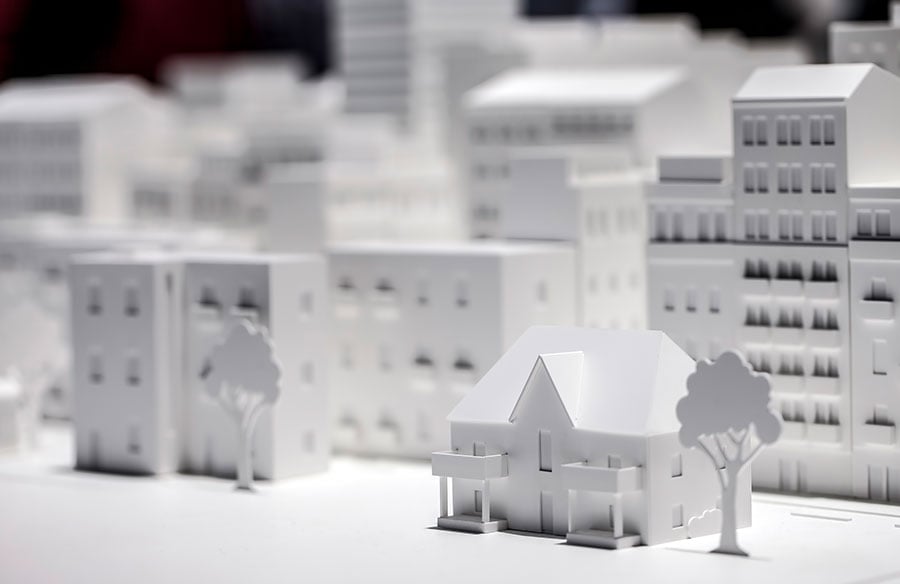
Architectural models are often judged by their appearance. Smooth surfaces, clean edges, carefully selected materials, and precise landscaping can make a model convincing enough to become an object of admiration in its own right.
Yet the most valuable model in a design studio is not always the most beautiful one.
A rough physical model can reveal that a circulation route feels compressed, a façade rhythm is too repetitive, or a proposed connection is difficult to assemble. It can expose questions that remain hidden in drawings and renderings, even when those digital representations are technically accurate.
This is particularly important as architectural practices become increasingly dependent on digital design tools. Computer models allow designers to explore geometry, lighting, materials, and performance in great detail, but they also encourage decisions to remain on screen for longer.
Rapid physical prototyping provides a counterbalance. Technologies such as fused deposition modelling, commonly known as FDM, enable architects to turn digital geometry into tangible objects that can be handled, viewed from different angles, tested, criticised, and revised.
The purpose of these prototypes is not to replace traditional model-making. It is to make physical testing a more frequent part of architectural thinking.
The Presentation Model and the Working Model
A presentation model communicates an architectural proposal to an audience. It may show a complete building, surrounding context, landscape, internal spaces, and material relationships. Its construction often requires considerable time because its finish contributes to the credibility of the presentation.
A working model has a different role.
It may represent only one part of a project, such as a staircase, roof junction, façade module, structural node, room, or piece of fitted furniture. It may contain visible seams, rough edges, incomplete surfaces, and several competing design options.
Its value lies in the questions it helps answer.
Does the massing create the intended sequence of spaces? Can a component be installed in the proposed order? Is the connection accessible for maintenance? Does daylight reach the lower levels? Will two parts fit together with sufficient clearance?
Once these questions have been answered, the working model may be modified, dismantled, or discarded. It does not need to survive as a permanent representation of the project.
This temporary character can make it more useful. Designers may feel less reluctant to mark, cut, test, and criticise a model that was created to support development rather than impress a client.
Why Digital Models Are Not Enough
Digital architectural models offer extraordinary control. Designers can move through proposed spaces, change materials, test environmental conditions, and produce coordinated information for consultants and contractors.
However, a screen mediates the designer’s understanding of scale.
A component can be enlarged until it fills the monitor, making a small detail appear visually substantial. A complicated assembly can be viewed in isolation, without the obstruction caused by neighbouring elements. Surfaces may appear seamless, even though they will eventually be divided into manufactured, transported, and installed parts.
Physical models introduce resistance.
Two pieces must genuinely connect rather than merely align in software. A cantilever must support itself. A moving element requires real clearance. A small opening becomes visibly and physically small.
This resistance is productive because buildings must ultimately exist under physical conditions. Materials have thickness, components have weight, tools need access, and construction follows a sequence.
A prototype makes these constraints available to the design process before they become problems on site.
What FDM Adds to Architectural Prototyping
FDM is an additive manufacturing process in which a thermoplastic material is deposited in successive layers to form a three-dimensional object. A digital model is prepared for printing, divided into layers by software, and then manufactured from the bottom upwards.
For architects, one of its main advantages is accessibility. A component developed digitally can be translated into a physical prototype without constructing elaborate moulds or permanent production tooling.
This makes the process suitable for iteration.
A prototype might test overall proportion. A second might examine the relationship between parts. A third could include revised wall thicknesses, connection points, or openings. Instead of attempting to resolve every issue before making anything physical, the architect can move repeatedly between digital editing and tangible testing.
Practices without suitable equipment in their studios can use an online FDM printing service to manufacture architectural models, test components, jigs, fixtures, or functional prototypes directly from prepared digital files.
The technology should not be viewed as a universal solution. Laser cutting may be more efficient for planar assemblies, CNC machining may be more appropriate for certain material and tolerance requirements, and handmade models may communicate spatial atmosphere more effectively.
The most useful fabrication method is the one that answers the design question with the least unnecessary effort.
Model Earlier, Not Only at the End
Physical models are sometimes produced after the main architectural decisions have already been made. At that stage, the model is used to explain the proposal rather than influence it.
Rapid prototyping is more valuable when introduced earlier.
During concept development, small FDM models can help designers compare several massing options. Because each version is produced from related digital geometry, the differences between them can be examined consistently.
One proposal may produce a stronger courtyard. Another may improve the transition between a building and its surroundings. A third may create a more legible entrance.
Seeing the alternatives together can encourage more objective discussion than reviewing them separately on screen.
Early prototypes can also challenge the design team’s attachment to a preferred idea. An option that appears elegant in a rendering may seem unnecessarily complicated when converted into a physical assembly. Another that appeared conventional may reveal better spatial relationships when viewed in three dimensions.
The prototype does not make the decision, but it gives the team additional evidence.
Testing Architectural Assemblies
Architecture is assembled from parts. Cladding panels connect to supporting systems, doors meet frames, handrails join balustrades, furniture incorporates hardware, and service components pass through structural and finished surfaces.
Digital coordination can identify many conflicts, but physical prototypes provide a different type of information.
Consider a custom façade screen composed of repeating modules. A small prototype could be used to test:
- How neighbouring modules connect
- Whether fixings remain accessible
- How much movement the joints permit
- Whether the installation sequence is practical
- How shadows change across the surface
- Whether the visual rhythm remains coherent at corners
- How damaged parts might be removed and replaced
A prototype may show that a connection requires an installer to reach an inaccessible position. It may reveal that a visually minimal joint leaves insufficient space for adjustment. Alternatively, it may demonstrate that the assembly can be simplified.
Because repeated elements multiply both successes and errors, testing one representative section can have significant value across an entire project.
Understanding Tolerance Through Making
Digital components can be modelled so that their surfaces meet exactly. Physical components rarely behave with such perfection.
Manufacturing variation, material behaviour, printer calibration, orientation, and assembly conditions all affect the final result. Components intended to connect may require a deliberate gap rather than identical dimensions.
FDM prototypes can help designers develop an intuitive understanding of these tolerances.
A press-fit connection may be too tight in the first version. A sliding element may bind because the clearance is insufficient. A hole may require adjustment to accommodate another component comfortably.
These discoveries are not necessarily failures. They are information.
By testing several variations, designers can determine which dimensions are critical and which can remain flexible. This knowledge improves communication with manufacturers and encourages tolerances to be specified according to function rather than applied indiscriminately.
Full-Scale Prototypes for Human Interaction
Not every architectural prototype needs to represent an entire building at a reduced scale. Small components can often be tested at full size.
This is especially useful for parts that people touch or operate, including handles, controls, switches, furniture fittings, display supports, lighting components, and accessible hardware.
A digital rendering cannot fully communicate whether a handle feels comfortable. A drawing cannot demonstrate how much effort is required to operate a mechanism. Even accurate dimensions may not reveal whether a control is easy to locate and understand.
A full-scale prototype allows the team to observe interaction.
Different users can test the same component and provide feedback. The architect can examine grip, reach, clearance, weight, movement, and orientation. Adjustments can then be made before the design is transferred to its final manufacturing process.
This approach also supports more inclusive design. Rather than assuming that one designer’s experience represents all users, the team can involve people with different physical abilities during development.
Using Models to Improve Communication
Architectural projects bring together people with different forms of expertise. Architects, engineers, fabricators, contractors, clients, planners, and end users may interpret the same drawing differently.
A physical model creates a shared reference.
Instead of discussing an abstract joint on a screen, the team can hold a prototype and examine how its parts relate. A contractor can explain where installation access is needed. An engineer can identify an area requiring greater support. A client can compare alternatives without needing to interpret technical drawings.
Physical models can be especially useful when discussing projects with community groups or users who do not work in the design and construction industries.
The objective is not to simplify the architecture into a decorative object. It is to give more participants a meaningful way to engage with the proposal.
A model can be turned, opened, separated, or annotated. It makes discussion more specific and can reveal misunderstandings early, when changes remain possible.
Letting the Prototype Show Its Process
FDM models often display visible layer lines. Supported areas may have a different surface character, and component orientation can influence the appearance and strength of the result.
For a final presentation model, these qualities may be treated as imperfections that need to be concealed. For a working prototype, they can be useful evidence.
Layer direction can help designers understand how the object was manufactured. Supports reveal which parts could not be produced without temporary material. Seams show where a larger model was divided to fit within the available build volume.
These traces encourage architects to think about fabrication rather than treating the prototype as a magically generated object.
They can also suggest design changes. A form requiring extensive support material might be reoriented, divided differently, or redesigned. A fragile feature may need to become thicker. A large object might be reorganised as a modular assembly.
In this sense, the manufacturing process participates in the development of the architecture.
Material Efficiency and Responsible Prototyping
The ability to produce models quickly should not encourage unnecessary production. Every prototype uses material, energy, machine capacity, and transport.
A responsible process begins by identifying the question each model needs to answer.
A rough massing study may not need dense internal material or a high level of surface resolution. A connection test may require only the joint rather than the entire component. Several design alternatives might be combined within one print.
Digital analysis and simple handmade models should continue to be used where they can resolve questions more efficiently.
Prototypes should also be documented. Photographing test results, recording dimensions, and noting reasons for changes help ensure that lessons are not lost when a model is discarded.
The environmental value of prototyping lies in preventing bigger mistakes. A small quantity of material used to improve a repeated component may reduce waste during production, simplify site work, or extend the lifespan of an assembly.
The relevant question is not whether a prototype uses resources, but whether the knowledge it produces justifies them.
Avoiding the Myth of Automatic Precision
Digital fabrication is sometimes described in language that implies perfect translation from computer model to physical object. In practice, every manufacturing process has limitations.
Successful FDM prototyping depends on design decisions such as orientation, wall thickness, support strategy, component division, material choice, and the intended function of the part.
Architects therefore need more than the ability to export a printable file. They need to understand how the chosen process affects the result.
This understanding develops through repeated making. A designer who tests several components will gradually recognise which details print reliably, where deformation may occur, and how assemblies should accommodate variation.
The goal is not to turn every architect into a manufacturing specialist. It is to establish enough fabrication literacy to design more realistic components and communicate more effectively with production partners.
Making Iteration Part of Studio Culture
The greatest contribution of rapid prototyping may be cultural rather than technical.
When physical models require days of specialised labour, studios may reserve them for important presentations. When working prototypes can be produced more frequently, testing becomes part of everyday design development.
This changes the status of the model.
It is no longer only a final object that confirms a decision. It becomes a tool for questioning decisions.
A studio that values iteration should make room for unsuccessful prototypes. Models that crack, fail to assemble, or expose awkward geometry are not wasted if they reveal why the proposal needs to change.
Design reviews can then focus not only on polished outcomes but also on what the team has learned through testing.
This culture encourages intellectual flexibility. Designers become more willing to revise ideas because each proposal is understood as one stage in an evolving process rather than a finished expression that must be defended.
From Perfect Images to Informed Decisions
Architecture is increasingly represented through images that appear complete long before construction begins. Renderings can communicate atmosphere and ambition, but their polish may disguise unresolved questions.
Working prototypes introduce uncertainty back into the process in a productive way.
They ask whether the building can be assembled, whether a detail can be used, whether dimensions feel appropriate, and whether the physical result supports the original intention.
FDM printing gives architects one accessible method for conducting these tests. Its real value does not lie in producing flawless miniature buildings. It lies in allowing ideas to become physical early enough to be challenged.
The model does not need to be beautiful. It needs to make the next decision better.