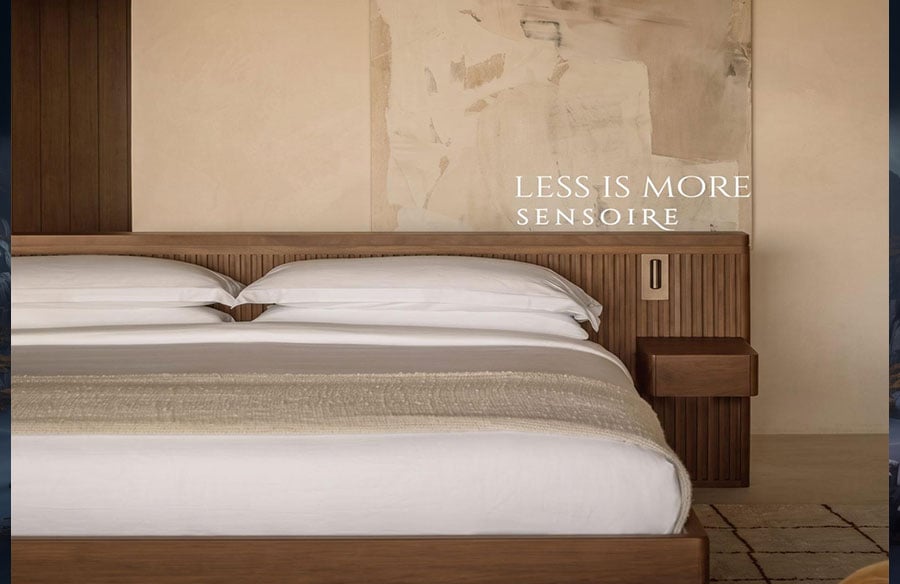
Of all the rooms in a house, the bedroom is the one we experience with our eyes closed. At Sensoire, a natural sleep brand working with mulberry silk and linen, that simple fact shapes everything we make. We spend roughly a third of our lives in the bedroom, most of it asleep, and yet it is usually designed as if it were a living room with a bed in it: composed for the photograph, lit for the evening guest, finished in whatever the rest of the house is finished in.
That approach misses what the room is for. A bedroom has one job that outranks all the others, which is to let the body let go. From where Sensoire stands, doing that well is less a question of style than of sensory design, and architects already have most of the vocabulary for it.
A room you experience with your eyes closed
Juhani Pallasmaa argued in The Eyes of the Skin that modern architecture had become a discipline of the eye, leaving touch, sound and smell as afterthoughts. Peter Zumthor’s Atmospheres approaches the same territory from another side, describing buildings through their sound, their temperature and the way their materials meet the body.
Both books read differently once you carry them into a bedroom. Here vision really does switch off. For seven or eight hours the room is known almost entirely through the skin and the ears: the weight of a duvet, the temperature of a pillow at 3 a.m., the faint hum of a fridge two walls away. A bedroom designed around how it looks at noon has been designed for the wrong hour.
At Sensoire we think about the bedroom in three layers, moving from the scale of the building down to the scale of the body.
The first layer: light and darkness
Light is where most bedrooms go wrong, usually in one of two directions. Either the room is over-lit with cool ceiling downlights that make 10 p.m. feel like an office, or it relies on curtains that leave a bright seam of streetlight along one edge.
Evening light works best when it is low, warm and indirect. Lamps at bedside height, bulbs around 2700K or warmer, and light that washes a wall instead of pointing at the bed all signal that the day is closing. Dimmers earn their place here more than in any other room.
Darkness deserves as much attention as light. Blackout lining helps, but the detail that decides the result is the junction: a curtain track returned to the wall, a blind recessed into the reveal, a door that closes without a gap beneath it.
Mornings ask for something different. Many people wake more easily to a gradual brightening than to a sudden one, which argues for layered window treatments, a sheer behind a heavier lined curtain, over a single fixed solution. When Sensoire photographs its own bedding, we work almost entirely in this kind of soft, low daylight, because it is the light a bed is actually seen in.
The second layer: sound and stillness
Hard bedrooms are loud bedrooms. Plaster, glass, stone floors and polished concrete all reflect sound, and a minimal room with few soft surfaces can carry every footstep in the corridor and every passing car.
The answer rarely involves acoustic panels. Textiles do much of the work on their own. A thick rug, lined curtains, an upholstered headboard and a generously dressed bed absorb the higher frequencies that make a room feel restless. This is one reason Sensoire treats bedding as part of the architecture of the room rather than a finishing accessory.
Planning helps too. Wardrobes placed along a shared wall act as a buffer, solid-core doors cut corridor noise, and a bed positioned away from the window puts distance between the sleeper and the street. Structure-borne sound is easy to overlook: a headboard fixed hard to a party wall carries movement and noise in both directions, so a small freestanding gap is often worth more than any finish.
The third layer: touch, temperature and the bed
This is the layer Sensoire works in every day, and the one architects most often hand over to someone else. It is also the one the occupant spends the longest time in contact with. Bedding sits directly against the skin for hours, and it shapes the micro-climate around the body more than the thermostat on the wall.
Most sleep guidance points to a slightly cool room, somewhere in the high teens Celsius. What happens under the covers is a separate matter. Sheets and duvets that hold on to moisture build a warm, damp layer close to the skin, the kind that wakes people in the small hours. Materials that breathe let heat and humidity move away instead.
So the choice of fibre at this scale deserves the same rigour as the choice of flooring or stone. Sensoire works with two natural fibres, chosen precisely because they are so different in character.
Silk
Mulberry silk is a protein fibre spun as long, continuous filaments. Woven, it gives a very smooth surface that feels cool at first touch and helps reduce friction against skin and hair. It is light, breathable and naturally temperature-balancing, which is why silk-filled duvets appeal to people who find down too warm.
Quality is described in two ways: the grade of the raw fibre, and, for woven silk, its weight in momme. One of Sensoire’s silk duvets shows how both apply to a single product. Its fill is Grade 6A mulberry silk, and its shell is a woven 22 momme silk. The inside and the outside of a duvet are two separate material decisions, much like structure and cladding.
Linen
Linen comes from flax and behaves almost in the opposite way. It is textured, dry to the hand and a little crisp when new, then softens with every wash. It handles moisture well and dries quickly, a natural fit for warm nights and humid climates. Its relaxed, slightly creased surface suits interiors where honesty of material matters more than polish, which is why linen sits alongside silk in the Sensoire collection.
Neither fibre has to be visually loud. Sensoire keeps both in a restrained palette of ivory, stone and greige, the same tones most considered bedrooms end up in anyway.
Designing from the bed outward
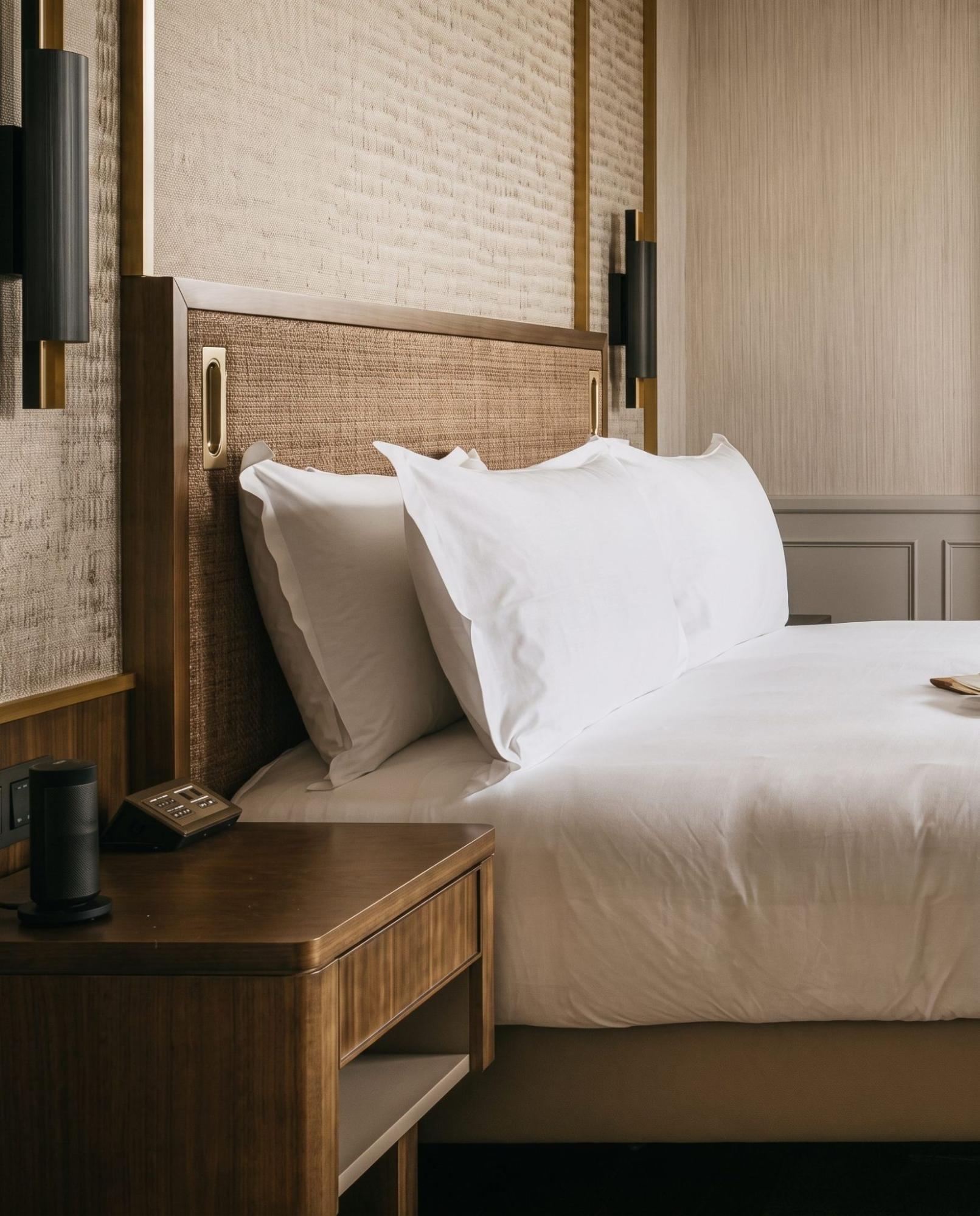 Most interiors are planned from the doorway in: what you see on entering, where the eye lands, how the room will photograph. At Sensoire we encourage the reverse. Working from the bed outward reorders the priorities. The bedside lamp comes before the pendant. The curtain junction comes before the curtain fabric. The sheets come before the art.
It changes the material conversation as well. Architects routinely specify timber species, stone finishes and plaster textures with great care, while the textiles that will touch the occupant for eight hours a night tend to arrive late, chosen by someone else from a catalogue. Bringing them into the brief from the start, with the same questions about origin, performance and ageing that apply to any other surface, produces rooms that feel finished in a deeper sense.
Sensoire sums up its approach in three words: Natural, Sleep, Ritual. A good bedroom carries all three. It goes dark when asked, stays still through the night, and meets the body with materials that feel right at 3 a.m. as well as at noon. Very little of that shows up in a photograph. All of it is felt.