The blistering heat that has gripped much of Europe in recent summers is becoming an increasingly familiar feature of the Northern Hemisphere’s climate. Recent heatwaves have led to school closures, restrictions on outdoor work, wildfire outbreaks across multiple countries, and public health warnings urging vulnerable populations to remain indoors as temperatures rise far beyond seasonal norms. These patterns align with observed increases in extreme heat events documented across Europe and globally.
Scientists have long warned that climate change is increasing the frequency, intensity, and duration of heatwaves. The Intergovernmental Panel on Climate Change (IPCC) has concluded with high confidence that human-driven warming is already producing more extreme heat events across most land regions, and that this trend will intensify in the coming decades.
As the impacts become harder to ignore, the conversation is gradually shifting beyond mitigation alone toward a parallel challenge: adaptation. Cities are now asking how urban environments can be redesigned so they can function safely in a hotter climate.
Learning from regions built for extreme heat
Increasingly, some of the most relevant lessons are coming from regions that have long lived with extreme temperatures as a structural reality rather than an anomaly.
Across the Arabian Gulf, countries including the United Arab Emirates, Saudi Arabia, and Qatar have invested heavily in urban design strategies tailored to harsh desert climates. While these nations face ongoing sustainability challenges, including high per-capita energy demand and water scarcity, they have also developed large-scale systems for managing heat in dense urban environments.
The World Meteorological Organization (WMO) has emphasized that heat stress is one of the fastest-growing climate risks globally, particularly in urban areas where built surfaces amplify temperatures. WMO Climate and Health
Urban design in extreme heat
Many adaptation strategies are conceptually simple, although technically complex to implement at scale. These include:
- Shaded street networks and pedestrian corridors
- High-albedo, reflective building materials
- District cooling systems
- Water recycling and reuse infrastructure
- Drought-tolerant landscaping
- Building orientation optimized for solar reduction
The United Nations Environment Programme (UNEP) has highlighted urban design as a key lever in climate adaptation, particularly in rapidly growing cities exposed to heat stress.
The Gulf as a living laboratory
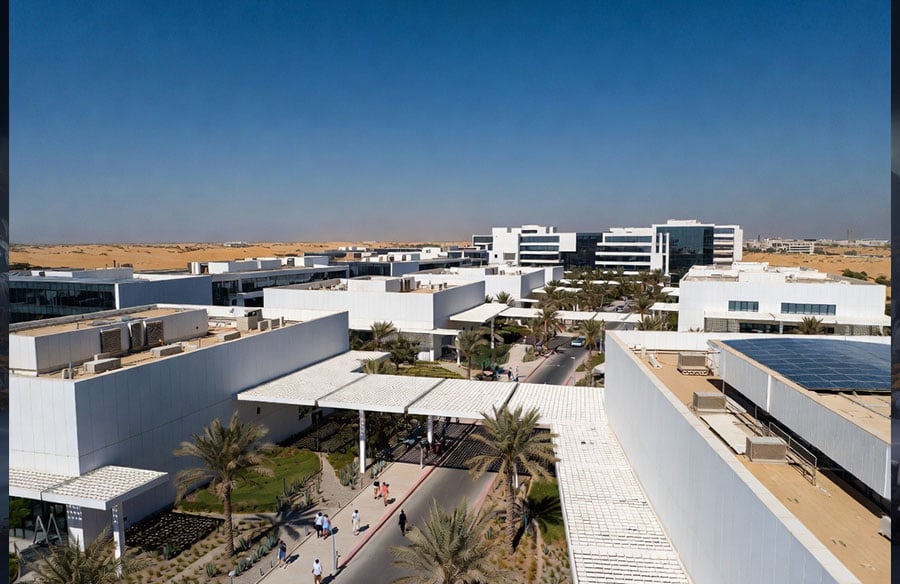
The United Arab Emirates provides one of the most visible examples of experimental climate-adaptive urbanism. Developments such as Masdar City in Abu Dhabi have explored low-carbon planning principles, pedestrian-friendly design, and energy-efficient building systems in extreme temperatures. Dubai has also expanded green building codes and large-scale solar investments as part of its long-term diversification strategy.
Saudi Arabia and Qatar have likewise integrated climate resilience into major infrastructure projects, particularly in transport, stadium design, and cooling technologies. The International Energy Agency (IEA) has noted that cooling demand is one of the fastest-growing sources of electricity consumption globally, which makes innovation in urban cooling systems a critical component of future energy planning.
COP28 and the shift toward adaptation
When the UAE hosted COP28 in Dubai in 2023, global attention focused heavily on emissions reduction and the transition away from fossil fuels. However, the summit also reinforced the growing importance of adaptation, recognizing that climate impacts already locked into the system require immediate planning and investment. The UN Climate Change (UNFCCC) process has increasingly emphasized adaptation finance and resilience planning as essential pillars alongside mitigation.
Europe’s infrastructure challenge
Europe illustrates the difficulty of retrofitting cities designed for temperate climates. Many urban centers were built before extreme heat became a recurring risk, leaving housing stock, transport systems, and public spaces vulnerable. The European Environment Agency (EEA) has reported a steady rise in heat-related mortality and economic disruption linked to extreme temperatures in European cities, underscoring the urgency of adaptation planning. EEA Climate Impacts
No single blueprint
The Gulf’s experience does not provide a universal template. Differences in governance, geography, wealth, and population density mean solutions cannot simply be transplanted elsewhere. Critics also highlight the tension between sustainability innovation and continued reliance on hydrocarbon-based economies. Still, the accumulated technical and architectural knowledge from building cities in extreme heat is becoming increasingly relevant as more regions face similar conditions.
A shifting global reality
For decades, desert cities were seen as exceptional cases of human adaptation to harsh climates. Increasingly, they are becoming early examples of a broader global condition.
Climate adaptation will likely remain geographically diverse. Scandinavian cities may focus on cold resilience, coastal regions on flood protection, and arid zones on water security. But when it comes to extreme heat, the Gulf’s long-standing experimentation with urban cooling and heat management is now part of a wider global conversation. As Europe’s latest heatwave subsides, the underlying trajectory remains clear. Cities built for the climate of the past are being tested by the climate of the present, and they will need to be redesigned for the climate of the future.