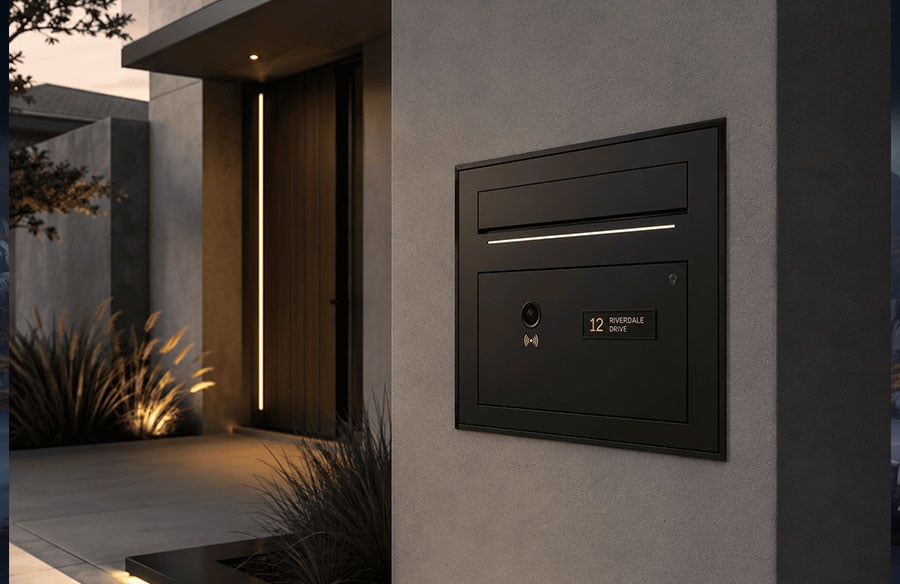
The mailbox has remained essentially unchanged for a century. Roy Joroleman’s 1915 arched steel design — weather-resistant, flag-equipped, readable at speed from a mail vehicle — still defines the American residential standard. But the forces reshaping residential architecture in the 2020s and 2030s are beginning to push against that century of inertia in ways that will make the next decade of mailbox design genuinely different from the last hundred years.
Architecture Is Getting Smarter — and Mailboxes Are Following
The dominant trend in residential architecture over the next decade is integration — smart home systems, connected appliances, and building materials that communicate with each other and with external services. The mailbox sits at the intersection of the physical property and the delivery network, which makes it one of the more logical candidates for this kind of intelligence.
The architectural response is a convergence between the traditional mailbox and the parcel locker — larger-format units with a separate oversized compartment for packages alongside the standard mail slot, all in a single curbside unit that maintains USPS compliance while handling the full range of modern delivery volume. This form factor is already available from forward-thinking retailers like Mailbox Avenue and will likely become the residential default within a decade as new construction standards catch up to delivery realities.
Smart mailboxes — already appearing in premium residential developments in Japan, Scandinavia, and parts of the US — embed sensors that notify homeowners the moment mail is deposited, distinguish between letter mail and packages by weight, and in some models, trigger automatic locking of the retrieval door from a smartphone app. These aren’t prototype concepts. They’re available today, though not yet mainstream.
The architectural driver is the rise of the connected home as a design standard rather than a premium add-on. As new residential construction increasingly integrates home automation at the foundation level — wiring, sensors, hubs — the mailbox becomes a natural node in that network rather than an isolated analog object at the property line.
The Package Problem Is Reshaping the Form Factor
Contemporary residential architecture is already responding to the package delivery explosion — new construction increasingly incorporates covered entry areas, built-in package lockers, and dedicated delivery zones as standard features rather than afterthoughts. The standard curbside mailbox, sized for letter mail in 1915, is simply too small for a household that receives 15 to 20 packages per week.
Materials and Aesthetics Are Converging With the Home Itself
Contemporary residential architecture has moved decisively toward clean lines, minimal ornamentation, and material honesty — exposed steel, concrete, and glass as design statements rather than utility choices. The mailbox is increasingly expected to participate in that language rather than stand apart from it as a functional afterthought.
The next generation of residential mailbox design will be indistinguishable in aesthetic ambition from any other exterior hardware on a well-designed home — specified by architects alongside door handles, lighting fixtures, and cladding materials, not selected from a hardware store shelf as an afterthought.
The mailbox that greets visitors at the property line is becoming a design statement. The infrastructure is finally catching up to the architecture it serves.