In the kitchen, material is rarely just a finish applied at the end of a project. It is one of the earliest design decisions — and often the one that quietly governs how the room performs for the next decade.
Material as a design decision, not a finish choice
The kitchen asks more of its surfaces than any other room in a home. Every plane has to work — taking heat, water, weight, and constant handling without losing its character. So choosing a material is not the same as choosing a look. It is a commitment to a set of behaviors: how a surface wears, how it cleans, how it ages, and how it reads in the room. In my experience, the kitchens that hold up best are the ones where material was treated as an early, almost structural decision rather than a finish picked at the end. Modern kitchens tend to lean on fewer, more honest materials now, and that restraint makes each choice matter more.
How materials behave over time
A surface is judged less by how it looks on installation day than by how it looks after a few years of ordinary use, and that is where the real differences surface. Every material has a maintenance behavior, and none is truly neutral. Natural stone can etch or take on a patina. Engineered quartz reads more uniform but may be sensitive to sustained heat. Timber warms a room, yet it usually wants sealing and tends to absorb marks as character rather than resist them.
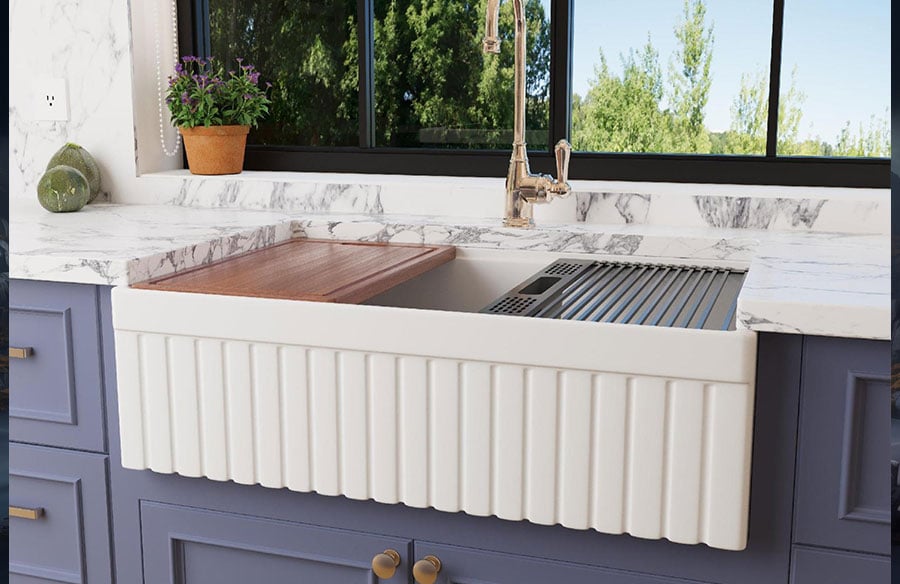
At the sink — the hardest-working fixture in the room — the trade-offs are easiest to see. A fireclay apron sink carries real visual mass and a traditional character, but it is genuinely heavy (a 33-inch fireclay basin can weigh well over 60 pounds empty) and it can chip under a hard, direct impact, so it depends on proper support. Stainless steel reads lighter and more utilitarian and shrugs off heat, but a thinner bowl — 18-gauge rather than 16 — will often telegraph more noise, water spots, and fine scratches over time. None of this is a defect. Each is simply a behavior you either want or plan around. The question I find more useful than “which lasts longest” is “which way of aging suits the people who actually cook here.”
Visual weight and proportion
Materials also carry visual weight, and that weight sets the proportion of the whole room. A fireclay farmhouse sink anchors a run of cabinetry as a solid, tactile presence; a flush stainless undermount almost disappears. That one difference changes how the eye reads the counter line and how grounded the composition feels. When a scheme leans traditional or transitional, a fireclay apron-front sink can give the room a deliberate focal point that a lighter fixture simply cannot. From there it is a question of balance: the horizontal line of the countertop, the vertical rhythm of the cabinetry, the quieter punctuation of hardware and fixture finishes. Matte or reflective, warm or cool, heavy or light — getting those relationships to agree is what makes a kitchen feel coherent rather than like a set of individually good choices.
Workflow and installation logic
Material decisions also carry an installation sequence, which is why fixtures should usually be settled before cabinetry and countertops are locked in. On the projects I have seen, the sink is where late changes cause the most rework. A heavy apron sink needs a base built for it — a 33-inch sink typically drops into a modified 36-inch sink base, often reinforced to carry the weight — so its size and support belong in the cabinet plan, not in a field adjustment afterward. Countertop fabrication depends on the sink as well: undermount, top-mount, and apron-front each change the template and the reveal. Choose the fixture late and you inherit compromises — a cabinet already built, a slab already templated. Get the order right, from fixtures and their support through cabinetry to the countertop relationships, and the whole job runs cleaner.
Designing for the long view
The strongest material choices still make sense years after installation. Color and finish trends move quickly; material behavior does not. A surface chosen for how it performs and ages will usually protect long-term usability, and residential remodel value, better than one chosen only for a current mood. Good kitchen design, to me, is measured less by how it photographs on the day it is finished than by how it supports daily life afterward — how a counter cleans after a real dinner, how a sink wears under constant use, how the room still reads once the reference that inspired it has passed. Material choice, made early and made honestly, is what carries a kitchen through that longer arc