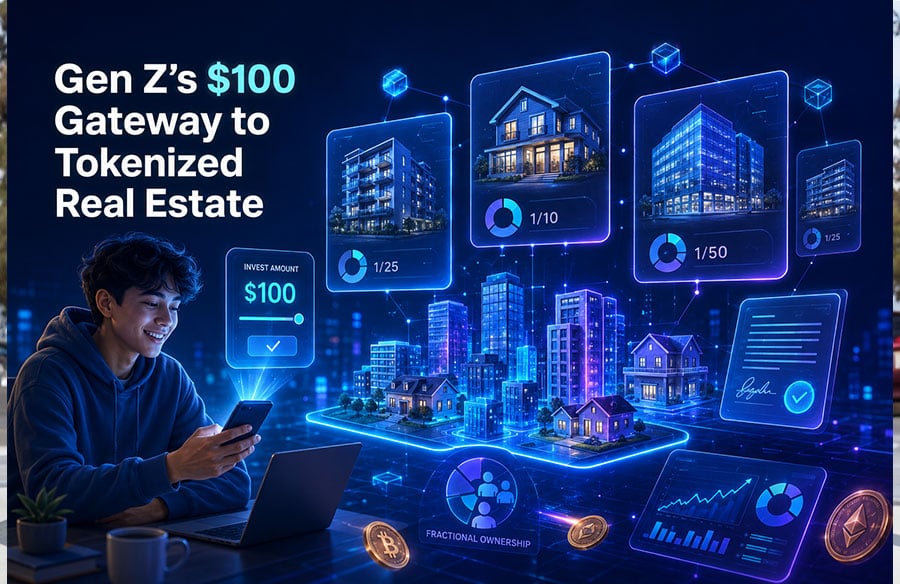
Search interest around one question is exploding:
“Can I invest in real estate with $100?”
For decades, the answer was no.
Traditional property investing required large down payments, mortgage qualification, and long-term capital lockups. Real estate investing for young investors was mostly aspirational.
But Gen Z investors are approaching wealth differently.
They are:
- Comfortable deploying micro-capital
- Used to app-based investment platforms
- Actively seeking portfolio diversification
- Less attached to physical ownership
This behavioral shift has opened the door to $100 real estate investment models powered by real estate tokenization.
Through tokenized real estate investment structures, property ownership can be divided into digital units, allowing investors to participate with significantly lower capital commitments.
The real shift is not affordability.
It is infrastructure.
Why Gen Z Investors Are Reshaping Real Estate Markets?
Millennial and Gen Z investors are entering capital markets during a fundamentally different economic cycle.
Home prices have surged. Interest rates fluctuate. Urban mobility is fluid. Remote work reshapes geography.
As a result, Gen Z real estate investing does not necessarily mean “buy a house.” It often means “gain exposure.”
Gen Z investors prefer:
- Fractional ownership over full liability
- Portfolio exposure over concentrated bets
- Digital investment platforms over paperwork
- Transparency over opacity
This is why investment platforms for young investors are evolving rapidly.
Instead of forcing long-term debt commitments, new Gen Z investment platforms allow exposure to assets in smaller, diversified allocations.
Real estate tokenization for Gen Z fits this model precisely.
It transforms real estate from a binary purchase decision into a flexible capital allocation strategy.
What Is Real Estate Tokenization?
Real estate tokenization is the process of converting ownership rights in a property into digital tokens recorded on a blockchain.
In most compliant models:
- A property is placed inside a legal entity, such as an SPV
- Equity or revenue rights are digitized into tokens
- Investors purchase these tokens
- Smart contracts govern ownership, transfers, and distributions
This structure enables tokenized real estate investment at scale.
However, issuing tokens alone is not enough.
A robust real estate tokenization platform must integrate:
- KYC and AML compliance
- Securities regulation alignment
- Digital cap table management
- Automated distribution systems
- Secondary transfer controls
This is where professional real estate tokenization becomes critical. A credible real estate tokenization company does not simply mint tokens. It builds compliant, scalable infrastructure that supports $100 real estate investment models while maintaining institutional-grade safeguards.
How Real Estate Tokenization Enables $100 Investments?
The idea of a $100 real estate investment becomes viable only when ownership is engineered for divisibility.
In a traditional structure, a property is a single, indivisible asset. In a tokenized model, the property is first placed inside a legal entity, typically an SPV. Ownership of that entity is then divided into digital units.
A real estate tokenization platform enables this process by:
- Digitizing equity or revenue participation rights
- Structuring fractional ownership units
- Embedding compliance controls into transfer logic
- Automating distribution of rental income or profit
If a $5 million property is divided into 50,000 digital units, each unit can represent $100 in exposure. Investors can invest in real estate with $100 by purchasing a small number of these units rather than acquiring the entire asset.
Tokenized real estate platforms manage:
- Investor onboarding and verification
- Allocation of fractional ownership
- Smart contract–based distribution of returns
- Governance and voting mechanisms where applicable
The $100 threshold works because ownership is programmable. Cap tables are digital. Transfers are controlled by code. Returns are distributed proportionally.
Architecture Behind Tokenized Real Estate Investment Platforms
Behind every successful tokenized real estate investment model is a layered infrastructure stack. A production-grade real estate tokenization platform typically includes:
Investor Onboarding Layer
This includes KYC, AML, accreditation checks, and jurisdiction validation. Gen Z investors may enter through a digital interface, but compliance requirements remain unchanged.
Compliance Control Engine
Transfer restrictions, holding limits, lock-up rules, and investor eligibility must be enforced automatically. In mature tokenized real estate platforms, compliance is embedded directly into smart contracts and backend systems.
Asset Tokenization Engine
This module manages token issuance, cap table digitization, ownership tracking, and corporate actions. It forms the operational core of real estate tokenization.
Smart Contract Framework
Smart contracts define issuance rules, revenue distribution logic, transfer conditions, and governance structures. Code audits and upgrade mechanisms are essential at this layer.
Payment Rail Integration
Fiat on-ramps, stablecoin compatibility, and payout systems connect traditional banking infrastructure with blockchain execution.
Custody and Wallet Infrastructure
Platforms must decide between managed custody, self-custody, or hybrid models. Institutional-grade security is non-negotiable.
Secondary Transfer Module
If liquidity is enabled, the platform must support controlled peer-to-peer transfers or marketplace functionality within regulatory boundaries.
Reporting and Audit Systems
Investor dashboards, performance analytics, and regulatory reporting tools ensure transparency and long-term trust.
Is Real Estate Tokenization Safe and Legal?
Real estate tokenization is typically regulated under existing securities frameworks in many jurisdictions.
When investors purchase tokenized equity in an SPV, they are often acquiring a security. That classification introduces legal obligations around disclosure, investor eligibility, reporting, and transfer restrictions.
A compliant real estate tokenization platform must address:
- Securities law alignment
- Retail versus accredited investor eligibility
- Cross-border participation rules
- Ongoing disclosure obligations
- Anti-money laundering requirements
Safety in tokenized real estate investment is not simply about blockchain security. It is about structural integrity.
Key safeguards include:
- Audited smart contracts
- Enforced transfer restrictions
- Segregated asset custody
- Transparent reporting
- Clear governance documentation
For Millennial and Gen Z investors entering the market through digital interfaces, the experience may feel seamless.
Why Real Estate Tokenization for Gen Z Is a Structural Trend?
The rise of real estate tokenization is not happening in isolation. It is aligned with how Gen Z investors already interact with capital.
Gen Z real estate investing is defined by access, flexibility, and digital fluency. This generation is accustomed to fractional ownership models — from ETFs to digital assets. They do not require full control of a physical property to participate in its financial upside.
Real estate tokenization for Gen Z introduces three structural shifts:
Lower Capital Thresholds
A $100 real estate investment reduces the psychological and financial barrier to entry. Instead of saving for years to purchase a property, young investors can begin building exposure immediately.
Portfolio-Based Exposure
Rather than concentrating capital into a single mortgage, Gen Z investors can diversify across multiple tokenized properties in different regions and asset classes.
Digital-Native Participation
Gen Z investment platforms are built around mobile-first interfaces, transparent dashboards, and real-time performance visibility. Tokenized real estate platforms integrate seamlessly into this behavioral model.
For Millennial and Gen Z investors, the question is no longer whether they can own property outright. It is whether they can allocate capital intelligently across asset classes.
Real estate investing for Gen Z increasingly means programmable ownership rather than physical possession.
Risks in Tokenized Real Estate Investment
Tokenized real estate investment introduces efficiencies, but it does not eliminate risk.
Smart Contract Risk
Vulnerabilities in contract code can expose investor funds or disrupt distribution mechanisms. Independent audits and upgrade governance structures are essential.
Regulatory Risk
Securities classifications and digital asset regulations continue to evolve. Platforms must remain adaptable to shifting compliance requirements.
Liquidity Risk
Even if investors can invest in real estate with $100, secondary liquidity may be limited. Fractionalization does not guarantee active trading volume.
Asset Performance Risk
Underlying property performance remains central. Vacancy rates, tenant stability, market cycles, and valuation changes still affect returns.
Operational Risk
Platform solvency, custody safeguards, and reporting transparency directly influence investor confidence, particularly for young investors entering the market for the first time.
A mature real estate tokenization platform addresses these risks through compliance-first design, clear governance frameworks, and disciplined operational controls.
Tokenization expands access. It does not replace due diligence.
The Gen Z Capital Thesis: Why Real Estate Tokenization Is Structurally Timed
Gen Z is not capital-poor. It is capital-fragmented.
Their money lives across:
- Digital wallets
- Brokerage apps
- Crypto exchanges
- Creator-led investment communities
- Micro-savings platforms
They are comfortable deploying $50, $100, $250 at a time but doing so frequently.
This behavior aligns almost perfectly with real estate tokenization.
Unlike previous generations, Gen Z does not view real estate as a once-in-a-lifetime purchase. They view it as an asset class exposure. Yield matters. Liquidity matters. Transparency matters.
A properly designed fractional real estate investment platform offers:
- Small-ticket entry
- Portfolio diversification across geographies
- App-native UX
- Transparent yield distribution
- On-demand ownership visibility
What changes at scale is not just access it is capital formation velocity.
If 50,000 investors deploy $100 each into a property, that is $5M in aggregated capital. Lower entry thresholds expand the investor base exponentially.
The generational appetite is already there. Infrastructure is catching up.
Capital Aggregation at Scale: What Happens When Entry Drops to $100
When minimum tickets collapse, capital behaves differently.
Three structural shifts emerge in a mature blockchain real estate platform ecosystem:
Distributed Capital Pools
Instead of one institutional check, capital is sourced from thousands of retail participants. Risk disperses. Funding timelines compress.
Long-Tail Property Financing
Mid-sized developments that struggle to secure traditional financing gain access to digital retail capital.
Global Investor Access
Geographic boundaries weaken. A user in Singapore can gain exposure to a property in Texas subject to compliance structuring.
Capital aggregation becomes programmable.
Smart contracts can:
- Automatically close offerings when funding thresholds are met
- Allocate oversubscription proportionally
- Trigger distribution cycles
- Manage governance voting
At this point, real estate tokenization development transitions from experiment to financial infrastructure.
However, scale introduces new responsibilities:
- Investor communication at volume
- Transparent reporting
- Robust cybersecurity
- Institutional-grade compliance monitoring
Platforms that succeed treat $100 investors with the same structural seriousness as institutional LPs.
Conclusion: The $100 Entry Point Is an Infrastructure Shift
The idea that you can invest in real estate with $100 is not a marketing slogan. It is the outcome of structural redesign.
Real estate tokenization transforms property from a capital-intensive, illiquid asset into a programmable financial instrument. Through compliant real estate tokenization and well-architected tokenized real estate platforms, ownership becomes divisible, traceable, and scalable.
For Gen Z investors and Millennial and Gen Z investors entering markets through digital-first investment platforms, access matters. But access alone is not enough. Regulatory alignment, custody security, and disciplined platform design determine long-term viability.
The platforms that succeed will not simply lower entry thresholds. They will build compliant, infrastructure-grade real estate tokenization platforms capable of supporting sustainable capital formation.
The $100 entry point is not the disruption. The infrastructure behind it is.