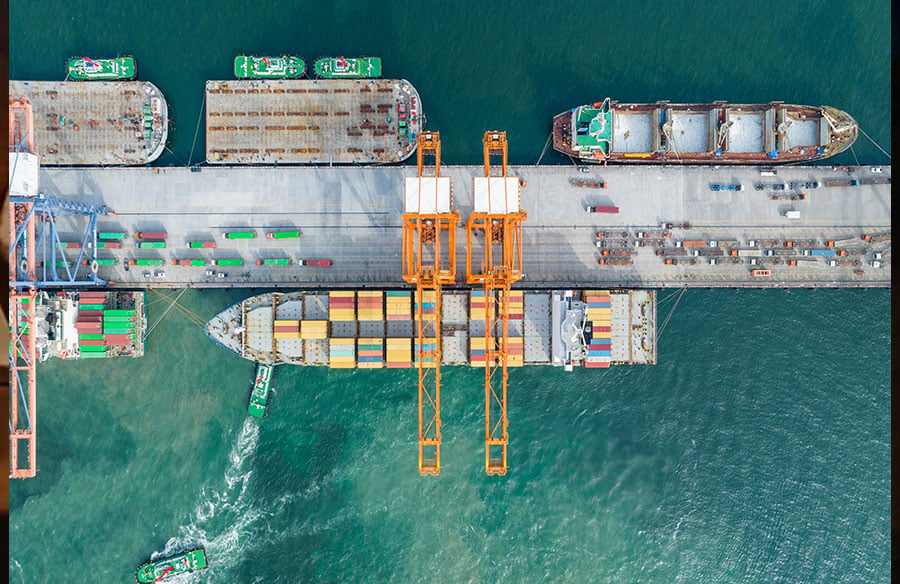
A container port looks like a chaos of steel boxes and tall cranes. Look again and it’s one of the most carefully engineered places in the world. A modern terminal is designed to a tight brief: berths, quay, yard and the rail and road links behind it are laid out to move goods on and off ships as fast as possible. Naval architecture, civil engineering, geotechnics and logistics planning all meet on one piece of reclaimed land. When it works, trade flows; when it doesn’t, ships wait, costs rise and the effects reach back to the factory and forward to the shop.
Designing for bigger ships
The single biggest force shaping port design is the size of the ships. The largest vessels afloat, the Ultra Large Container Vessels, now carry more than 24,000 twenty-foot equivalent units (TEU). They run to around 400 metres long and 61 metres across the beam, roughly 24 rows of containers side by side. These giants work the busiest trades, above all out of China, which handles more than 40% of global container traffic, so booking sea freight from China means moving through ports built for sheer volume.
Depth comes first: a laden megaship draws around 16 metres, so the berth, approach channel and turning basin must all be dredged to match. Reach comes second: the ship-to-shore (STS) gantry cranes must span all 24 rows on deck, with twin-lift spreaders to move two or four boxes at once. The quay wall beneath them must carry the point loads of the crane rails and the surcharge of stacked containers behind. A berth built for the Panamax ships of twenty years ago cannot take today’s vessels, so quays are constantly deepened and re-piled.
The yard: where design meets flow
Once a box comes off the ship it lands in the container yard, where spatial design earns its keep. The yard is not storage but a sorting machine, measured in ground slots and stacking density, and its layout sets the terminal’s throughput.
The key decision is the handling equipment, because that dictates block geometry. Straddle carriers give a lower, looser stack but move quickly. Rubber-tyred and rail-mounted gantry cranes (RTGs and RMGs) stack higher and denser over longer blocks, saving land. Designers fix block orientation, perpendicular to the quay for automated end-loading or parallel for wheeled operations, and reserve powered slots for reefers. Stack too high and every retrieval means re-handling; too low and the land runs out. The best yards balance density against moves per box, keeping dwell time down so a lorry or train is never left waiting.
The gate and the world beyond it
A terminal is only as good as its landside connection. A ship can be worked fast, but if the boxes cannot clear the site, yard density climbs until the quay itself slows. This is why the land side, gates, internal roads and rail sidings, matters as much as the water side.
Good design pushes strong intermodal links to the edge of the terminal. On-dock rail lets containers leave by the trainload rather than one lorry at a time, while automated gates with optical character recognition and appointment systems cut queues. Getting a box from the quayside to an inland warehouse depends on this planning, and on the container haulage that carries it the rest of the way. Ports that under-build these links become bottlenecks, no matter how modern their cranes.
Automation and the digital layer
Port design is now as much about software as concrete. Automated stacking cranes and guided vehicles (AGVs) work the largest terminals with no driver in the yard, while remote operators handle the exceptions. Holding it together is the terminal operating system (TOS): the software that knows the position of every container, sequences each crane move and plans the stow. China, home to the busiest ports on earth, leads the way in building these fully automated terminals.
The aim is flow: when the system holds a real-time position for every box and machine, the yard sequences itself and runs faster and safer. Design here is no longer only the shape of the quay and yard but the digital twin running through them.
Where the port ends and the forwarder begins
For the business shipping the goods, all this engineering is out of sight; what they feel is whether cargo arrives on time and without surprise costs. That is where a freight forwarder fits in, joining the terminal to the customer.
Once a container lands and clears customs, its contents are often broken into smaller consignments, and organising pallet freight for that final leg turns a full container load into deliveries a business can actually use. Good design gets the box to the dock; the right partner gets the goods to the door.
The bottom line
Ports are among the largest machines we build, and their design shapes global freight more than most people realise. The dredged depth of a berth, the outreach of a crane, the stacking density of a yard and the strength of a rail link all decide how smoothly trade moves. For the businesses relying on it, choosing partners who know the journey is the difference between goods that flow and goods that get stuck.