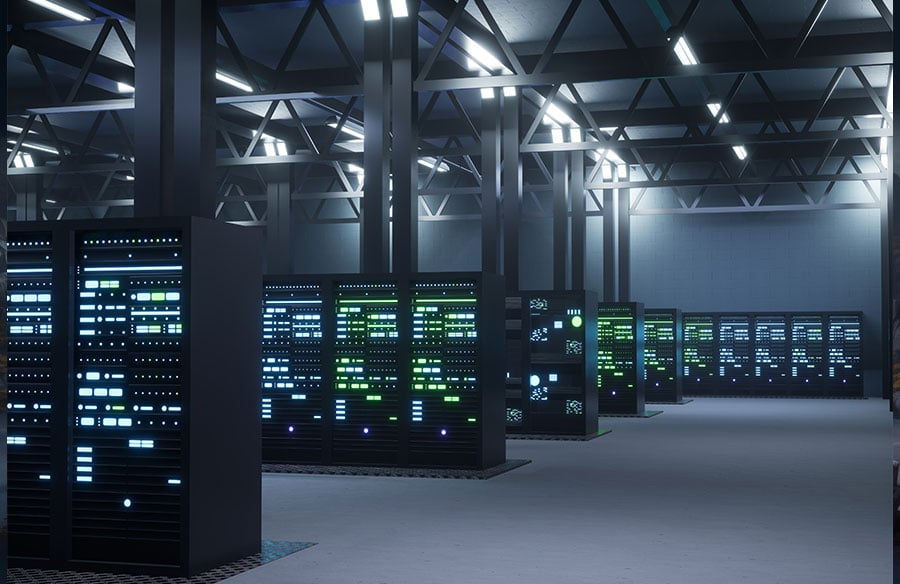
There is a quiet revolution happening beneath the surface of our cities. Not in the skylines we admire or the civic spaces we inhabit, but in the vast, humming buildings that make the digital world possible. Data centers, once regarded as utilitarian boxes best hidden on the industrial outskirts of a city, are rapidly becoming some of the most architecturally and technically demanding structures of our time. At the heart of this transformation is artificial intelligence.
As AI workloads grow exponentially, the architecture of data centers must evolve in ways that challenge nearly every convention of how we design, construct, and think about buildings.
For architects and engineers looking to stay ahead of this shift, Blackridge Research’s data center database provides visibility into data center projects worldwide. By tracking where new AI data centers are being planned and built, it helps identify emerging demand, high-growth markets, and the evolving infrastructure requirements shaping the next generation of data center design.
From Server Room to Spatial System
Not long ago, the design brief for a data center was relatively straightforward: maximize floor space, ensure adequate cooling, secure the perimeter, and keep the power on. The building was, in many ways, a container, a neutral vessel that existed in service of the technology within it.
AI has dismantled that simplicity entirely.
Training a large language model or running real-time inference at scale requires orders of magnitude more compute than conventional enterprise IT workloads. This translates directly into spatial consequences. Rack power densities that once averaged 5 to 7 kilowatts per rack are now pushing 40, 60, even 100 or more kilowatts in AI-optimized facilities.
The thermal loads generated by these systems are so intense that the traditional raised-floor, forced-air cooling model, an approach that served the industry for decades, is simply no longer adequate.
For architects, this is not merely a mechanical engineering problem. It is a spatial reorganization problem. The entire logic of how a building is sectioned, how air and liquid flow through it, and how human access is balanced against machine density must be rethought from the ground up.
The Cooling Imperative: Architecture Follows Thermodynamics
If there is one force driving the architectural evolution of the modern data center, it is heat. The buildings that house AI infrastructure are, at their core, thermal management systems first and computing facilities second.
Liquid cooling, once a niche solution, has become the defining design variable of the AI data center era. Direct liquid cooling (DLC), immersion cooling, and rear-door heat exchangers are reshaping not just the equipment inside these buildings but also the mechanical rooms, pipe routing, structural slabs, and even the exterior massing of facilities.
Buildings now need to accommodate glycol loops, coolant distribution units, and heat rejection systems at a scale that would have been unrecognizable a decade ago.
This creates fascinating architectural opportunities. The waste heat generated by AI computing is no longer just a problem to be expelled; it is increasingly a resource. Progressive data center designs are integrating heat recovery systems that channel thermal output into district heating networks, agricultural greenhouses, or even public amenity spaces like swimming pools and wellness facilities.
In Scandinavia, several large-scale facilities already supply heat to nearby residential districts. The data center, in this vision, stops being a parasitic urban element and becomes a productive participant in the city’s energy ecosystem.
This is where architecture has a genuine and urgent role to play, not just in designing the shell of these buildings, but in shaping how they are woven into the urban fabric around them.
Spatial Logic in the Age of AI Infrastructure
The interior architecture of an AI-ready data center reflects a new logic of scale and specialization. Gone is the uniform grid of racks stretching across a single open floor plate. In its place, we see a more differentiated spatial hierarchy: high-density AI compute zones that require liquid cooling, lower-density general compute zones, storage clusters, networking spine areas, and increasingly, on-site power infrastructure that rivals the complexity of a small electrical substation.
This spatial differentiation demands a kind of programming rigor more commonly associated with hospitals or research laboratories than with industrial buildings. The adjacency of systems matters enormously. A poorly conceived floor plan can add kilometers of cable routing, impair cooling efficiency, or introduce latency into high-speed interconnects, each of which carries real operational and financial consequences.
Modular design has emerged as the dominant response to this complexity. Rather than designing a data center as a single, fixed building, leading firms are now developing facilities as a series of discrete, standardized capacity modules, each self-contained with its own power, cooling, and networking, that can be deployed, commissioned, and scaled independently. This approach borrows directly from principles well-established in industrial and prefabricated architecture: the reduction of on-site uncertainty, the acceleration of construction timelines, and the flexibility to adapt as technology evolves.
The Building as Infrastructure: Urban and Landscape Dimensions
As AI demand pushes data centers toward ever-larger footprints and power requirements, the site selection and urban integration of these facilities have become a critical design challenge. A hyperscale AI data center can demand 500 megawatts or more of electrical power, an amount that rivals mid-sized cities.
Siting these facilities requires negotiation with power grids, water sources for cooling, and local communities who are increasingly vocal about the land use, visual impact, and environmental footprint of what are, essentially, enormous energy-consuming machines.
This is an area where architects and urban designers must step forward with more than technical competence. They must offer a vision for how data centers can be responsible neighbors. That means thinking seriously about landscape integration, architectural character, visual screening, and the creative reuse of industrial and post-industrial sites that already have the power infrastructure these facilities need.
Repurposed industrial zones, former steel works, and decommissioned power stations all represent opportunities to place data center infrastructure within existing energy corridors while regenerating underutilized land.
Some of the most compelling emerging concepts go further still: underground data centers housed in former tunnels or bunkers, offering natural thermal stability and minimal surface footprint; data centers co-located with renewable energy generation at the point of production, eliminating transmission losses; and even off-grid, floating facilities positioned offshore to leverage seawater cooling. These are not science fiction. They are serious architectural and engineering proposals being actively developed today.
What Architects Bring to the Table
It would be easy to conclude that data center design is fundamentally an engineering discipline in which architecture plays only a cosmetic role. That conclusion would be both wrong and costly.
The decisions that shape a data center where it sits, how it relates to its surroundings, how its internal spaces are organized, how it manages and shares its thermal and energy outputs, and how it will adapt to technologies that do not yet exist are precisely the decisions that architects are trained to make. They require the integration of technical, spatial, environmental, and social thinking that is the essence of good design practice.
The AI era has not diminished the relevance of architecture to data infrastructure. It has intensified it. As these buildings become larger, more powerful, more energy-hungry, and more consequential to the communities around them, the need for thoughtful, inventive, and responsible architectural intelligence has never been greater.
The machines are learning. It is time the buildings that house them started thinking, too.
Conclusion
The data center of the AI era is not simply a bigger version of what came before. It is a genuinely new building type that demands new spatial logics, new material strategies, new relationships to energy and landscape, and a new understanding of how infrastructure can participate constructively in the life of cities. For architects willing to engage with its complexity, it represents one of the most significant design challenges and opportunities of the coming decade.
The architecture of intelligence is being written right now, in concrete and steel, in coolant pipes and power cables, in the decisions made on drawing boards and in planning chambers around the world. The question is not whether architects will shape it. The question is whether they will do so boldly enough.