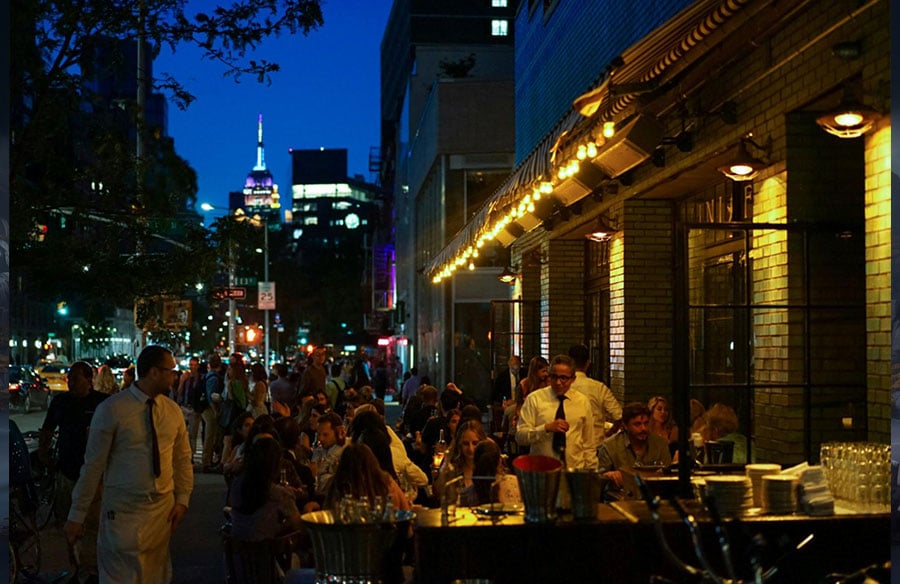
New York City is home to over 17,000 restaurants, according to Google Maps data. While each restaurant has their own cuisine and culture, the success of each New York restaurant depends on much more than just the menu.
According to Brooklyn-based spatial designer Shivani Pinapotu who specializes in restaurant design, the dining experience is complex. It sits at the intersection of a unique experience that combines scenography, cultural narrative and architectural precision.
Pinapotu is driven by a profound interest in how spaces convey narrative, culture, and meaning. Her work reflects a commitment to creating environments that resonate with the stories and experiences of their inhabitants.
Throughout her career, Pinapotu has developed a strong portfolio of high-profile hospitality and residential projects, showcasing her ability to blend creative rigor with a narrative-driven design sensibility. Her expertise lies in ensuring that each design not only meets aesthetic standards but also serves a functional purpose. She believes that every space has a story to tell, and she strives to bring that narrative to life through thoughtful design.
What defines dining in New York? According to Pinapotu, it is a unique blend of density and demand. “New York dining is defined by its density of cultures, ambitions, and references all existing within a few blocks of each other,” said Pinapotu. “Nowhere else can you eat your way across the world in an afternoon, and nowhere else does that feel completely unremarkable.”
However, this density creates a high-pressure environment for spatial designers like Pinapotu, who is interested in how spatial design can translate narrative and cultural context into inhabitable form, combining material craft, strategy and social inquiry to create spaces that evoke meaning and care.
“New Yorkers have seen everything, eaten everywhere, and have very little patience for something that doesn’t earn their attention,” she said. That raises the stakes for everyone, including the designers. A restaurant in New York has to know exactly what it is, because the city will find it out either way.”
Drawing on her background in scenography and installation art, Pinapotu views the entrance of a restaurant as a critical “threshold.” In a city as overstimulating as New York City, which has a population of over 8 million residents, the design must provide a sense of arrival, providing a unique experience that ushers in guests with intention.
“New York streets are relentless, so the best restaurants create a genuine sense of arrival, a feeling that you have crossed into somewhere intentional,” she said.
Authenticity is another note that must be hit. “I notice, almost immediately, whether the space has a point of view and a set of decisions that feel considered and specific, rather than assembled from a mood board of current trends,” she adds.
First impressions matter. “When I walk into a room, I look for coherence,” Pinapotu explains. She asks herself if the space feels like a “set,” not in a theatrical way, but in its ability to orient the visitor. “You know where you are, what kind of story you’re inside, how to hold yourself,” she explains. “When I walk into a room, I look for coherence and a sense that every element is in conversation with every other element.”
Pinapotu began her journey in the design field by working at several up-and-coming design studios across India. She honed her skills in spatial design and gained valuable insights into the architectural landscape.
She has also been a Teaching and Research Assistant at the Rhode Island School of Design, where she contributed to courses on the history of interior architecture and sustainable design futures. This teaching experience not only deepened her knowledge but also allowed her to engage with emerging designers and foster a collaborative learning environment.
Pinapotu notes that restaurant design often takes a backseat to the smells and sounds that fill a restaurant. But she explains that designing a restaurant for leveled acoustics is key. It also requires preparation. In her expert analysis of the industry, Pinapotu identifies that sound can make or break a restaurant’s business.
“Acoustics, without question, is an overlooked aspect of restaurant design,” said Pinapotu. “And I say that as someone who arrived at it through experience, rather than theory. New York restaurants, especially in Manhattan, often feel more like bars, than dining rooms. The noise level becomes its own kind of atmosphere, which can work for certain concepts, but it frequently crosses into something that makes conversation effortful and the experience exhausting.”
She adds: “Sound is invisible, which makes it easy to deprioritize during the design process, but it shapes how long people stay, how relaxed they feel, whether they come back. It’s also one of the hardest things to fix after a space is built, which makes it all the more important to think about early.”
Pinapotu is a graduate of the Rhode Island School of Design (RISD) with a Master of Design in Interior Studies, and works at Home Studios in Brooklyn, NY, where she is developing her design capabilities and understanding of the complexities involved in interior residential and hospitality projects. She has spent over five years examining how spaces convey meaning and today, she is at the forefront of a design movement that treats restaurants not merely as eateries, but as immersive environments where every detail, from the acoustics to the measurement of restaurant furniture, can tell a story.
Pinapotu’s dedication to her craft has been recognized through various accolades, including the prestigious Dorner Prize in 2023 for the project “(un)heard voices” at the RISD Museum. This recognition highlights her commitment to creating culturally responsible and inclusive design solutions that resonate with diverse audiences. Additionally, she was awarded the RISD Fellowship from 2021 to 2023, further solidifying her reputation as a rising star in the field of spatial design. Her expertise extends beyond traditional design practices, as she is well-versed in curation and exhibition design, construction documentation, and custom furniture and lighting design.

In her practice, Shivani embodies values of empathy, cultural awareness, and respect for craft, striving to create spaces that foster connection and agency. With a keen eye for detail and a passion for storytelling through design, she continues to make significant contributions to the field of spatial design, shaping environments that inspire and engage.
If anyone would know, Pinapotu knows that elevating a dining experience with design that feels right requires in-depth research. “I start with the question of how I want someone to feel, rather than what I want the space to look like,” said Pinapotu. “My background in scenography and installation has taught me to think about a dining space the way a set designer thinks about a stage: every element is in service of an experience, and nothing is arbitrary.”
Materials are also just as important. “I’m drawn to materials, references and details that are rooted in a particular culture or place, rather than borrowed from a global design vocabulary,” she said. “When a space feels specific, it feels real. And when it feels real, people trust it.”
As a spatial designer, part of her job is making guests feel comfortable at a restaurant. One restaurant design detail that Pinapotu is conscious of is the quality of seating provided. Wooden chairs may be inexpensive and look rustic, but they’re not always the best fit for comfort-seeking guests.
“It’s not the style, but the ergonomics,” she explains. “When it comes to dining chairs in a restaurant, the height of the chair must be relative to the table, and we must be mindful of the way a chair holds you over the course of a two-hour meal. People notice immediately when seating is wrong: they shift, they become uncomfortable, they want to leave. But when it’s right, it disappears entirely into the experience. You stay longer, you order another drink, you feel inexplicably at ease without knowing why. It’s one of those details that does enormous work in silence, which, to me, is the mark of a genuinely good design.”
Every borough, according to Pinapotu, has something to offer, cuisine-wise. “Each borough, and really each neighborhood within each borough, has its own relationship with food and space,” she explains. In her experience, Brooklyn is a bit more rough around the edges. It’s more local, more rooted in the specific character of a block. “The best Brooklyn restaurants feel like they grew out of their surroundings, rather than being dropped onto them,” said Pinapotu. Meanwhile, Manhattan demands a different set of scale, foot traffic and expectations. “But Queens, for instance, has some of the most culturally specific and spatially interesting dining environments in the city, precisely because they’re designed for communities, rather than audiences,” she adds.
Pinapotu’s philosophy eschews a globalized design vocabulary in favor of materials and references rooted in specific cultures. This commitment to authenticity is what she believes modern New Yorkers are truly searching for.
“New York has an acute sensitivity to inauthenticity,” Pinapotu said. “The most coveted dining experiences in this city tend to be the ones that were something before anyone was paying attention. The exclusivity feels like a byproduct of integrity rather than a strategy.”
As she continues to work on restaurants locally and globally, Pinapotu notes that New Yorkers want authenticity. “I think what people are really chasing is the feeling of being inside something genuine, a place that has a clear identity and doesn’t need to explain itself,” she said. “New York has an acute sensitivity to inauthenticity; people here can tell almost immediately when a restaurant is performing exclusivity, rather than simply being itself.”
Article by Margaret Wright
Published on June 3, 2026