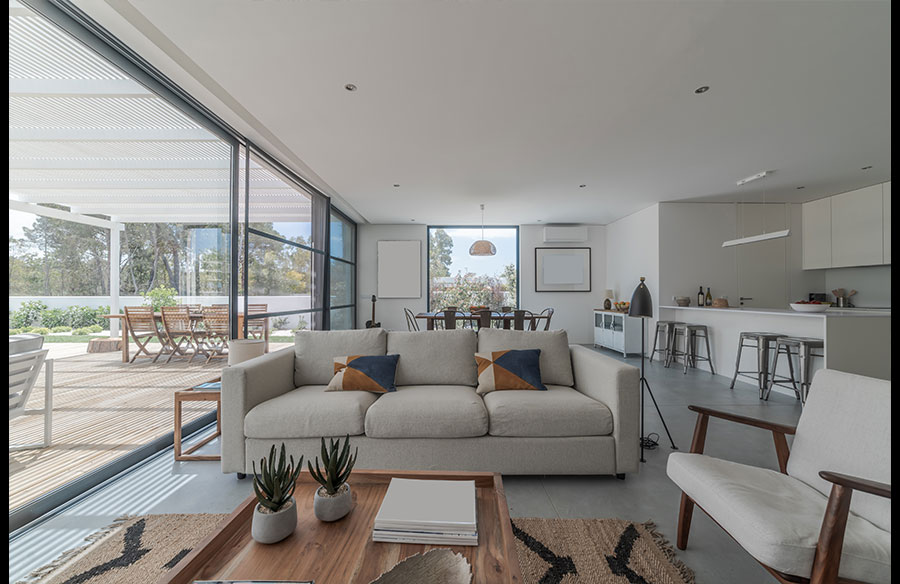
Here is something nobody warns clients about when they sign off on knocking down the wall between the kitchen and the living room.
The dust travels.
I do not mean a little. I mean the fine grease aerosol from sautéing garlic on a Tuesday evening will, within about an hour, settle on the spines of the books on a shelf twenty feet away. The dander from the dog sleeping on the couch ends up on the kitchen island. The flour from making pancakes on Saturday morning lands on the throw pillows.
We designed it that way. We just do not talk about it.
A wall is not just a wall
Walls did things for us that we have collectively forgotten. They contained cooking smoke. They blocked humidity migration from the bathroom to the dining room. They kept dust generated in one room more or less in that room. The doorway, with its threshold and its hinged barrier, was a surprisingly effective HVAC device.
When we removed those walls in pursuit of the open-plan ideal, we got a beautiful, light-filled, social space. We also got an airflow problem nobody mentions in the design press.
I had a conversation last year with the owner of a gut-renovated row house — the kind with the original front parlor opened up to the kitchen, fifty feet of uninterrupted floor. She told me she had never in her life vacuumed her living room and found dried oregano. She has now. Twice.
The materials make it worse
The materials we love right now are not helping. Matte black taps. Honed marble. Wide-plank engineered oak with deep micro-bevels. Brushed brass. Every one of these surfaces photographs beautifully and shows every fingerprint, every water spot, every speck of grit. I have specified all of them. I am going to keep specifying them. But I have also stopped pretending to my clients that they will look the same in two years as they do on handover day, unless someone is putting in real maintenance work.
And here is the uncomfortable part: most clients have no idea what that maintenance actually involves. They think a Swiffer and a Saturday afternoon will do it. It will not.
Why the once-a-week deep clean is dead
The traditional cleaning model — a couple of hours every Saturday, kitchen to bedrooms — was built around compartmentalized homes. Clean the kitchen, the dust stays in the kitchen. Done.
In an open-plan home, that model fails on contact with reality. Dust dislodged from a bookshelf at 10 AM is on the kitchen counter by lunch. The pet hair you vacuumed off the rug on Saturday is back, distributed by foot traffic and HVAC, by Tuesday. You are not cleaning rooms anymore. You are managing a continuous airborne ecosystem that does not respect your room labels.
A lot of homeowners eventually figure this out. They either accept that their beautiful open-plan home will look slightly grimy most of the time, or they find someone who actually understands modern interiors and pay them to handle it.
What the good cleaning operators are actually doing
I have started paying attention to the cleaning companies my clients hire, partly because the ones doing it well are quietly extending the life of the surfaces I specify. The good ones do not look anything like the cleaning service of fifteen years ago.
They start at the ceiling and work down. They use HEPA-filtered vacuums, not the bagless ones that re-aerosolize half of what they pick up. They have specific protocols for honed stone (no acidic cleaners, ever), for matte black fixtures (microfiber only, no spray-on degreasers), for engineered wood (damp, never wet). They train their teams on this stuff. The cheap services do not.
In Washington, where I do most of my residential work, Pure Homes Cleaning, a professional cleaning service in Washington, DC, is one of the operators I have ended up recommending more than once. They get the modern-interior thing in a way most of the legacy services do not. I have no financial relationship with them. I just got tired of watching clients ruin honed marble countertops with vinegar.
What this means for how we design
I am not arguing that we should go back to compartmentalized floor plans. I would not want to design those, and most clients would not want to live in them. But I do think the design profession has been sloppy about the downstream consequences of the choices we make.
When I specify a material now, I tell the client what it will take to keep it looking right. When I open up a floor plan, I tell them their dust patterns will change. And when I hand over the keys, I increasingly find myself recommending a cleaning service that knows what to do with the home I just built. The alternative is watching a year of careful design decisions slowly get ruined by a Roomba and some Windex. We owe clients better than that.