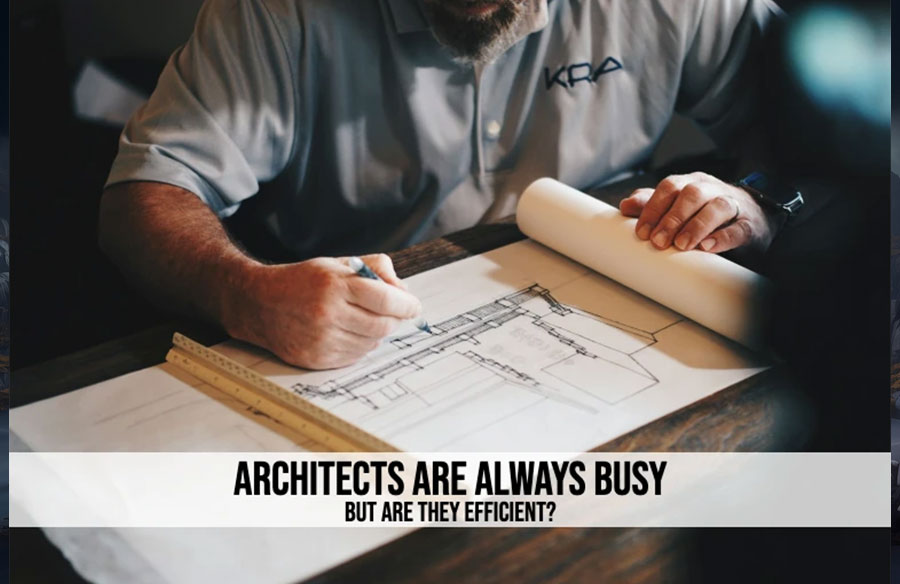
Architecture is somehow always linked to long hours, late nights, and an almost romanticized culture of being busy. When you walk into any studio—no matter if it’s a boutique, firm, or a global practice—you’ll likely see teams juggling dozens of deadlines, switching between drawings and meetings, and responding to endless threads of client emails.
They are busy, for sure.
But are they actually efficient? The two are not the same.
In this article, we’ll define what “being busy” really means in architectural practice, where time actually goes, and why efficiency is often not that easy to achieve.
The Culture of Busyness in Architecture
Architecture sits at a unique intersection; it’s part creative discipline, part technical service, and part project management engine. That’s why architects are rarely doing just one thing at a time.
They are designing, coordinating, documenting, presenting, revising, and communicating, all that within the same day (even the same hour).
Research into architectural practice shows how deeply time is embedded in the profession. A study of architects’ working patterns found that time in architecture is often negotiated and shaped by studio culture, deadlines, and expectations rather than clear boundaries or systems.
In other words, architects use time, but they also adapt to it. And that’s where things start to take a downturn, because when time is fluid and reactive, busyness becomes the default state.
Productivity in Architecture Is Hard To Measure
Unlike manufacturing or software development, architectural output is difficult to quantify. And studies confirm this.
A study on design productivity explains that traditional productivity metrics, like hours worked versus output, don’t translate well to design professions. Instead, measuring productivity requires tracking the evolution of work, like drafts, revisions, approvals, and iterations.
Think about that for a moment.
A single drawing can go through multiple revisions.
Similarly, one design idea can take hours or days to mature.
And a “quick” client request can affect an entire project.
So, while architects are undeniably busy, it’s not always clear which hours are productive, which tasks create value, and where their time is actually going.
The Productivity Problem in AEC
Now, let’s zoom out to the broader AEC (Architecture, Engineering, and Construction) industry, and you’ll see a consistent productivity pattern: challenges tracking productivity.
A 2026 study on team productivity in AEC projects found that things like task invisibility, cultural differences, and uneven workload distribution all quietly ruin efficiency.
Task invisibility in particular. It’s exactly what it sounds like: work that happens but never really gets seen, tracked, or acknowledged. Think emails, internal reviews, time spent staring at a design problem until it clicks; all real work, none of it showing up anywhere. And because that work stays invisible, projects get underestimated, expectations drift, and teams end up feeling like they’re constantly running behind for no obvious reason.
That’s why everyone feels they’re busy, but no one has a clear picture of why.
Being Busy Feels Like Being Productive
Let’s add a psychological layer to this, along with a simple fact: busyness feels productive.
Answering emails, attending meetings, making quick edits… all these tasks create a sense of accomplishment, even though work is fragmented, reactive, and shaped by interruptions.
The tasks are immediate and easy to justify.
But they come at the cost of deep, focused work, and the kind that actually drives projects forward. Architects may be working long hours, but much of that time is spent navigating complexity rather than improving design.
 The Real Cost of Inefficiency
Inefficiency in architecture seems to affect all aspects of the business:
- Project overruns become more frequent.
- Burnout increases across teams.
- Creative quality suffers.
- Profit margins shrink.
And perhaps most importantly, there’s no real visibility. Without clear data on how time is spent, decision-making becomes something businesses do as they go.
Where are the bottlenecks?
Which projects are profitable?
Which phases take longer than expected?
Who knows.
Traditional Time Tracking Isn’t the Right Way
At this point, the obvious solution is simply to track time.
But in practice, it’s not that easy because time tracking systems often rely on manual time tracking. Such tracking:
- Interrupts creative flow.
- Gives admin overhead.
- Creates inaccurate entries.
- Asks you to rely on memory.
What’s even worse, design work doesn’t fit neatly into predefined time blocks, and that’s why architects often despise tracking time. No one can say confidently, “That idea took exactly 46 minutes.”
Introducing Automatic Time Tracking
Now we’re getting to the good part.
Instead of asking architects to track their time manually, automatic time tracking tools capture it automatically, quietly, in the background. They work by recording activity across apps and workflows to build an accurate picture of how time is spent, without requiring any user input.
With such tools, everything invisible becomes visible, and you can finally answer questions about where time actually goes during a project, which phases consume the most effort, and how much time is lost to context switching or admin work.
And for anyone working with sensitive client data, privacy matters. The good news is that the better automatic tracking tools are built with that in mind. All activity is captured locally and stays on your machine, meaning no data is uploaded to the cloud and no one else has access to it, not even the tool’s developers. You get full visibility into your own work without compromising your clients’.
One of these tools is Memtime, designed specifically to track time automatically without manual input. It records activity in the background and lets architects review their day retrospectively, without disrupting workflow. For architecture and engineering teams, this approach can be valuable because it aligns with how work actually happens.
Are Architects Efficient?
Hmm… It’s hard to answer this question.
Architects are highly skilled, deeply committed, and often superproductive under pressure. But the systems they work within don’t always support their efficiency. They don’t need to work faster or longer; they just need more awareness of how time is actually spent, where value is created, and where effort is being lost.
Final Thoughts
Architecture will probably always be busy; it’s part of the profession’s DNA.
But efficiency is something they should strive to achieve, and it can be designed. It all starts with understanding the system and how they work. Once they see how time is really being used, they can start shaping it more intentionally and strategically, and expect far better outcomes.