The organization and design of buildings, public areas, transportation networks, services, and amenities are all part of the dynamic and intricate discipline of urban design. Promoting social contact in public areas is one of its main goals in order to foster a strong feeling of community. 3D rendering has become a vital tool as urban designers work through the challenge of creating public areas that encourage community engagement. This article examines how 3D rendering is changing urban public space design to make it more accessible and community-focused.
Architectural renderers as a visual language
Traditional plans, sections, and schemes have long failed to meet the needs of a wide audience. For most people, an architectural project remains abstract and difficult to understand. This is where 3D renderers come to the rescue – they translate a complex architectural language into visual images that are easy to understand and discuss even without a professional education.
Visual renderers allow you to:
- imagine how the new space will look in the context of the existing urban environment;
- evaluate the scale and proportions of objects;
- understand how light, shadow, and materials will interact in the future space.
This makes it easier for participants to engage in a dialogue, compare options, and make more informed decisions than using only drawings or text descriptions.
3D rendering as a mediator between the architect and society
One of the key tasks of the modern architectural process is to ensure a dialogue between specialists and citizens. In this context, 3d product rendering services, such as those provided by Zolak, play an important role: they not only create realistic images, but also become a means of exchanging meaning between the architect and society.
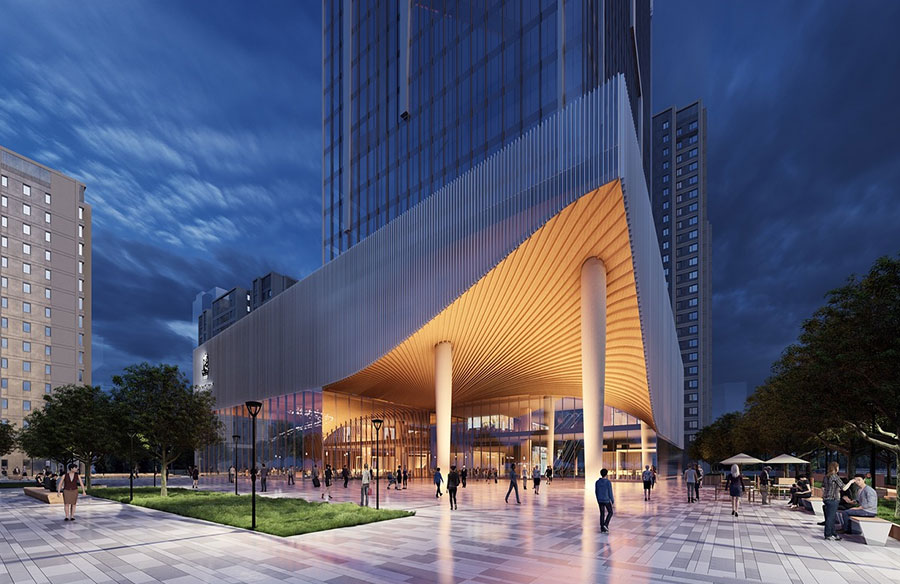
Such services allow you to visualize not only individual buildings, but also entire public spaces, including sidewalks, squares, parks, landscaping elements, traffic flows, and even people in their daily activities. These visual images become a common language that is understandable to both professionals and residents of the city.
What is especially important:
- visualization makes the design accessible and understandable for discussion;
- it can be used in public hearings, online surveys, and presentations;
- it encourages discussion, participation, and community engagement.
Thanks to this mediation, citizens feel heard, and architects receive valuable feedback that can be taken into account in the early stages of the project.
How visualization shapes the perception of future spaces
When a project is presented in the form of a high-quality 3D render, it ceases to be an abstract idea. People seem to “experience” the future space even before it is created. This allows you to:
- feel the scale and atmosphere of the space;
- see how the elements of landscaping, architecture, and landscaping and architecture will interact;
- imagine how different groups of people will use the space.
This visualization helps to avoid surprises after construction: the more accurate the idea of the project, the more realistic the expectations of society.
A tool for inclusive and collaborative design
Modern technologies make it possible to adapt visualization not only to a professional audience, but also to a wide range of users. Public presentations and online platforms with 3D renderers make the discussion more inclusive: residents can comment, suggest changes, or ask questions using visual material as a starting point.
The advantages of this approach include:
- intuitive understanding of the project – visualization removes technical barriers;
- the ability to take into account the needs of the community – people see how the proposed changes affect their lives;
- building trust in the design process – transparency and accessibility of information strengthen the dialogue between residents and architects.
Practical examples of participation through visualization
The role of visualization in citizen participation has already proved its effectiveness in several international projects. The examples show how deep visual representation helped:
- stimulate discussion and collect constructive feedback from citizens;
- adjust the project based on the opinion of the residents and stakeholders;
- increase the level of support for the project in the community.
For example, in the Netherlands, the use of three-dimensional renderers in the urban waterfront development project allowed residents to understand the prospects for the transformation of the territory and become more actively involved in the discussion.
Visualization and trust: the psychological effect
It is important to understand that visualization is not just a graphical representation. It acts as an intermediary that creates a sense of the future space and reduces uncertainty. When people see a realistic image, they have an emotional connection with the project, which increases the level of trust in the development process.
Also, visualization can help:
- reduce resistance to change, as the picture gives a clear idea of the result for residents;
- stimulate discussion and a collective search for the best solution together openly;
- create a sense of belonging to the architectural project within communities.
Limitations and criticisms of visualization
Despite the obvious advantages, visualization is not a universal solution. It can:
- simplify complex design aspects;
- create overly idealized paintings that do not correspond to reality;
- create high expectations among residents if the visualization is far from future realization.
Therefore, it is important to combine visualization with other engagement methods, such as site tours, group discussions, and interactive meetings.
Conclusion
Community-centered public places are becoming more and more necessary as cities continue to expand and change. In order to envision, develop, and construct public areas that genuinely meet the requirements of the community, designers are finding that 3D rendering is a very useful tool. Urban designers may develop public areas that are not only aesthetically pleasing and useful but also promote community building and social engagement by utilizing the power of 3D rendering.