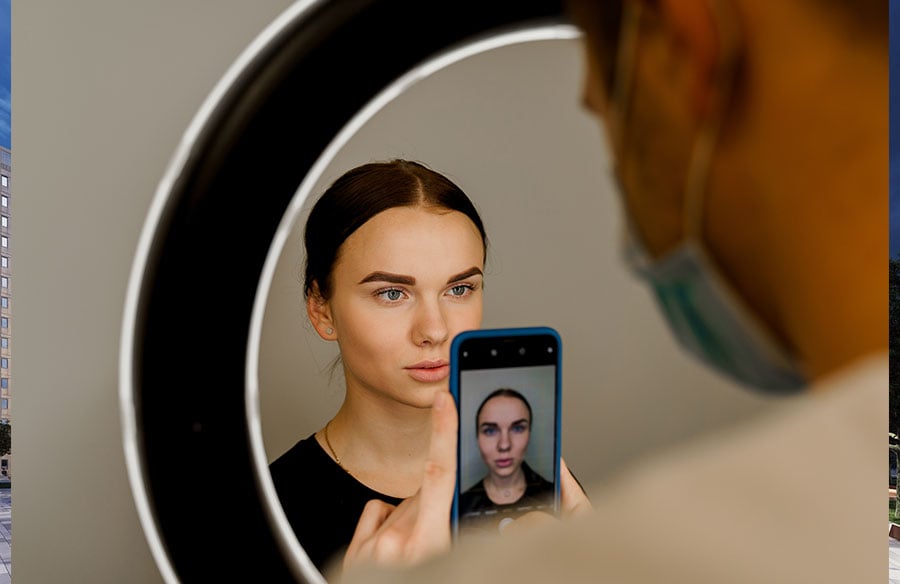
Technology has transformed the way people approach beauty, grooming, and self-image. Today, artificial intelligence can evaluate facial features in seconds, offering structured insights that were once only available through professional consultations. Among the most talked-about digital tools are face shape AI detectors and pretty scale analyzers. These tools promise to analyze your facial proportions, identify your face shape, and even calculate a beauty score based on symmetry.
But what exactly are these tools? How do they work? And how can they genuinely help individuals in practical ways? This article provides a detailed exploration of face shape detectors and pretty scales, explaining their purpose, functionality, usage, benefits, and limitations.
The Digital Transformation of Beauty Assessment
Beauty standards have always evolved with culture and time. However, the rise of artificial intelligence has introduced a new way of understanding facial features—through data and measurable proportions. Instead of relying solely on subjective opinions, AI-powered systems analyze facial geometry using algorithms trained on large datasets.
These systems rely on computer vision technology. Computer vision enables software to detect and interpret facial features from images. Once a photo is uploaded, the program maps specific landmarks on the face and calculates distances between them. This information forms the foundation of both face shape detectors and pretty scale tools.
What Is a Face Shape Detector?
A face shape detector is an AI-based application designed to categorize a person’s face into a structural type. Common face shape categories include oval, round, square, heart, diamond, and oblong. Each of these shapes is defined by specific relationships between the forehead, cheekbones, jawline, and face length.
The main purpose of a face shape detector is to analyze geometry rather than attractiveness. It identifies patterns in facial proportions and matches them to predefined structural templates. For example, an oval face usually has balanced proportions and slightly wider cheekbones. A square face may feature a strong jawline and equal width across the forehead and jaw. A round face typically has similar width and length measurements with softer edges.
By identifying your face shape, the tool provides clarity about your natural structure. This knowledge can be useful for personal styling and grooming decisions.
What Is a Pretty Scale?
A pretty scale is a digital tool that evaluates facial harmony and symmetry. Unlike a face shape detector, which focuses on classification, a pretty scale generates a numerical score based on proportional balance.
Many pretty scale systems use mathematical principles such as symmetry analysis and the golden ratio. The golden ratio is a mathematical proportion that has historically been associated with visual harmony in art and architecture. In facial analysis, the tool compares distances between features—such as eye spacing, nose alignment, and lip proportion—to these idealized standards.
The final result is usually presented as a score, often on a scale from 1 to 10 or 1 to 100. This score represents how closely facial measurements align with programmed harmony standards. It is important to remember that the score reflects algorithmic criteria, not universal or absolute beauty.
How Face Shape Detection Technology Works
The process begins with facial landmark detection. When you upload an image, the system identifies specific points on your face, such as the outer edges of your forehead, the corners of your eyes, the tip of your nose, and the contour of your jawline.
Once these landmarks are mapped, the software measures distances between them. It calculates ratios like face length to face width, forehead width to jaw width, and cheekbone prominence. These ratios are compared against a database of structural patterns representing various face shapes.
The algorithm then selects the category that most closely matches your proportions. Some advanced systems provide additional feedback, such as percentage similarities across multiple shapes.
Accuracy depends heavily on image quality, lighting conditions, and proper head alignment.
How Pretty Scale Algorithms Analyze Facial Harmony
Pretty scale tools follow a similar landmark detection process but place greater emphasis on symmetry. After mapping facial points, the system divides the face into sections and compares the left side to the right side.
The algorithm evaluates whether the eyes are evenly aligned, whether the nose sits centrally, and whether the lips and chin are proportionally positioned. It also measures vertical balance between the upper, middle, and lower thirds of the face.
By comparing these measurements to ideal ratios, the tool assigns a final score. Some platforms may also highlight areas where symmetry is strongest or where slight imbalances exist.
How to Use a Face Shape Detector Correctly
To achieve accurate results, preparation is important. Begin with a clear, high-resolution photo. Your face should be directly facing the camera, with no tilting or turning. Keep your expression neutral to avoid distorting proportions.
Ensure the lighting is even and natural. Harsh shadows or overexposed lighting can interfere with landmark detection. Pull hair away from your forehead and jawline to allow the system to measure full contours.
After uploading your image, the analysis typically takes only a few seconds. Once completed, review your face shape classification and consider any styling recommendations provided.
How to Use a Pretty Scale Tool Responsibly
Using a pretty scale requires similar preparation. Upload a well-lit, front-facing photo with minimal editing. Avoid heavy filters, as they can alter symmetry measurements.
After processing, the tool will present a score. It is essential to approach this score with perspective. The number reflects structural harmony based on mathematical models. It does not account for personality, confidence, cultural context, or emotional expression.
Treat the result as informational rather than definitive.
Practical Applications in Styling and Grooming
Face shape detectors are especially useful for personal styling. Knowing your face shape can guide decisions about haircuts. For example, certain styles add height to shorter faces, while others soften sharp angles.
Eyewear selection becomes more strategic with structural awareness. Frames that contrast your natural face shape often create visual balance. This knowledge reduces uncertainty when shopping for glasses.
Makeup techniques also benefit from structural understanding. Contouring relies on reshaping visual proportions. By knowing your face shape, you can apply contour and highlight more effectively.
Men can use face shape analysis to choose beard styles that enhance facial balance. A well-designed beard can elongate, soften, or define features depending on the goal.
Psychological and Confidence Benefits
Understanding facial structure can increase self-awareness. When individuals know their proportions, they often feel more confident making appearance-related decisions.
Pretty scale tools may also help individuals identify their most balanced photo angles, which can improve professional headshots and social media images.
However, confidence and authenticity remain far more influential than symmetry alone. Tools should enhance self-understanding, not create insecurity.
Limitations and Ethical Considerations
Despite their advanced technology, these tools have limitations. Image distortion from camera lenses can affect results. Lighting and facial expressions may alter measurements.
AI systems are also dependent on training data. If datasets lack diversity, the results may not be equally accurate across different facial types and ethnic backgrounds.
Most importantly, beauty is subjective. Cultural differences, trends, and personal preferences shape perceptions. No algorithm can fully define attractiveness.
Conclusion
Face shape detectors and pretty scale tools represent the growing intersection of artificial intelligence and personal image analysis. A face shape detector categorizes facial structure based on measurable proportions, helping guide styling and grooming decisions. A pretty scale evaluates symmetry and balance, offering insight into structural harmony.
When used thoughtfully, these tools can improve self-awareness, simplify styling choices, and enhance confidence. However, they should always be viewed as supportive guides rather than absolute judgments.
Technology can measure proportions with precision, but true beauty goes beyond mathematics. Confidence, personality, and individuality remain qualities that no algorithm can fully capture.