Railways are the arteries of modern civilization, moving people and goods across vast distances with remarkable efficiency. The process of railway construction is a monumental undertaking, blending heavy engineering, precision technology, and uncompromising safety standards. From high-speed passenger lines to heavy-haul freight routes, building a railway is about creating a durable, reliable, and safe infrastructure that can last for generations.
This comprehensive guide explores the essential components of modern railway construction. We will delve into the critical role of railway track fastening systems, examine the logistics of sourcing materials and equipment, and highlight the paramount importance of safety. Furthermore, we will cover the technology behind track alignment and maintenance, and discuss the impact of large-scale railway infrastructure development projects on our world.
The Anatomy of a Railway Track
Before diving into the construction process, it’s crucial to understand the basic components that make up a railway track. Each part plays a vital role in distributing massive loads, guiding trains safely, and withstanding the forces of nature.
To begin with, the foundation of any track is the subgrade and ballast. The subgrade is the prepared earth upon which the entire structure rests. Above this lies the ballast, a bed of crushed stones that provides drainage, distributes the load from the ties, and holds the track in place.
On top of the ballast are the sleepers (or ties), which are laid perpendicular to the rails. Traditionally made of wood, modern sleepers are often made of concrete or steel for greater durability and longevity. Finally, the steel rails are attached to the sleepers, creating the smooth surface on which the train wheels run. The method used to attach the rails to the sleepers is one of the most critical aspects of the entire system.
The Heart of the Track: Railway Track Fastening Systems
A train exerts immense vertical, lateral, and longitudinal forces on the track. A railway track fastening system is an assembly of components designed to securely attach the rail to the sleeper. Its job is not only to hold the rail in place but also to absorb vibrations, maintain the correct track gauge (the distance between rails), and provide electrical insulation in signaled tracks.
Effective railway track fastening solutions are engineered to provide:
- Clamping Force: To prevent the rail from moving vertically or overturning.
- Creep Resistance: To stop the rail from moving longitudinally in the direction of traffic.
- Elasticity: To absorb shocks and vibrations, reducing wear and tear on both the track components and the train.
- Gauge Retention: To maintain the precise distance between the rails.
There are many types of fastening systems, but most modern systems are built around a key component: the railway track clip.
The Critical Role of Railway Track Clip Installation
The railway track clip is a deceptively simple-looking component that is vital for track safety and stability. These clips provide the clamping force that holds the rail down. Proper railway track clip installation is essential for the fastening system to perform as designed.
The installation process must be precise. Insufficiently tightened clips will not provide enough clamping force, leading to potential rail movement. Conversely, over-tightening can damage the clip or the sleeper. For that reason, specialized hydraulic or electric tools are often used to apply a consistent and correct amount of torque during installation. The integrity of the entire track relies on every single clip being installed correctly. Given these points, this process is a key focus during quality control inspections.
Sourcing and Logistics: The Unseen Backbone
Railway construction is as much a logistical challenge as it is an engineering one. A project requires a vast amount of materials and specialized machinery, all of which must arrive at the right place at the right time.
Choosing Railway Construction Materials Suppliers
The quality of the final track is directly dependent on the quality of its individual components. Therefore, selecting reputable railway construction materials suppliers is a decision of utmost importance. This includes suppliers for rails, sleepers, ballast, and, of course, the fastening systems.
When choosing a supplier, especially railway track clip manufacturers, project managers should look for:
- Quality Certification: The manufacturer must be able to provide documentation proving their products meet stringent international standards (such as ISO, AREMA, or EN standards).
- Proven Track Record: Look for manufacturers and suppliers with a long history of providing materials for major railway infrastructure development projects.
- Technical Expertise: A good supplier will offer technical support and be able to advise on the best products for a specific application (e.g., high-speed vs. heavy-haul).
- Production Capacity: The supplier must have the capacity to deliver the required volume of materials according to the project’s timeline. Delays in material delivery can have cascading and costly effects on a construction schedule.
The Role of Railway Construction Equipment Rental
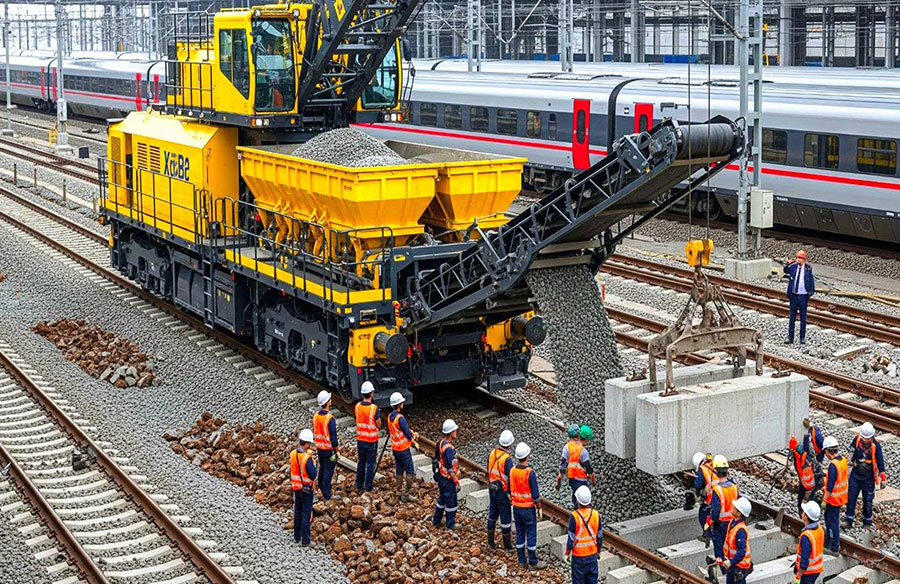
Railway construction requires a fleet of highly specialized and expensive machinery. This includes everything from ballast regulators and tampers to rail lifters and clip installation machines. For many construction companies, purchasing this equipment outright is not financially feasible, especially for a single project.
This is where railway construction equipment rental becomes an indispensable service. Renting provides access to a modern, well-maintained fleet of specialized equipment without the enormous capital investment. Moreover, rental companies are responsible for the maintenance and repair of the equipment, reducing downtime and logistical headaches for the construction team. This flexible model allows contractors to scale their equipment needs up or down as the project demands.
Precision and Longevity: Alignment and Maintenance
Building a railway track is one thing; ensuring it remains safe and operational for decades is another. This requires incredible precision during the initial construction and a dedicated program of ongoing maintenance.
The Importance of Railway Track Alignment Systems
The geometric precision of the track is critical, especially for high-speed rail. Railway track alignment systems are used to ensure the track is perfectly straight on tangent sections and smoothly curved where required. Even minor deviations can cause uncomfortable rides, increased wear on wheels and rails, and in the worst cases, derailments.
Modern alignment is achieved using sophisticated technology:
- Tamping Machines: These are large, multi-function machines that lift the track, move it into the correct horizontal and vertical position, and then “tamp” the ballast underneath the sleepers to hold it in place.
- Laser and GPS Guidance: Advanced tampers use laser-guided systems or GPS to position the track with millimeter accuracy according to the digital design plans.
- Inertial Measurement Units (IMUs): Trolleys equipped with IMUs can survey the track at speed, providing a continuous record of its geometry and identifying areas that need correction.
The Need for Railway Track Maintenance Tools
Once the railway is operational, a new phase begins: maintenance. Regular inspection and repair are essential to ensure the track remains safe. A wide array of railway track maintenance tools are used for this purpose.
These tools range from simple hand tools for tightening bolts to sophisticated machinery. For example, ultrasonic testing devices are used to detect internal flaws in the rails before they can develop into critical fractures. Grinding machines are used to re-profile the rail head, removing surface defects and restoring the optimal wheel-rail contact profile. In essence, maintenance is a proactive process of preserving the integrity of the track structure.
Safety: The Non-Negotiable Priority
Above all else, safety is the single most important consideration in railway construction. The potential for accidents involving heavy machinery, high-voltage lines, and live rail traffic is immense. For this reason, strict railway construction safety standards are enforced on every project site.
These standards cover all aspects of the work, including:
- Personal Protective Equipment (PPE): All workers must wear appropriate PPE, such as hard hats, high-visibility clothing, steel-toed boots, and safety glasses.
- Site Hazard Management: Before work begins, a thorough risk assessment must be conducted to identify potential hazards, such as unstable ground or proximity to other infrastructure.
- Worker Training and Certification: All personnel, from equipment operators to track workers, must be properly trained and certified for their specific roles.
- Lockout-Tagout Procedures: When working on or near existing lines, strict procedures must be in place to ensure tracks are closed to traffic and de-energized.
- Safe Equipment Operation: All machinery must be inspected daily and operated only by qualified individuals according to established safe-work procedures.
A strong safety culture is the bedrock of any successful railway construction project. It protects the workforce and ensures the long-term safety of the public.
The Bigger Picture: Railway Infrastructure Development Projects
Railway construction is often a key component of larger railway infrastructure development projects. These projects can have a transformative impact on a region’s economy and society. They can connect remote communities, reduce road congestion, create jobs, and provide a more environmentally friendly mode of transport compared to road and air travel.
These large-scale projects, whether a new high-speed line connecting major cities or a freight line to a new port, drive innovation in the industry. They push railway track clip manufacturers to develop more robust and reliable products and encourage the development of more efficient construction and maintenance techniques. In the final analysis, these projects are not just about laying track; they are about building the framework for future economic growth and social mobility.
To conclude, modern railway construction is a complex, high-tech, and high-stakes field. It relies on a deep understanding of engineering principles, a commitment to sourcing high-quality materials from reputable suppliers, and an unwavering focus on safety. From the precise installation of every track clip to the laser-guided alignment of the rails, every detail matters. By bringing together the right expertise, technology, and materials, we can continue to build and maintain the railway networks that are so vital to our world.