From time immemorial, geometrical and rhythmic systems have played an indispensable role in urban planning, acting as scaffolding to alter city design and make it more functional and aesthetically satisfying. Designers to construct environments that are both humane and efficient using space while being in harmony with nature are using basic geometric principles, meaning the designs are planned according to the principles of geometry (a kind of meta-geometry), which is typical in both ancient grids and modern fractal-like layouts. Artificial and natural designs contribute to the personality and pulse of the cities, providing a sense of location and connection. The comprehension of the integration of geometry into the process of urban design is a must in the present era, with cities facing the major problems of overpopulation, sustainability, and the introduction of technology, to deal with them.

Patterns in Urban Design
Urban functioning and beauty can be defined through the help of patterns. They give birth to the feeling of belonging and order by introducing such features as open spaces, facades, and streetscapes:
- Networks on the streets:
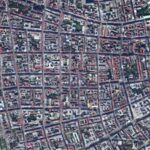
It is the layout of streets, which stand as the lifelines of cities, that has a large impact on social interactions and transportation. Cul-de-sacs, curvilinear roadways, and grid-based networks all have distinct urban needs. Designers frequently apply fractals inspired by natural patterns to create good connections and reduce traffic congestion. Fractals, (the patterns that are similar to those in nature), are widely used by designers to minimize traffic congestion and bring people together.

2. Public Areas:
Complicated patterns that deal with geometry and art are commonly shown in parks, squares, and other public areas. These patterns not only enhance the aesthetic appeal of the design of the place but also require the cooperation of all the members. Some examples are the gardens in Versailles and the mosaics of the Alhambra which are made according to Islamic principles, with a symmetrical design.

3. Building Patterns:
Local characters of the community and metropolitan skylines are the products of architectural geometry. Villages and metropolitan skylines are directly affected by building shapes. Tessellations, parametric patterns, and modular designs are all used successfully to make buildings sustainable and efficient. Through digital tools, architects have shifted from the use of conventional urban planning to experimenting with novel geometric shapes in building design.
Geometry and City Plans
In the city sector, geometry can take many shapes, from organic and curvy patterns to grids or radial systems. Each technique has both its benefits as well as its drawbacks.
- Grid Systems:
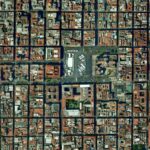
An example of how a grid pattern works in towns like New York and Barcelona is something that demonstrates the direct and orderly nature of it. This layout allows for flexibility in future expansion, easy transportation, and fair land distribution. Nevertheless, the grids can sometimes show no variation and they lack the ability to adapt to their natural surroundings completely.

2. Concentric and Radial Designs
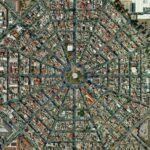
The use of linear and radial patterns is mainly inspired by central streets with radiating lanes and is the product of the influence of geometry and nature. Examples like Paris and Moscow are leaders in this model of transport which helps to reflect the accessibility to the important attractions and the connectivity of the cities. Although the radial system often creates the most attractive and user-friendly areas, it also can be seriously affected by congestion at the center.

3. Organic Patterns:
The patterns that occur naturally and the shape of the organic are mostly not in compliance with the strict laws of geometry. The city’s method of this type of pattern used in various urban settings like Venice, is mainly about the sustainability aspects. Organic patterns are nice and you can use them anywhere; however, they are not eco-friendly, and maintaining them is mission impossible.

Using Geometry in Sustainable Design
Nowadays sustainability is on the top list of the most important issues in urban planning in the city and has a special role in geometry. Compact urban patterns have proven to be an excellent method for generating new types of neighborhoods, which help to decrease land consumption and encourage walkability. It is common for urban planners to often design mixed-use buildings in a manner that integrates the three different functional spaces. They usually need the initial space planning to get the most out of the area. Also, integrating the generation of electricity by solar panels and wind turbines as well as the local availability of other renewable energy resources can be planned based on geometric principles. Therefore clean energy generation can be facilitated by driving the wind turbines and solar panels equally to the geometric positions. In addition to their functionality in terms of the systems, tessellations, orientation, and angles also help in optimizing energy efficiency as well as conserving the environmental surroundings. The bioretention cell, a dry well as well as a street filter are excellent stormwater management tools, and they can replicate water management patterns that mimic the fractals and natural drainage systems.

Developments in Technology and Challenges
Modern technology has changed the way geometry and patterns are used in urban planning. Designers have become able to analyze spatial data and devise geometric layouts that are optimized with the help of GIS (Geographic Information Systems). Using these methods helps in problems such as distribution of resources, density of population, and traffic flow. Complex geometric patterns can be tried out by architects using parametric design software such as Grasshopper and Rhino. The creation of sustainable, adaptive structures that change with the environment is facilitated by parametric design. Building complicated geometric shapes is now a reality due to enhancements in 3D printing technology. This innovation, from modular homes to imaginative installations, elevates the whimsy and efficiency of urban design. Nevertheless, there are disadvantages to using geometry in urban planning. The only way to ensure the possibility of adaptability and cultural continuity is through the maintenance of this balance. Inclusive design techniques are indispensable for fair opportunities and resource access. To overcome the issue of climate resilience the urban patterns need to be recast. Urban heat islands and severe weather events are lopped by using geometric designs which include passive cooling systems and green infrastructure.

The future urban design is expected to be based on the integration of geometry and patterns, making use of advances in AI, machine learning, and biomimicry technologies. When the aim is to use the least space and resources optimally, applications such as smart cities and vertical urbanism will be mostly characterized by the exact geometrical layout. In the field of urban design, patterns and geometry are not merely decorative elements; they are indeed crucial for the construction of cities that are sustainable, meaningful, and practical. With a historical, cultural, and technical approach, urban designers can create environments that are not only inspiring but also lasting and can contribute to a better understanding of geometric properties.
Citations:
- Re-Thinking The Future, n.d. Symbolism and geometry in urban planning: The relationship between city design and cultural symbolism. [online] Available at: https://www.re-thinkingthefuture.com/architectural-community/a10828-symbolism-and-geometry-in-urban-planning-the-relationship-between-city-design-and-cultural-symbolism/ .
- Architecture History, n.d. Urban planning – 20th-century architecture. [online] Available at: https://architecture-history.org/schools/URBAN%20PLANNING.html .
- ResearchGate, 2019. Algorithms-aided sustainable urban design: Geometric and parametric tools for transit-oriented development. [online] Available at: https://www.researchgate.net/publication/330481831_Algorithms-aided_sustainable_urban_design_Geometric_and_parametric_tools_for_Transit-Oriented_Development.
- Wikipedia, n.d. History of urban planning. [online] Available at: https://en.wikipedia.org/wiki/History_of_urban_planning.
- SPUR, 2012. Grand reductions: 10 diagrams that changed city planning. [online] Available at: https://www.spur.org/publications/urbanist-article/2012-11-09/grand-reductions-10-diagrams-changed-city-planning .
- Metropolis Magazine, n.d. Designers must adopt a ‘geometry of resilience’. [online] Available at: https://metropolismag.com/projects/designers-must-adopt-geometry-resilience/ .
- Harvard Design Magazine, n.d. The way we were, the way we are: The theory and practice of designing cities since 1956. [online] Available at: https://www.harvarddesignmagazine.org/articles/the-way-we-were-the-way-we-are-the-theory-and-practice-of-designing-cities-since-1956/ .
- Fiveable Library, n.d. Urban geometry – Sustainable urban planning. [online] Available at: https://library.fiveable.me/key-terms/sustainable-urban-planning/urban-geometry.
- Pro Papers, n.d. The influence of geometry in architecture and urban planning. [online] Available at: https://pro-papers.com/samples/science/geometry/the-influence-of-geometry-in-architecture-and-urban-planning .
- CarFree, n.d. A brief history of urban form. [online] Available at: https://www.carfree.com/papers/huf.html .
- MDPI, 2023. Computational design for multi-optimized geometry of sustainable urban drainage systems. [online] Available at: https://www.mdpi.com/2071-1050/16/7/2750 .
- Autodesk, n.d. Sustainable design technology. [online] Available at: https://www.autodesk.com/sustainability/sustainable-design-technology .
- arXiv, 2022. Using open data and open-source software to develop spatial indicators of urban design and transport features for achieving healthy and sustainable cities. [online] Available at: https://arxiv.org/abs/2205.05240.
Images:
- Sanchez-Cuenca J. Mexico city street network [Photograph] (https://www.thepolisblog.org/2012/12/urban-morphology-in-mexico-city.html )
- Chicago – New Orleans – Rome [Photograph] (https://findingspress.org/article/122117-a-review-of-the-structure-of-street-networks )
- Street Networks [Photograph] uploaded by Geoff Boeing (https://www.researchgate.net/figure/One-square-mile-of-each-citys-street-network-created-and-plotted-automatically-by_fig21_318862360 )
- Ceria C. Barcelona Cerda Grid [Photograph] (https://www.thepolisblog.org/2012/12/urban-morphology-in-mexico-city.html )
- Sanchez-Cuenca J. Mexico city street network [Photograph] (https://www.thepolisblog.org/2012/12/urban-morphology-in-mexico-city.html )
- Zekedrone. Toledo Spain [Photograph] (https://www.centroidpm.com/types-of-urban-blocks-urban-projectization/ )
- Aerial view of Vienna streets [Photograph] Google Maps, Imagery ©2012 CDNGI, DigitalGlobe, GeoEye (https://2030palette.org/street-networks/ )
- Maxartechnologies. Stockholm, Sweden [Photograph] (https://www.centroidpm.com/types-of-urban-blocks-urban-projectization/ )