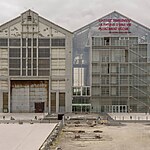
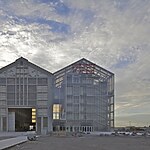
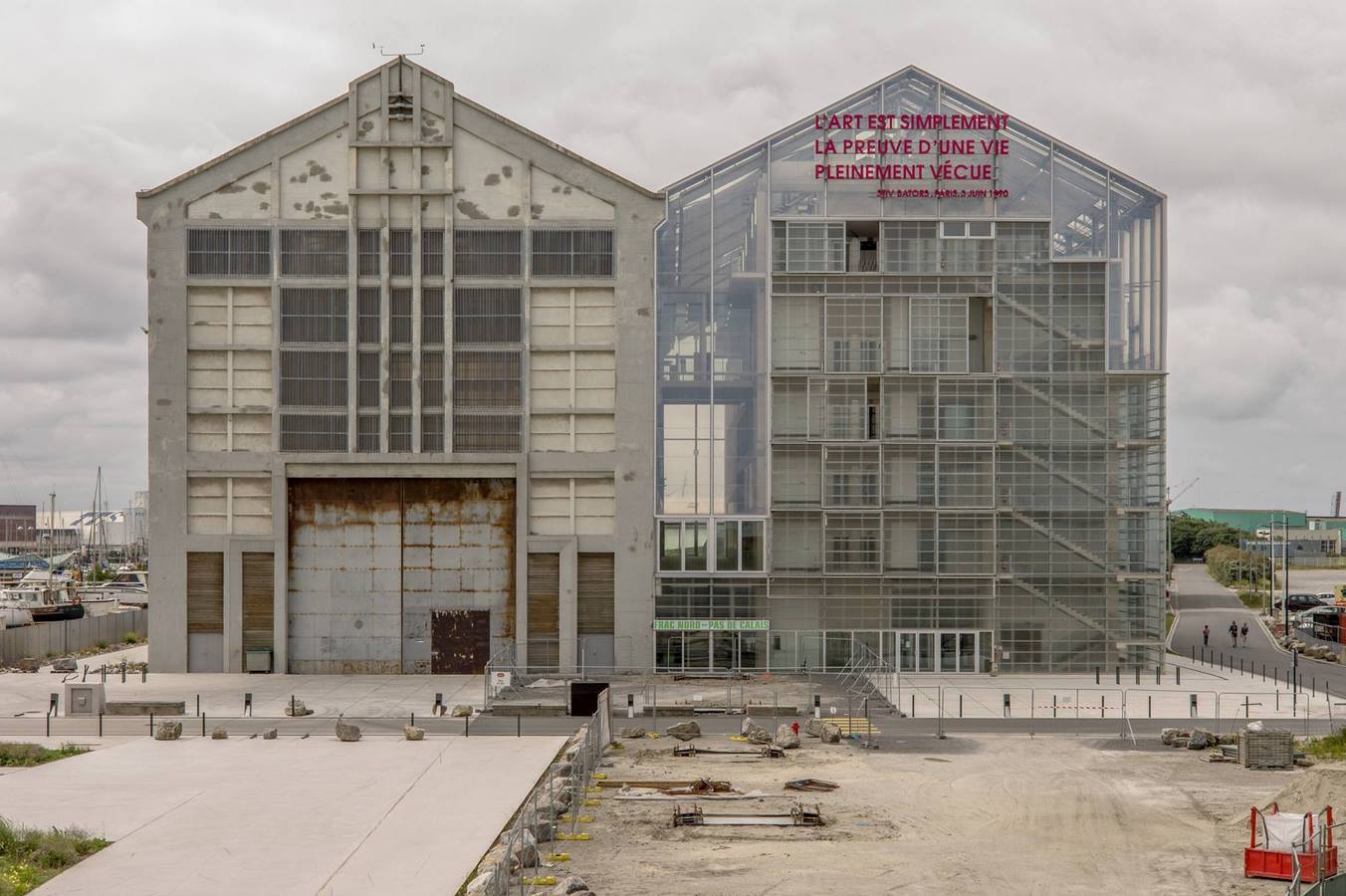
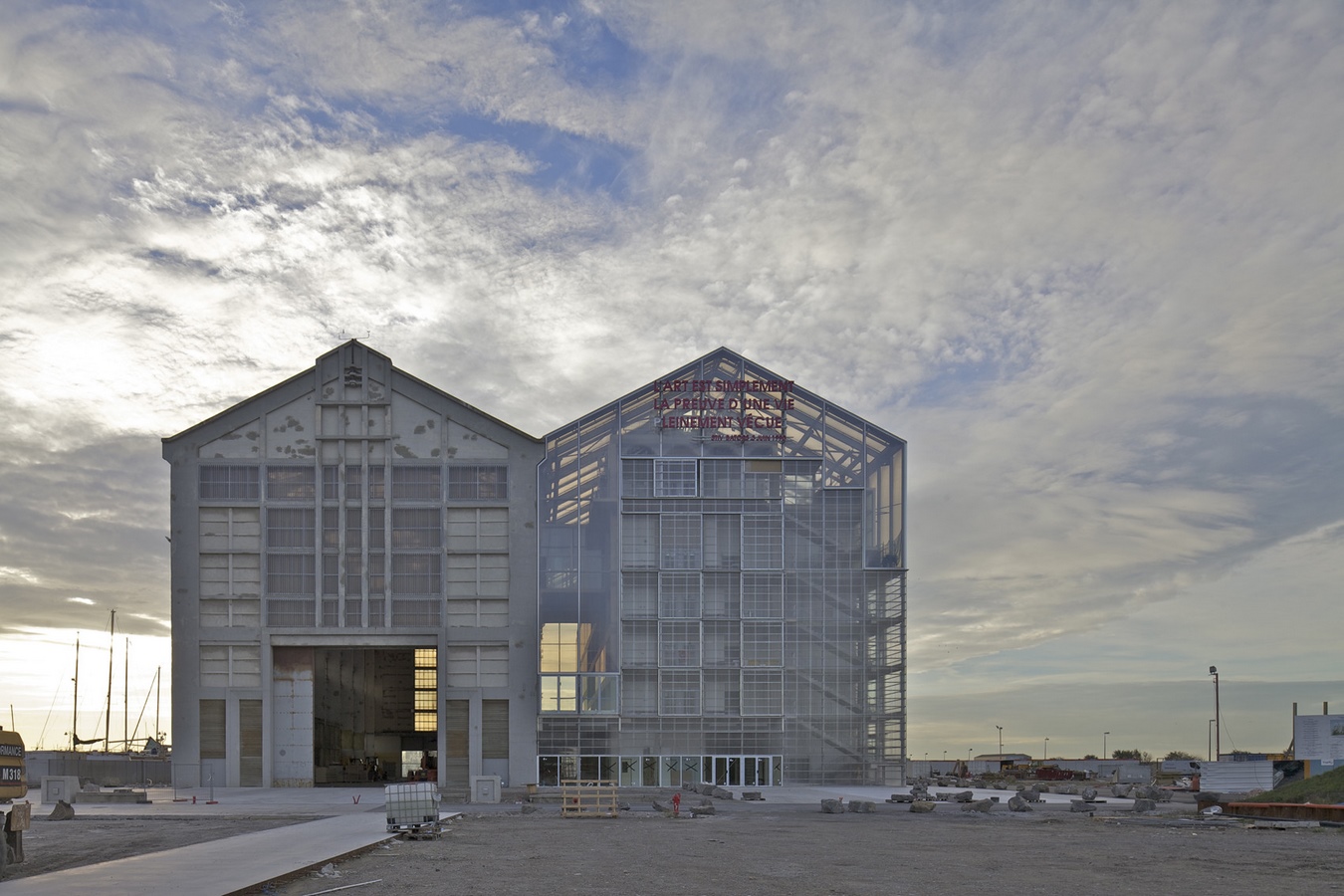
Catrica, P. (2013). The FRAC (Fonds Régional d’Art Contemporain) designed by Lacaton & Vassal, is a cultural space that defies traditional architectural conventions by combining innovation, economy of means and a profound sensitivity to its industrial and landscape context. Located in the port city of Dunkerque, France, the project integrates a former 20th century shipbuilding vessel with an adjacent contemporary structure, creating a dialogue between past and present.
Heritage is not neutral (…) Heritage is entirely political —Carlota Mir and Rado Ištok
Architecture’s relationship with historical periodisation extends beyond the material into the metaphorical and the media. Traditional models of recording history have taken a materialist stance, cataloguing and archiving the built within timelines according to the dominant modes of production in each period. An entire chronology of space has been mapped from its invention, multiple resurgences, crises and adaptations, drawing a cartography around the productive forces and relations that propelled the construction of representative architectures. (Durelle and Toti, 2024) Alternatively, the use of metaphors, especially in writing, has mobilised a second layer in the storytelling of history to serve a more melancholic, heroic and sometimes critical ends, calling into play the idea of a historical temporality with a certain angle on technology, politics and the aesthetic machine, and whose evidence emanates from photographs, magazines, films and any reproducible media that rely on the visual. (Colomina, 2019) Architecture may be one of the most effective vehicles for visiting the canon of human history, precisely because its material body, the meanings attached to its production and the media that circulate its representations have been attributed to cultural expressions and interactions, more so to identity and the commons, (Plowright, 2018) thus making possible an association in favour of a universal historiography where architecture and cultural heritage are recorded in a distant past, often romanticised, rather than in a thicker present where social values are dynamically projected out of standard.
What is preserved or authorised as heritage is usually associated with official cultural aesthetics and discourses, which have received sufficient attention to allow their documentation and historical development to be processed. Most iconic buildings are recognisable not only for their material value or pharaonic scale but also because many of these infrastructures are part of marketing projects. This condition is perhaps best demonstrated by the ‘Bilbao effect’, where a building has ceased to be an urban attribute and has become a ‘singular artefact’ of the economy, capable of positioning itself in a panorama of global references and whose propaganda makes it part of a capital gains market. (Aurtenetxe, 2018) More critically, what conservation initiatives are formulated for spatial projects linked to cultures and materials with little historiographical support, such as the Bedouin settlements in the West Bank or the urbanisms for peace developed by ex-combatants in Colombia, which are more prone to collapse due to climate change or political ideologies? or what mechanisms ensure that dozens of historically valuable postmodern architectures in London are not dismissed as ‘minor inconveniences’ by planners and developers whose arguments for ‘public benefit’ mask the loss of buildings that can still find a useful life through regeneration and refurbishment. (The Twentieth Century Society, 2019) What is at stake is the question of the value of the built and landscape heritage vís-a-vís contemporary modes of production, together with conservation mechanisms that go beyond maintenance or stylistic valuation and operate as a spatial practice centred on tangible and appropriable historical debts in the present, as well as notions of reuse, adaptation, retrofitting, and preservation of the experiential depth of space and the city. (Architectural Association School of Architecture, 2024).
As Virilio discusses in his concept of dromology, the control of reality by the accelerated passage of time, or chronopolitics, has created a phenomenon of widespread collapse of geographical and temporal distances. (Virilio and Polizzotti, 2006) This condition implies a change in the material perception, relative value and function of spaces, as new regulatory, commercial and political spheres are subjected to the stress of the future. The accelerated obsolescence of architecture, deterritorialisation and the crisis of permanence is cementing a culture of replacement via tabula rasa in which buildings, both historical and generic, are swept away and reconfigured in new territories for rapid and sometimes aggressive expansion. (Deleuze and Guattari, 1987). Added to this are the effects of climate change, economic fluctuations and the emergence of new infrastructures due to war enterprises, migration and extractive practices.
Rather than focusing on erosion, critical conservation adopts a narrative of replacement and reuse. What is lost or in danger of disappearing becomes a space for active participation and a place to rethink current conservation models. (El Hakim, 2017) This suggests a less subtractive attitude towards history, which acknowledges the thickness of the present as a valid temporality of classification, and the collage of experiences and new standards linked to cultural and political spaces as dynamics and traditions that transcend the division between the traditional and the modern, or the division between the past and the future. This challenges the conventional paradigms of architectural preservation, which often assume the timelessness of structures and uphold entrenched power hierarchies through top-down regulation. (Critical Conservation, 2024) This foregrounds the social, political, and cultural dimensions of heritage, revealing how architecture can serve as a place-making tool to counteract the “official” deployment of historical narratives.
Reference List:
Architectural Association School of Architecture (2024) Conservation and Reuse. Available at: https://www.aaschool.ac.uk/academicprogrammes/postgraduate/conservation-and-reuse (Accessed: 29 December 2024).
Aurtenetxe, J. (2018) ‘The «Bilbao Effect». An Exception Or A Way To Imitate?’, OBETS. Revista de Ciencias Sociales, 13(3), p. 317. Available at: https://doi.org/10.14198/OBETS2018.13.1.12.
Colomina, B. (2019) X-ray architecture. Zürich: Lars Müller publishers.
Critical Conservation (2024) Harvard Graduate School of Design. Available at: https://www.gsd.harvard.edu/master-in-design-studies-mdes-pre-fall-2021/critical-conservation/ (Accessed: 29 December 2024).
Deleuze, G. and Guattari, F. (1987) A thousand plateaus: capitalism and schizophrenia. Minneapolis: University of Minnesota Press.
Durelle, K. and Toti, A. (2024) Provisional theses, Historical Materialism & Architecture Research Group. Available at: https://hmarg.org (Accessed: 29 December 2024).
El Hakim, N. (2017) ‘Critical Preservation’, Decolonizing Architecture Advanced Studies. Available at: https://www.daas.academy/research/critical-preservation/ (Accessed: 29 December 2024).
Mir, C. and Ištok, R. (2018) ‘Undoing Heritage’, Decolonizing Architecture Advanced Studies. Available at: https://www.daas.academy/research/undoing-heritage/ (Accessed: 29 December 2024).
Plowright, P. (2018) ‘Extending Skin: Architecture theory and conceptual metaphors’, ARCC Conference Repository[Preprint]. Available at: https://doi.org/10.17831/rep:arcc%y552.
The Twentieth Century Society deplore the loss of Grade II* listed Richmond House – The Twentieth Century Society(2019). Available at: https://c20society.org.uk/news/the-twentieth-century-society-deplore-the-loss-of-grade-ii-listed-richmond-house (Accessed: 29 December 2024).
Virilio, P. and Polizzotti, M. (2006) Speed and politics. Los Angeles, Calif: Semiotext(e) (Semiotext(e) foreign agents series).