According to the World Economic Forum, the building sector accounts for 37% of total Carbon Emissions globally, due to the threat of the consequences of climate change it is vital to shift architecture towards a more sustainable construction model. In order for this to occur, architects require a higher level of awareness of the impact their work has on the environment. There certainly is a degree of expectation on today’s architectural projects to reach a level of sustainability, however, this expectation does not always translate into deliverance, instead, it often results in Greenwashing in Architecture.
The truth is sustainable design can be expensive, at least in a short-term period, meaning the incentive is low to make an effort towards sustainability. Furthermore, the education that most working architects have on sustainability is superficial and lacking, specifically taking into account the relevance it has nowadays. Thus, this results in projects being branded as sustainable when in reality they are not, at least not all that they ought to be. These are the main causes of Greenwashing in Architecture.
Certifications with no real guarantees

The concept of sustainability is vague enough to allow for misleading and superficial interpretations. Certifications are used to assign the degree of sustainability of projects. The issue with this is that certifications rely on broad generalizations instead of applying the local construction context of each individual project. This facilitates Greenwashing in Architecture since projects can appear ecologically conscious by applying simple general concepts without achieving long-term sustainability. As Adele Bilitardo claims in her article published by Archdaily “Greenwashing in Architecture: Identifying False Sustainable Strategies”: ‘While green roofs and solar panels offer many advantages, particularly in urban environments, they alone do not guarantee that a construction project meets sustainability standards. This is particularly evident when other critical factors like energy efficiency and the choice of environmentally harmful materials and construction systems are neglected.’
‘LEED (Leadership in Energy and Environmental Design) is the world’s most widely used green building rating system’. However, these certifications can be instrumentalised for Greenwashing in Architecture, according to the study carried out by Professor John Scofield of Oberlin College, buildings that are certified by LEED do not use significantly higher or lower amounts of energy that those without certification. Furthermore, Adele Bilitardo states that LEED’s ‘norms reward particular types of air conditioning, but not windows that can open. There are also points for bicycle racks or electric-car parking spaces.’ This permits architects to brand their projects with ‘green certifications’, even if the production process of the project has produced a disproportionate amount of waste, which should ban the project from ever being labeled as sustainable.¨
Sustainable buildings, the latest trend for Greenwashing tech firms

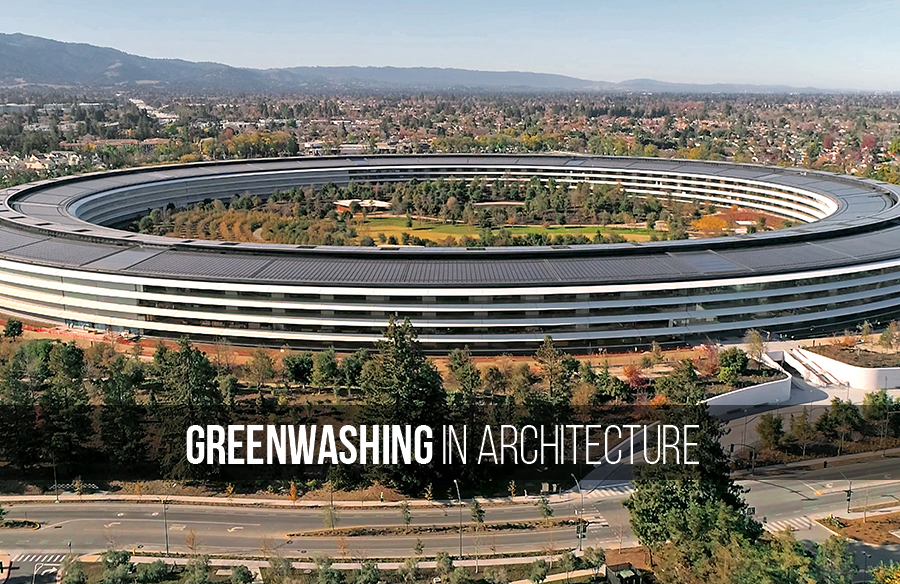
Norman Foster‘s new Apple Park has become an illustration of Greenwashing in Architecture. Apple is responsible for so much exploitation of labour, resources, and pollution. The figures are a mystery since Apple does not publicly release a comprehensive exact figure for its total annual resource consumption, including raw materials like metals and rare earth elements. Apple’s attempt to appear ecologically conscious by investing in a sustainable architectural project is baffling, the amount of carbon emissions saved by the project is simply a minuscule proportion of what Apple has already contaminated on a global scale. This exemplifies how sustainable architecture is greenwashing when it is used as an advertising strategy.
As Wade Graham a landscape designer and writer stated: ‘Today’s green urban dream is too often about bringing a technologically controlled version of nature into the city and declaring the problem solved, rather than looking at the deeper causes of our current environmental and urban discontents.’ The simple act of covering a building with vegetation is insufficient, architects must take into account the building process and the energy consumption of the building’s entire life span, to not do so and instead cover the project with superficial bushes, trees, and an occasional flower is what Greenwashing in Architecture looks like.
The system and institutions are failing
The capitalist economic system is built on the exploitation of resources, and it allows for companies to benefit from labour exploitation and unregulated markets from so-called ‘third-world countries’. No single architectural project covered in green areas, water fountains, and electric car charging stations is going to put a stop to the damage that is being carried out on what is left of the natural resources of the planet. Systematic change is needed on a global scale to properly tackle the climate crisis, in terms of the building industry it is up to people in power to bring about change, from local governments to international institutions such as the EU. Legislation that enacts change is critical, today’s mere expectation on architects and firms to become more sustainable is not enough and has permitted Greenwashing in Architecture to occur, delivering only a minuscule amount of progress.

Expanded Polystyrene is the most common material used as insulation and according to the European Commission, nearly half of 200 kilotonnes of annual EPS waste is landfilled, meaning it is buried under soil. This is particularly concerning since EPS produced before 2015 contains Hexabromocyclododecane an organic pollutant. To make matters worse it is very likely that most architects are unaware of this, EPS is so widely used, as it is excellent for insulation, specifically regarding its significantly low cost. This reflects a problem in the education system. Architects aren’t educated on the waste issues of the construction industry. Sustainability in architecture is mostly an afterthought, it is rarely taken into account from the origin of the design. Generally, the design process focuses on aesthetics and is limited mostly by economic factors, everything else remains secondary. Thus, to avoid Greenwashing in Architecture, sustainability must be tackled from the very root of the formation of architects.
Sustainability is not taught in university, at least not to the degree necessary to bring about change in the industry, educational institutions must take the leap into shifting the priorities of future architects, forming architects with a genuine interest in ecologically conscious design. Greenwashing is part of every industry, from agriculture to the makeup industry, sustainability is a label used without proper care, an advertising plot, and in architecture it is a façade hiding the unsustainable building industry. Tackling sustainability issues is of utmost importance since it is only a few who benefit from the commonplace superficial sustainability, yet it is all of us who have to gain from adequate sustainable architecture, and to reach this point Greenwashing in Architecture must be put to an end.
Olson, E. (2021). Plants on Rooftops: Greenwashing in Architecture. [online] Climate Review. Available at: https://www.theclimatechangereview.com/post/plants-on-rooftops-greenwashing-in-architecture.
Graham, W. (2016). Op-Ed: Are we greening our cities, or just greenwashing them? [online] Los Angeles Times. Available at: https://www.latimes.com/opinion/op-ed/la-oe-graham-folly-of-green-buildings-20160306-story.html.
Worldcrunch. (2016). Greenwashing Architecture? The Myths Of Sustainable Buildings. [online] Available at: https://worldcrunch.com/green-or-gone-1/greenwashing-architecture-the-myths-of-sustainable-buildings.
Belitardo, A. (2023). Greenwashing in Architecture: Identifying False Sustainable Strategies. [online] ArchDaily. Available at: https://www.archdaily.com/1008813/greenwashing-in-architecture-identifying-false-sustainable-strategies.
webgate.ec.europa.eu. (n.d.). LIFE 3.0 – LIFE Project Public Page. [online] Available at: https://webgate.ec.europa.eu/life/publicWebsite/project/LIFE16-ENV-ES-000258/expanded-polystyrene-sustainable-recycling-from-eps-waste-to-food-contact-ps-final-market.
USGBC (2020). LEED Rating System. [online] USGBC. Available at: https://www.usgbc.org/leed.