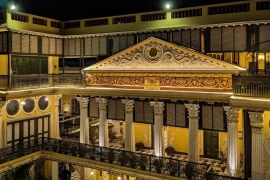
Complementary contrast while framing the time.
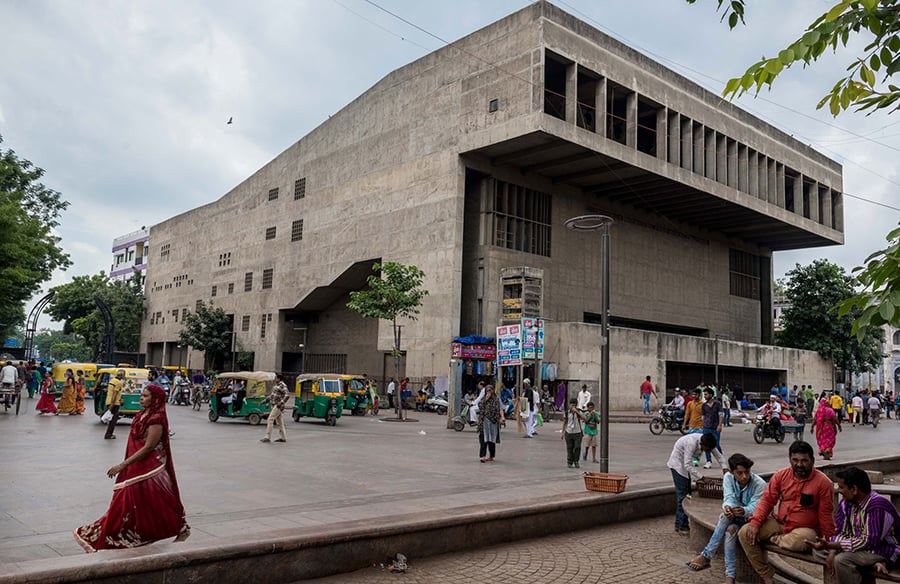
Premabhai Hall was designed by B.V Doshi and was constructed post-independence in India when rapid change took place to forge its independent identity and architectural expression. Modernism, material honesty, exposed structure, and practicality were prioritised over ornamentation by architects such as Louis Kahn and Le Corbusier, who left their stamp on notable constructions like the Mill Owners Association Building and IIM Ahmedabad. However, in the centre of Ahmedabad, where historical echoes could still be seen throughout the walled city, a brutalist public building had a significant influence on the architectural language and style. Premabhai Hall, an iconic example of brutalist architecture designed by B.V. Doshi in 1976 that represents the newly independent India, is now only a monument after it was closed in 1997 because of financial difficulties and fire safety regulations.

The juxtaposition while respecting the context
Bhadra Plaza, as its name suggests is enclosed by Teen Darwaja, Lal Darwaja, Bhadra temple, Bhadra fort, Parsi Galli, and Premabhai Hall each representing their period of existing thrives as a busting market throughout the year forms the socio-financial centre of Ahmedabad. To fulfil the need for art, culture, and theatre, Gujarat Vidhyasabha commissioned B.V. Doshi for a theatre hall of 1000 seating capacity at the heart of the 600-year-old walled city of Ahmedabad that would gel with the urban fabric as an important social and cultural hub.
“The question was can we really build something new alongside these monuments, and if so, what should be the nature of our design ..?” – Doshi, 1979.
From an egg-shaped lattice structure hovering in the square to the stepped cantilever part reaching out towards the main plaza seen today, Premabhai Hall’s architecture has undergone numerous variations since 1958. Proposed adjacent to historical buildings, the hall had to be humble yet monumental and not overbearing to the existing context.
Rather than attempting to blend in with the fort’s traditional architecture, the hall creates a contrast that emphasises modernity while coexisting with heritage intending to be a modern counterpoint to the city’s rich architectural heritage through its bold, minimalist design, reflecting the city’s journey from its historical roots to its modern aspirations. Doshi’s vision for the hall was not just as a functional space but as a social hub for the people of Ahmedabad, where art, culture, and community could converge, a key aspect of respecting the context in a city where public spaces play a vital role in social interaction.
The main hall is elevated above street level, hence, its lower level facing Bhadra Plaza is both accessible and inviting. Today, the hawkers and street vendors have their stalls there starting from teen Darwaja to Lal Darwaja contributing socio – economic space.

Brutalist architecture
Brutalism places a strong emphasis on functional design and stark, exposed shapes. Premabai Hall’s exterior is dominated by bare concrete, giving it an austere, unadorned appearance. Despite being straightforward, the facade gives off an air of solidity and strength. Large, wide spaces are purposefully built for practicality rather than ornamentation in the minimalist interiors. The Brutalist ethos of honesty in materials and construction is reinforced by the exposed structural features, such as beams and columns, which are part of the overall style.

Dialogues through staircase
Premabhai Hall’s steps are a unique architectural element that accentuates the massive and geometric qualities of the structure. Their crisp definition and angular shape accentuate the geometric aspect of the entire edifice. The external staircases break up the monolithic concrete mass and provide dynamic visual movement when viewed from the exterior. They give dynamic and visual complexity by contrasting the hall’s horizontal massing. The stairs are more than just functional features; they are integral to the building’s architectural identity.
V. Doshi integrated these dramatic stairways into the exterior, creating a means of access and a layer of dynamism between the building and its urban context. They stand as a testament to Doshi’s ability to combine functionality with sculptural form, making them an iconic feature of Premabhai Hall.


Light and shadow game


The contrast between solid walls and voids is a critical part of the building’s aesthetic, creating an interplay of light and shadow, particularly with the large, angular openings. Premabhai Hall in Ahmedabad is a unique architectural masterpiece designed to maximise natural light and airflow. The building’s exterior is solid, but large windows and openings allow sunlight to filter into the space, creating a dynamic interplay of light and shadow. The design considers the hot and dry climate of Ahmedabad, and Doshi’s approach to architecture is evident in the interior. Natural light filters through windows and open spaces, creating a soft, diffused light contrasting the structure’s solid, heavy form. The minimalist, utilitarian feel of the interior is further enhanced by the beams and columns.
Design elements

The Premabhai Hall in Ahmedabad is a rugged, industrial structure that uses concrete’s thermal mass to regulate its internal temperature, making it functional in the city’s hot and arid climate. The building’s design incorporates deep overhangs and recessed openings to protect the interior from the sun and allow light to enter without excessive heat gain. The use of thick concrete walls helps moderate indoor temperature, absorbing heat during the day and releasing it at night, allowing the building to cool naturally. The orientation and design of the building takes advantage of natural ventilation, minimising the need for mechanical cooling systems. The interior is minimalist, with wide, open spaces reflecting the principles of Brutalism on the exterior. The 20-foot cantilevered library acts as a frame for the adjacent Bhadra fort. Cantilevered sections create drama and architectural tension, while the public plaza in front encourages social interaction and civic engagement. The design reflects Doshi’s belief in creating civic spaces where people gather and engage with their community.

Premabhai Hall’s exposed concrete needs periodic maintenance to avoid degradation, just as many other Brutalist structures. The preservation of the building has faced obstacles due to weathering and structural problems. Premabhai Hall stands as an example of how architecture can blend cultural heritage with modernity. Its importance extends beyond its physical structure, serving as a place for community bonding and cultural celebration. It reflects a spirit of modernity, progress, and a break from colonial and traditional styles of architecture. The hall embodies the values of self-reliance, industrial growth, and the ambition to create public spaces for intellectual and cultural advancement.