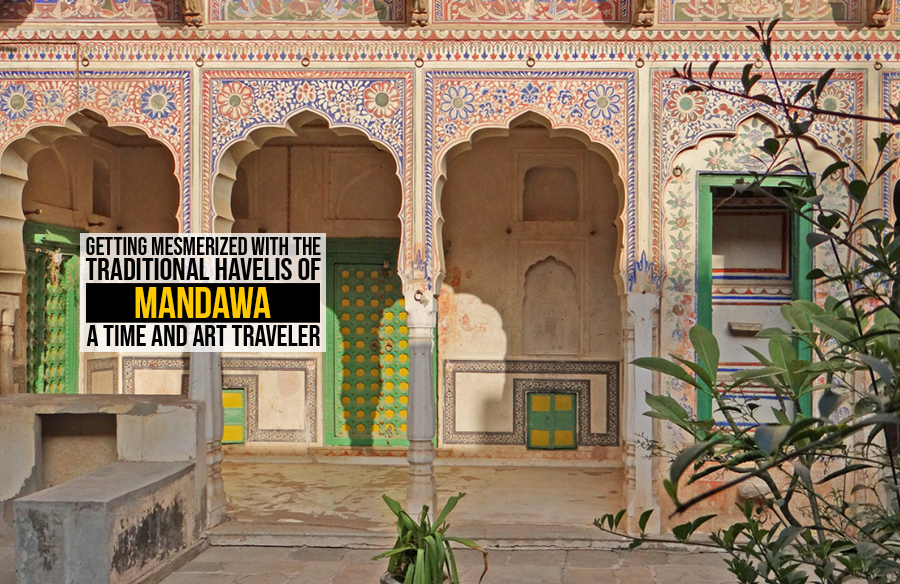
Shekhawati, India’s largest open-air art gallery, stands right in the middle of Rajasthan. This vast landscape, therefore, replete with art, makes one feel the aroma of hundreds of intricately painted havelis, temples, and cenotaphs carrying their stories and customs in the broadest murals spread over centuries. These architectural treasures were given to the world by a volume of Marwari merchants who amassed fortunes the same way as trade. Fabulously vibrant, steeped in the history of yester years, the havelis of Mandawa and the Shekhawati region are pulsating canvases of art and culture.
A Canvas Like No Other

The traditional mansions of Shekhawati, or havelis, trace their starting point back to the merchants-businessmen from the Vaishya and Agrawal communities who gained their wealth through the trade of opium, spices, and textiles.
This richness did not remain confined to the vaults or material achievement. It was architectural glory, and every haveli turned into a home-cum-testimony of your success. But, much as their beauty lies in the majesty of these imposing facades, true splendour of those havelis tells a different tale altogether. It lies within, on the walls, where rich tradition meets the-To perpetuate Shekhawati fresco paintings.
This stretches over a stretch of more than 100 km, with thousands of buildings donned with coloured vibrancy depicting vibrant murals covering the region. They paint diverse themes, ranging from myths and folklore to daily life features, including paintings of Indian gods Krishna and Shiva, Lakshmi, and scenarios of Ramayana and Mahabharata along with pictures of festivals like Holi and Gangaur.
The technique of the paintings themselves is a wonder; artisans used natural pigments like kesar and kajal that have survived the test of time with colours so vibrant.
Mandawa: The Pride of Shekhawati

On a visit to Mandawa, one finds a one-time market town jewel, strung with havelis echoing a bygone era of where wealth converged with art. Two of the grandest examples are the Gulab Rai Ladia Haveli and Murmuria Haveli, whose frescoes sport colours speaking of myth, history, and even modernity. Over there stands sprawling Mandawa Fort, which used to be a critical trading post but is now a hotel—a living reminder of what the town used to be, prosperous.
Time does not change in the walled city of Mandawa. Wandering through narrow Bustling streets and frescoes transport you to the world of 19th century India, curiously interwoven with symbols of European Motor cars, Gramophones, and even British officers. Witness a demonstration of cultural exchange that silently shaped this region. But time changes nothing in frescoes: vivid and their stories so true.
Nawalgarh-A riot of Colours
While Mandawa could be the heart of Shekhawati, Nawalgarh is its pulse. This busy town has a sprawling marketplace surrounded by well-planned architecture. Going through the kaleidoscope of painted havelis is a huge sensory overload in this very town. A few examples are Murarka Haveli, Roop Niwas Kothi, and Dr. Ramnath Poddar Haveli with frescoes that range from religious depictions to intricate geometric designs.
This haveli itself is a museum that belongs to Dr. Ramnath Poddar, having more than 750 frescoes on its walls displaying the beauty of Rajasthan in its art and culture. Roop Niwas Kothi, as one may say, is affectionately also called the Horse Lovers’ Paradise-abandoning one back in time when royalty and elegance ruled the day. It is too easy to get lost in the stories these walls will tell you with such an imposing structure and beautifully restored murals.
The Art of Shekhawati
Art lies at the nucleus of Shekhawati’s charm-a uniqueness interfacing Rajput with Mughal. The havelis were a sort of visual diary detailing life, belief, and aspiration regarding the merchant families who built them. Frescoes of early times were dominated by geometric designs and floral motifs; later works were much more expressive, dealing with tales from mythology coupled with chronicling life in the Rajput courts. Repetitive sequences of the themes of folk mythology and Krishna Lila started to appear in the Ragmala paintings, but with time, these walls started narrating new stories. The British invasion left their marks on them, and images of motorcars and aeroplanes and even women from Europe carrying gramophones started to appear. Fresh coats in Shekhawati frescoes started looking like a mirror to the world beyond. Indeed, striking details capture both tradition and change in storytelling.

Preserve a legacy
The government, along with other such organisations, have been working to save what was, indeed, a considerable art heritage of Shekhawati during these years. The Jawahar Kala Kendra at Jaipur and the National Crafts Museum at Delhi house Shekhawati paintings for a wider section of the audience.

But steps taken thus far are not enough to save these fragile works of art, whose fate still appears to hang in the balance. You feel that you’re not just witnessing history through walking on the streets of Shekhawati but are being part of it. More than buildings, the fading frescoes in the facade of these havelis enclose stories that are awaiting narration, rest etched in stone.
The Enchantment of Traditional Havelis
From the Aath Haveli complex in Nawalgarh to the Sone Chandi ki Haveli in Jhunjhunu, these havelis do form a bequest of art on their own in Shekhawati. Almost every small town of Shekhawati narrates a new story and provides a new perspective and way to experience the art of this region. Be it the royal Alsisar Mahal now housing the celebrity-studded Magnetic Fields Festival, or the serene beauty of Ramgarh Fresco Hotel, Shekhawati promises to be a feast for all senses for every art connoisseur.
More than history, such painted havelis are the soul of Rajasthan: a place where art and culture are made to sell and buy the miracles that are in front of us. It is in the delicacy of the strokes of the brush, in the saturation of colours, that heritage lives in these murals; it shines as a gleam, reminding of what has been brought into this world, as it forward would seem to roll perpetually. Almost as if in Shekhawati, art was not viewed but lived and breathed in. The pale frescoes and beautiful structures of the havelis open you up to a world where stories are painted on walls, and where history as much belongs to the present as it does to the past. So, in case one finds themselves in Rajasthan, well, there is that detour toward the havelis of Mandawa. You will leave, not with memories, but with stories etched into your soul.
References:
Guru, R., Yadav, P., & Saini, U. (2023). Studies on traditional heritage in Shekhawati Havelis and wall Painting: Creative design. ResearchGate. https://www.researchgate.net/publication/371954588_Studies_on_Traditional_Heritage_in_Shekhawati_Havelis_and_Wall_Painting_Creative_Design/link/649e4fca8de7ed28ba64b5e1/download?_tp=eyJjb250ZXh0Ijp7ImZpcnN0UGFnZSI6InB1YmxpY2F0aW9uIiwicGFnZSI6InB1YmxpY2F0aW9uIn19