

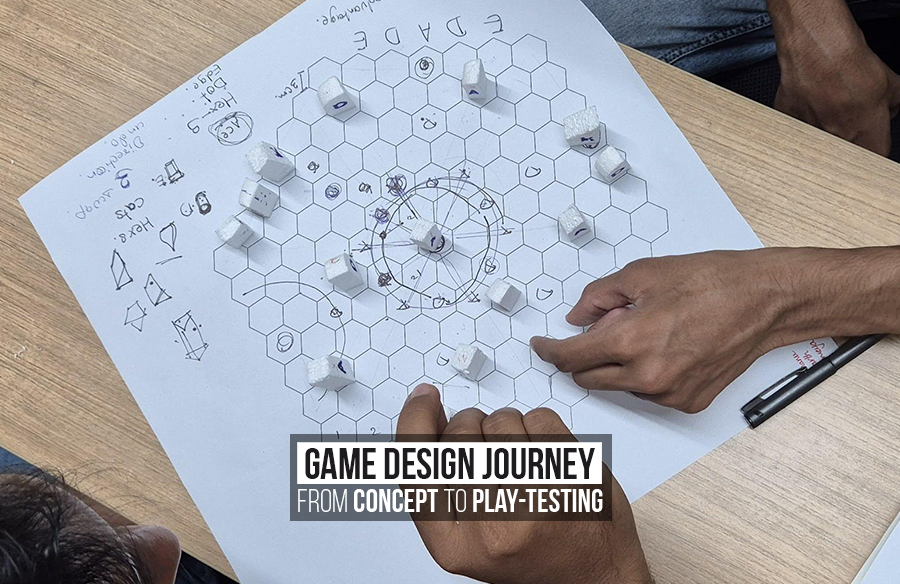
Game designing is cool because of the combination of creativity, strategy, and testing involved. In the recent project, three of us, plus a couple of juniors, took up the challenge of designing a new board game inspired by traditional games such as chess and UNO. We wanted to make a strategy-based game with the familiar elements of competition but with a fresh twist: hidden moves and unpredictable outcomes.

Inspiration
Our design journey began with a concept from chess wherein gamers are allowed to see their opponent’s moves and strategize accordingly. It is this aspect of transparency in chess that allows the opponent to gauge and anticipate his opponent’s next steps. This is a strong point in chess, but at the same time, it puts a limitation on adding more excitement to the game. So, we decided to incorporate an element of surprise into our game. Whereas all the pieces would normally be visible at all times, they would otherwise remain hidden from the opponent; hence, this makes a game of uncertainty and strategy. This led us toward a more engaging and less predictable experience of gameplay.
Another game we drew inspiration from, aside from chess, was the classic card game of UNO, which introduced us to the use of chance and its associated unpredictability. Taking these influences together, we aimed at a game that would require players to think well in advance but also to handle fateful situations, thereby making it accessible to a broad category of players.
The Design Process

One of the first important decisions to be made in designing our game was the shape of the board. We did a lot of playing around with designs, including a circular board that didn’t feel quite right. When a few ideas had been thrown around, we settled on a hexagonal layout: the board would comprise 127 hexagons in rows of seven, creating an intricate, modular pattern that gave the game a unique structure and allowed for interesting movement patterns. This hexagonal structure was not solely for aesthetic purposes but further impregnated into the movement and strategy involved in the piece. It gave more flexibility in terms of movement, allowing different tactics than one can achieve with a traditional square grid.
Continuing with that tradition of fusing tradition with innovation, we decided to “Indianize” the game. Each player had five pieces named after major elements in Marathi culture. These names brought into view not only the cultural base of this game but also the depth and character of each piece, making it more meaningful for players. Pieces included:
- Shree – The king, which moved circularly, missing the first adjacent hexagon. Being the most important piece on the board, Shree’s movement needed much consideration, and its position is vital in both offence and defence.
- Kon: This is the most mobile of all pieces, which moves diagonally from corner to corner, up to two steps at one time. Because of that, it easily can range over most of the board and can therefore be both a strong tool and an easy target for opponents.
- The direct movers, Rud move only in straight lines but can go up to two steps. Though less mobile than Kon, the piece was strong regarding the control of given pathways and blocking opponents.
These unique movements added depth to the game and also correlated with the cultural naming and their significance in Marathi, hence making the game more interesting and relevant.
Making the Game Realistic
Since we wanted to give this game a realistic perspective, we decided to make the board of the jute fabric to give it that Indian feel and look. Jute is a natural, eco-friendly material, and for the game board, it placed the design in Indian culture. However, we quickly realised during the design process, that would make for some frustrating gameplay when a person does not have an easy time keeping track of their moves on a hexagonal grid. The lines between hexagons needed to be quite visible so as not to confuse and assure a smooth run of play.
To make it, we coloured the board and added distinctive border lines in two different colours to clarify the pattern of movement and make it easy to follow. Besides giving an attractive look to the game, the functional aspect came from there: players would not mess about with some relatively confusing layout but rather be able to pay attention to their strategic game.
The following are some key elements that we added: cards. Whenever one piece captures another, the player draws a card from one of several cards placed randomly on the board. Cards fall into two categories: advantageous and disadvantageous. An advantageous card entitles a player to tell their opponent in which way to move, while a disadvantageous card requires a player to make a compulsory move. Thus, it added an element of luck and strategy to the game quite effectively.
Testing and Refining
We titled the game Shut Cone, a derivative of the Marathi word for hexagon. Of course, it wasn’t all smooth sailing. First, we tried the game amongst ourselves; it was then that we realised how continuous the testing of the game needed to be to refine rules and board balance. Every time the game was tested, we changed the rules and gameplay to better it further. This was a well-deserved iterative process to create a wholesome game.

Testing of our game began with our group and extended to professors and external players. With each new test, something important concerning the game was revealed. We initially came to realise that the size of the board needed to be adjusted. It needed to be large enough for pieces to move around on, but we didn’t want it to overwhelm a player so that he or she would be able to handle it. So, we reduced the number of pieces and sizes of the board until we found just the right balance where strategic movement felt challenging without frustrating you.
Also, the card system needed tuning. The advantage and disadvantage cards were supposed to add variation, but the probability of those was something we had to adjust so they would not overpower the game’s strategic aspect. We polished the rules, making the effects of cards balanced and such that both players had equal chances of winning.
In these rounds of tests and re-factors, we picked up important lessons on the need for flexibility when designing games. Certainly, the plays showed that testing was an indispensable process in wringing out areas that could present problems and enhance overall performance.
Final Thoughts
Last but not least, Shut Cone is not a lucky game but a highly strategic one, drawing heavily from the Indian board game tradition with new mechanics to keep the modern player in mind. The combination of the hidden moves, the unique hexagonal board, and the card system creates a game where both skill and luck come into play in determining the winner.

Through this process, we took away valuable lessons, such as how game design is not just about having a good idea but rather testing, adjusting, and improving that idea over time. It has deeply engraved in us how to create appealing, provoking games that could give players something both familiar and new at the same time. This has been a very satisfying process because at the core of our game designing was to drive ourselves to think out of the box while retaining contact with our native roots.







