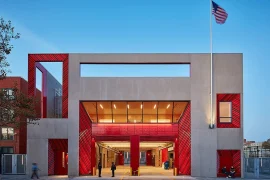
The Parish Church of Santa Monica is located in Rivas-Vaciamadrid, Spain. A parish is an area or district that has its church and priest. A parish church serves as a religious centre for the town. It may also host social and cultural events that represent the locality. The premises may be used in small villages for personal or non-religious activities.

The Proposals
The Parish church of Santa Monica was designed by Vicens and Ramos Architects, and completed in 2009. The one that has been materialised is their third proposal. They have expressed the shame of the first two proposals getting rejected. According to the architects, the first two proposals were more interesting from the perspective of the public worship norms of Vatican II. They claim their first proposal to be the best despite the difficulties faced due to the shape of the site. The site is located on a corner of a junction having a curved edge on one side. In shape it is longitudinal and narrow, thus restricting the built form to a long rectangular plan.
The first proposal was inspired by the Roman temple of Sant’Andrea al Quirinale designed by Bernini., where the floor plan is an ellipse and the minor axis(shorter axis) houses the entrance on one extreme and the altar at the other. The seating of the worshipers is along the length of the major axis(longer axis) placing the altar right in the centre. The concept is to have worshipers in a central rather than a directional layout of worship. This proposal was rejected due to the requirement of having to build a maximum of the buildable area on the site. Also, the bishopric wanted a clear directional building to maximise the built-up. The architects claim this as one of their failed projects where they were unable to convince.
As per the above requirement, the second proposal was done in concrete, which was discarded due to a lack of finances. Due to budget issues, the concrete proposal was not materialised and architects had to opt for materials that would fall into their budget along with providing a directional building serving best to the given site. Finally, the third proposal that we see today is built. The material used is corten steel.
The Final Proposal

The site has two buildings unified into one. One building is the church and the other one houses administration and accommodation for the priests. Though it is a continuous building connected throughout along the longer axis. The ground floor has a church, a classroom, and offices. The upper floor has two apartments with three private bedrooms, bathrooms, a pantry, and a living room.Image 3_Ground Floor Plan_©Vicens+Ramos


The end of the church facade explodes into skylights in different directions. This expression makes it the most striking feature of the building and also demarcates the altar. These skylights bring light from different directions, providing a unique play of light inside. This is also symbolic of the emergence of ground and sky, and matter and light. The way skylights open up to various angles and directions traps the light inside which is again symbolic of the gift of light to matter. The structure is of metal with corten cladding and plasterboard lining.


The architects involved many artists. José Manuel Ciria painted a mural in the chapel of the Blessed Sacrament which shows the creation of the world. Javier Viver has done images of the Virgin and Saint Monica. José Luis Sánchez has done the Crucifix. The Via Crucis is done by José Antonio Ramos, made with fourteen different crosses treated with painted bandages. Javier Martínez has done the sculpture of Christ in the sacristy. Fernando Pagola painted the main altar, ambo, seat, and baptismal. These artists have been generous enough to give away their work without charging any fees is one of the things that makes this church special.

The interior colour scheme is such that it gives an expression of the horizon. The black granite used for flooring and walls to a certain height makes a clear fine edge with white walls above it with window slits. By painting both side walls and ceiling white, a focus is created on the yellow altar highlighting its feature sculptures and the box skylights. This composition makes the environment feel sacred.

The fine and straight clear geometrical shapes and lines represent the discipline of a sacred space. Again, the colours and volume of the space offer minimal distraction, offering one the opportunity to become centred.

The project faced many difficulties and challenges starting from the kind of site which was given, the directional built form requirement to the limitation of the budget. Despite all the hurdles, the hard work of the design team, the support of the priest and vicar, the generosity of the artists, and the support of the parish community have made the project come alive and stand tall. This project is an example of the reality of architectural practices. Despite the efforts and best proposals, architects fail to convince the clients of their goods, and many times well-thought designs don’t come alive, falling short of budget.
This project also shows the ability of designers to make the best out of their limited resources and turn limitations into opportunities. If it wasn’t for this particular site and a small budget, this project wouldn’t have turned out the way it has turned out as an example of unconventional sacred architecture style.
References:
Sant’Andrea al Quirinale – Data, Photos & Plans (2020) WikiArquitectura. Available at: https://en.wikiarquitectura.com/building/santandrea-al-quirinale/ (Accessed: 18 August 2024).
Arquitectura Viva (2020) Centro parroquial en Rivas-Vaciamadrid – Vicens & Ramos , Arquitectura Viva. Available at: https://arquitecturaviva.com/obras/centro-parroquial-en-rivas-vaciamadrid (Accessed: 18 August 2024).
Juan Antonio Rueda Lucio, A.S.F. (2019) Iglesia parroquial en Rivas Vaciamadrid – Vicens & Ramos: Estudio De Arquitectura, Vicens & Ramos | Estudio de Arquitectura. Available at: https://vicens-ramos.com/es/estudio/arquitectura/catalogo/obra/iglesia-parroquial-en-rivas-vaciamadrid/?r=L2VzL2VzdHVkaW8vYXJxdWl0ZWN0dXJhL3Bvci10aXBvLz9maWx0ZXJfdHlwZT1hcnF1aXRlY3R1cmEtc2FjcmE (Accessed: 18 August 2024).
Vicens + Ramos, Pablo Vicens · Parish Church of santa monica, Rivas Vaciamadrid. Madrid, Spain (no date) Divisare. Available at: https://divisare.com/projects/310137-vicens-ramos-pablo-vicens-parish-church-of-santa-monica-rivas-vaciamadrid-madrid-spain (Accessed: 18 August 2024).