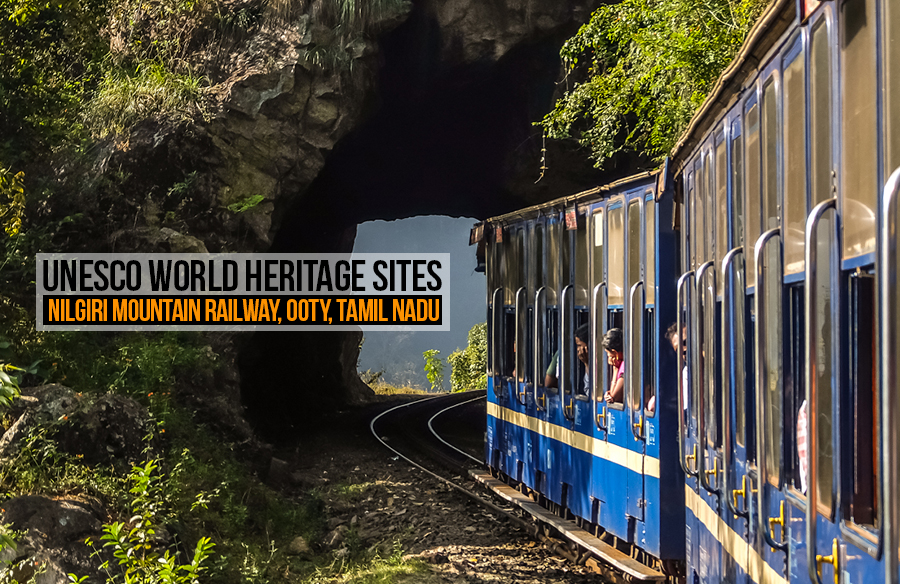
The Nilgiri Mountain is a spectacular range of mountains, standing as a mammoth landmark in the diverse landscape of Indian geography. These mountains have rightfully become part of the UNESCO World Heritage sites because of their lush picturesque beauty and the way it seamlessly connects the hill station of Ooty (Udhagamandalam) through the railways travelling over rough terrains. It provides a snippet into the beautiful backdrop of the Nilgiri Hills and the Hill Station of Ooty. The Nilgiri Mountain Railway was declared a UNESCO World Heritage Site only in 2005 along with “Darjeeling-Himalayan Railways” and “Kalka-Shimla Railway” becoming a part of the group known as the “Mountain Railways of India”

Tamil Nadu’s Rich Architectural Heritage:
Since the beginning of the colonial era, a vast landscape of the Madras presidency has witnessed the colonial architecture of the time, which has since been preserved and maintained. These architectural marvels stand as a testimony to the region’s colonial past. The NMR was also one of them representing the colonial architectural influence, and Ooty in particular also adds to the vintage charm of the era that has gone.

History and Construction of the Railways:
The Nilgiri Mountain Railway is an engineering marvel of its time and even today, it reminds us of how the engineers might have carved out pathways through a lush and dense forest, traversing inclines and creating numerous bridges, tunnels and viaducts. Construction of the railway mountain began in 1891 during the British Raj with the proposal being of a – 46 km long metre gauge single-track railway. The construction took more than a decade to complete in 1908, scaling an elevation of 326m to 2203m. The intended purpose of constructing the railway mountain was to connect the lowland of Mettupalayam to the hill station of Ooty, providing a route and a scenic journey for the visitors. At the time Britishers wanted a place to relocate to, to beat the scorching heat in the south of India as they belonged to a colder climatic region, Hence it became important to set up a Summer retreat for them nearer to the Madras Presidency.
One of the remarkable accomplishments of the construction was the “Rack and Pinion System” to overcome the steep slope, which made this mountain railway stand out. In the Rack and pinion system, a toothed rack is mounted between the running rails and a Cog (Pinion) is provided on the locomotives to contain the grip. The Nilgiri Mountain Railway is the only Indian railway that uses the Rack and Pinion system.

Storytelling In The Mountains:
The Nilgiri Mountain Railways became a picturesque backdrop setting for many Indian Storytellers and Movie makers, which provided a scenic glimpse into the mountains. One of the popular songs “Chaiyya Chaiyya” from the Indian Movie – Dil se, is shot on one of the locomotives of the Nilgiri Mountain Railway, the song also captures the essence of darkness in the viaducts and the train coming out to bright light which is a remarkable experience to witness while on the actual train journey. The NMR became a part of many movie shoots, and continues to be considered for its beautiful backdrop. Many other popular films like Sadma, Barfi etc, had also been shot in the NMR. The beauty and the mammoth backdrop of the mountains transformed into culminating points for many storytellers in their movies.

Conservation And Relevance Of The Railways Today:
The fact that UNESCO in 2005 has given recognition to the Nilgiri Mountain Railway makes it more relevant for conservation practises to be adopted for the architectural marvel. This recognition aids in the support internationally and also helps in its funding for maintenance and conservational requirements. There have been continuous efforts to ensure the operational efficiency of the railways by the government as well as to retain the historical authenticity of the place and thereby also aid the tourism sector.
The Nilgiri Mountain railway today has become a significant tourist attraction not just for the locals but also overseas, because of its engineering marvel and the experience of the journey through the train taking us back to the olden days. Travellers who visit the place would want to experience this journey by train to experience and feel the nature, and vintage vibes with a backdrop of lush green mountains and a chilling climate. It takes one back to a world which existed in the past.

There are few places in the world, which transform a journey into an experience. These places sometimes need to be given their due diligence. The Nilgiri Mountain Railway is an exceptional journey that transforms something within. It stands as a bridge between the past and present and makes the visitor experience something magical yet surreal.
Citations for websites:
- UNESCO World Heritage Centre(2005). Mountain Railways of India. [online]. Available at: https://whc.unesco.org/en/list/944/[Accessed 23 May 2024.]
- Indian Railways Fan Club. Nilgiri Mountain Railway.[online]. Available at: https://www.irfca.org/docs/nmr.html