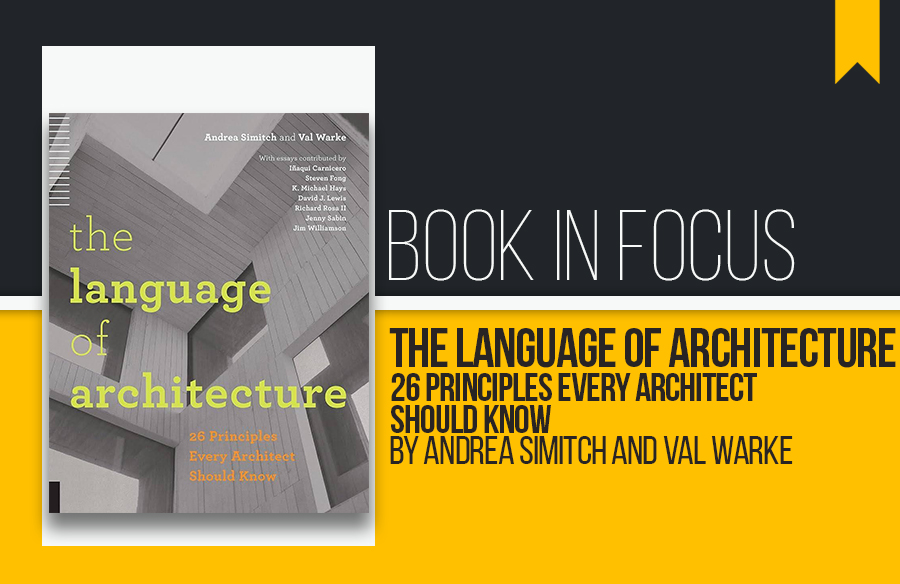
The Language of Architecture 26 Principles Every Architect Should Know by Andrea Simitch and Val Warke is a book with 26 Topics with separate representations that describe the design and its process, it’s a very clean and neat book for beginners as well as for well-known architects, it consists of visual representation as well one who doesn’t like to read can see the pictures and understand as well and one who doesn’t have any knowledge about architecture and design can have the idea of the design and interprocess everyone with subtopics with a perfect explanation of why, what and how. This L of architecture is recommended for students who are interested in this design field it will be a better foundation for knowledge as well. The authors Andrea Simitch, and Val Warke wrote this book for both professionals and common people, Andrea Simitch was an educator and an architect and Val Warke was a professor they both had a concept of perfectly explaining architecture through their language with a concept of 26 – alphabets which is the base for the English language like that they depicted their topics in 26 and their language of architecture.

The First 13
Andrea Simitch and Val Warke explained in detail for better understanding and here is the brief that goes through the 227 pages in 8 minutes.
1.Analysis
Analysis what is the design, and what happened is the first step in every process analysis of past projects gives more clarity on how it evolved, and the interpretation gives more knowledge than creating something new.
To know more about the structure, circulation, exterior spaces, minor and major spaces. In this part, diagramming is a crucial thing which discover more ideas and knowledge.
2.Concept
Concept is the core of any design and it should not be fixed, it should grow, evolve and even alternate according to the process.It’s an action and it’s a versus of ideas.In this part, Sketching and Modelling will help provide light to the dark in between the design of no-concept zones.
3.Representation
Architects represent, they don’t build. Representing what is the art can be done by artists, musicians, dancers, and directors through various mediums. Architects represent their language through some typology of representations:
Plan
Section
Elevation
Axonometric
Perspective
Animation
Hybrids
4.Program
To be a part of a program is more important than anything, fully devoted in that even though the program is set by the client as well with their perspective, budgets, and desires.
Programs can be
Functional
Dimensional
Relational
Buildings codes
Empathy
Hybridization
5.Context
In any case, there should be a context that should be malleable and measurable. It also be platonic, casual, symbolic, or detrimental.
Physical context
Material
Scale
Space
Site
Infrastructure context
Layers
Network
Epithermal
Tradition
Narrative
Historical
Variety
6. Environment
Architecture is the part of an environment that is passive and takes over the advantages of the environment.
A balance between exploitation and enhancement.
Vegetation
Materials
Remediation
Energy
Holistic view
7. Mass
Mass is a presence of volume density where every material and system binds together in a building.
Process
Additive
Subtractive
Characteristics
Density
Gravity
8. Structure
Structures transfer loads and assist the city, it’s an interpretation of tension and compression. Architecture is a body and structure is a skeletal system.
Elements of Structure
Walls
Columns
Beams
Slabs
Hybrids
9. Surface
Surface is a civic mask, it’s a personality to the building and first impressive to the world which determines the character.
It is different according to :
Perception
Interfaces
Performance
10. Materials
Materials act as a main element in a building it speaks with the people in the region, the usage of traditional methods and become a visual representation of the culture and traditions of people. It can be natural or artificial based.
Characteristics
Phenomenal
Textural
Permeability
Indices
Site
Program
Culture
11.Space
Space is a 3d platform for architecture where the design takes place, it is nothing but a void and that void should be used properly.
Spatial Zones
12.Scale
Scale is the visual representation of art where that comparison of small and big, near and far, odd and perfect.
The Body
Perceptual
The Near and Far
Multiple scales
Interlocking scale
13.Light
Light is a form of instrument enhancing a three-dimensional space with shadows and layers.
Textural
Distortion
Colour
Perceptual
With keywords and simple meanings there will be some basic understanding of the book, the first 13 hold a primary meaning of design. Andrea Simitch and Val Warke makes the book interesting with many elements of words explaning the design.

The Last 13
1.Movement
Movement makes a 2D to 3D, it gives life to the building that is settled on the ground.
Curating space
Filmic
Professional
Narrative
Theatric
The movement has a sequence and dialogue which convey meaning about the building physically.
2.Dialogue
After the scene, the dialogue will play a major role and that dialogue is from the artist’s soul of idea what he is creating, dialogue can be any form
Contrast
Redirection
Addition
Indexing
Scales of dialogue
The City
The building
The detail
3.Tropes
Tropes tell a story, and it has a unique meaning that will be considered equally to the poems which have separate terms that enhance the poetics’ quality of delivering the message.
Metaphor
Metanomy
Hyperbole
Personification
4.Defamiliarization
It’s an illusion of design that makes the user believe the familiar term as the biggest marvel. Simple shelter is a familiar one but if that is designed as well as ever it will not be a familiar one.
Operation
Appropriation
Subversion
Reception
Receptivity
Accident
Wonder
Poetic
Extension of awareness
5.Transformation
Transformation is the 3D impact which can in any scale from a small hut to the biggest building, it can be transformed every minute.
It can be literal and imperial.
Literal
Animation
Topological
Smart materials
Programmatic
Variations
Memory
6.Infrastructure
Infrastructure is the body of the architecture, it has multiple layers and networks
Physical
Scales
Evanescent
Cultural
Circulatory
7.Datum
Datum is the period that brings everything in a space together it can be surface, object etc.
Surface
Space
Grid and Axis
Horizon
Mass
8.Order
It is a process of what comes after and next it affects the design with patterns and morals of ethics of the standards
Repetition
Aggregation
Hierarchy
9.Grid
Grid is a space where everything happens it makes everything equal and fine.
Reference point
Rhythm
Proportion
10.Geometry
It depicts the design as visually appealing and enhanced.
Numbers
Complexity
Variability
Network
11.Fabrication
It’s an outer source of a building that brings a greater impact than the interior. It is with a lot of detailing and stuff.
It can be
Digital
Craft
12.Prefabrication
It’s a trendy and new method of fabricating the models in the industry and transferring them to the site.
Standards
Statelessness
13.Presentation
It’s a final output of design that represents the ideas to the world it should be presented perfectly as well.
It can be a
Documentary
Media.
These 26 principles of the Language of architecture make someone understand the process of design simply.