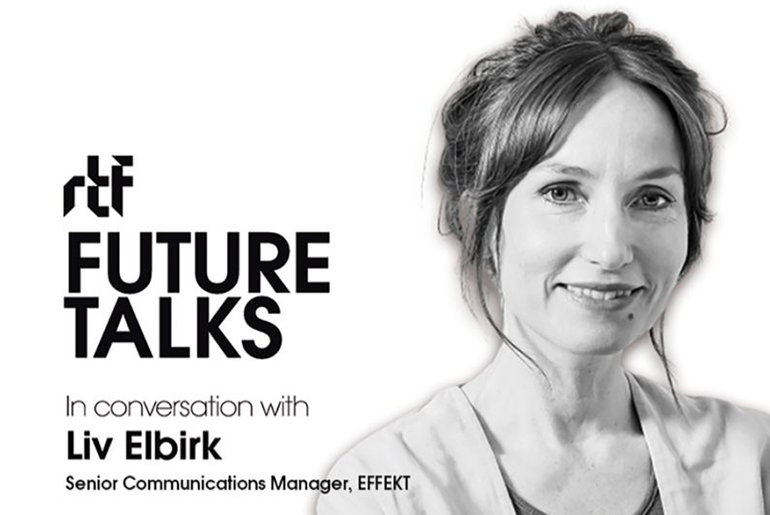
Welcome to Future Talks by RTF, your gateway to engaging conversations with the brilliant minds at the forefront of design innovation. In this episode, we have the distinct honor of introducing Liv Elbirk, the Senior Communications Manager at EFFEKT Architects. EFFEKT Architects is a dynamic design studio based in the vibrant city of Copenhagen, where creativity converges at the intersection of architecture, urbanism, and landscape.
Founded in 2007, EFFEKT Architects has grown to encompass a team of 50 diverse professionals, including designers, thinkers, and builders, all guided by the visionary leadership of its founders, Tue Hesselberg Foged and Sinus Lynge. This pioneering studio is renowned for its commitment to holistic design solutions that address some of the most pressing challenges of our era. EFFEKT’s mission extends far beyond aesthetics; it strives to create lasting social, economic, and environmental transformations for the betterment of both people and the planet.
EFFEKT Architects has not only left an indelible mark on the international architecture scene but has garnered acclaim with multiple award-winning projects. Among these, the iconic 45-meter-high Forest Tower in Gisselfeld Kloster’s forest stands as a testament to their innovative spirit. Their latest concept, Living Places, developed in collaboration with the VELUX Group and Artelia, gave rise to expectations of a more sustainable future by showcasing the lowest CO2 emissions in Denmark.
Join us in this captivating conversation with Liv Elbirk, as we delve into EFFEKT’s world of transformative design, their commitment to sustainability, and their profound influence on the architectural landscape. This episode promises to be an illuminating exploration into the boundless possibilities that the world of design holds for our future.
RTF: Please tell us about yourself, your background, and how you delved into communications?
Liv: During my university years I was searching for a way to create positive change in the world through the arts. My greatest hero was Martin Luther King Jr. and the way he was able to spread light in a world shrouded in ignorance through the power of his words, nonviolent resistance and clarity of thinking.
Forms of artistic expression, such as writing, painting, sculpting, etc. can hold in them a depth of knowledge or wisdom that often gets lost in economized societies where what’s measurable overshadows those things that are felt or experienced. Similarly, architecture has the potential to be informed by people’s needs, stories, hopes and dreams, if it is based on meaningful dialogue and collaboration with the vast number of stakeholders involved in its creation. In this context, architecture can serve as a conduit for positive transformation, influencing the way we live, work, find enjoyment, connect with one another and the natural world.
My personal interests guided me toward the study of communications and art history, where I delved into the realms of contemporary art and architecture, exploring how they can evoke the dreams and visions of a more sustainable world. Not least because the built environment can contribute to restoring our sensory experience of connection with nature and the social communities that nurture our growth and well-being.
I recognized that communication plays an important role in bringing about this transition, or paradigm shift, because it takes storytelling, awareness raising, inspiration, mobilization and collaboration. Eventually, my studies led me to career opportunities within NGOs, cultural institutions and purpose-driven architecture studios such as EFFEKT architects.
RTF: You have worked as a communications consultant at various design studios, please elaborate on the kind of work that the role involves.
Liv: The role will look different depending on the design studio. With a sense of purpose developed over fifteen years, EFFEKT not only aims to communicate clearly to each potential client about the practice’s values, strengths and capabilities, but also to examine and communicate how we can contribute to reducing the larger-scale environmental impact of construction.
What makes the role of a communications manager particularly intriguing at EFFEKT is our involvement in information campaigns, publications, exhibitions, and cross-disciplinary collaborations that seek to raise awareness about broader civic issues. Moreover, most of our projects, spanning urban planning, landscape design, and architecture, explore novel approaches to pressing societal issues like climate change, public health, and housing dilemmas.
Engaging with diverse audiences requires tailored content to address various needs, knowledge levels, and objectives. Moreover, it’s essential to unfold and explain design through narratives that enrich individual projects and foster a greater understanding of the construction industry as a whole and the need for a collaborative approach, especially in light of the imperative shift towards sustainability. I really believe that architectural firms must secure their relevance by conveying their essential role in this shifting landscape.
RTF: What does your day as a Senior Communications Manager at EFFEKT look like?
Liv: My daily activities involve a wide array of tasks and collaborations. You might find me in one room, discussing with representatives from the Danish Architecture Center on how to unravel the narrative of an upcoming exhibition featuring one of our projects. In another room, I could be working closely with one of our architects, briefing a photographer for an upcoming photo shoot. We could be brainstorming ways to distill a complex publication into compelling key takeaways for our social media platforms or sculpting the storyline of a project that’s about to make its debut on our website. You might also catch me providing guidance on how to amplify the reach of an information campaign or exploring strategies to garner media attention.
I typically spend a significant portion of my day writing. I think writing is such an important sister to architecture. Lyrical writing can mime architecture and bring it to life for non-designer audiences. Stories can make people really see a building for the first time where before they might have hurried past it barely noticing that it was there. Offering your audience supplementary context, tools, prompts, and messages to examine architecture enables them to better understand and appreciate it.
In my opinion, the poetic dimension of architecture is occasionally overshadowed by considerations of functionality and performance. Yet, the truth is, one of architecture’s principal functions is its ability to interpret and elevate our relationship with its surrounding context and the natural world – going beyond ethics and into aesthetics. When we tap into people’s yearning for nature, light, air, texture, beauty, and connection, we capture their attention, drawing them into the narrative.
On a more strategic level I’m charged with developing our tone of voice and devising a communications strategy for how EFFEKT talks, looks and interacts with the world. Importantly, people are drawn to brands – not companies. It takes a distinct, strong and well-crafted brand to influence, inspire and engage. Companies themselves do not elicit emotions.
RTF: Do you have an in-house PR and communications team at EFFEKT or does a PR firm handle those aspects? Which, in your opinion, is better?
Liv: Having an in-house PR and communications team holds immense value. It allows us the time and space required to intimately grasp the core identity of our studio and effectively translate its vision, mission, and values into a compelling practice narrative, tailor-made stories for diverse media outlets, and creative content production. Moreover, my proximity to the architects responsible for the projects I write about is a significant advantage. It enables me to develop a familiarity with them, listen to the anecdotes and understand the battles they lost and won along the way. This intimate knowledge is reflected in the stories we tell. In essence, the in-house PR and communications team is in a better position to capture these nuances, which can be more challenging for external PR firms.
However, I believe that collaboration with external agencies is equally valuable, particularly for tasks like campaigns, brand strategy, and transformation processes that necessitate engagement across the entire company. External firms bring an impartial perspective, often playing a vital role in delivering candid assessments and driving decisions.
RTF: How do you pitch projects to publications and what is your frequency of follow-ups? What is your pitching process like? What is the right way to pitch?
Liv: I believe that every individual refines their own pitching process over time. In my case, thorough preparation is key before approaching publications. I make sure to have a clear understanding of the story’s angle, substance, and its relevance, aligning it with the media’s profile. This groundwork is crucial for building a convincing pitch.
My outreach strategy varies depending on the publication. Sometimes, I personally initiate a dialogue with journalists, while for others, I opt for sending a press release. The critical element is having a compelling press kit complete with irresistible visuals and persuasive content. Fortunately, storytelling is a significant part of our overall work.
RTF: How often do you pitch projects and how do you choose which publications to approach for getting projects featured?
Liv: Before launching a project, I reach out to a diverse range of media outlets. This includes not only architecture and design-focused platforms but also others, depending on our specific storytelling goals. On some occasions, we choose to publish opinion pieces, particularly when our projects offer fresh insights or inspiration that can benefit the industry and contribute to a broader agenda for change.
RTF: What makes a project worthy of getting featured? What is your advice for young designers wanting to get featured?
Liv: I firmly believe that quality is a critical factor. When evaluating a project, it’s important to consider how it contributes value to those who will live in or use it. Equally important is the project’s impact on its immediate surroundings. Does it aim to address specific issues? Is it characterized by generosity? Does it ignite our imagination, evoke emotions, or impart wisdom? Does it introduce innovative approaches? Does it harbor historical significance or celebrate the revival of craftsmanship and traditions? Perhaps it’s a work of art, where its intrinsic purpose is simply to exist. Irrespective of its underlying purpose, it’s imperative to scrutinize the project, discerning the what, the how, and, most significantly, the why behind its existence.
RTF: Are you approached by publications to get your projects featured?
Liv: Yes, we are in the privileged position that we are approached every week by different publications who would like to publish our work.
RTF: The media landscape has changed significantly over the years. How has that impacted your work?
Liv: The fast-paced changes in technology and society mean our audiences are spread across many platforms. To reach them effectively, we need tailored content. I see my role in communications more like a creative design process than just a support function. It’s important, especially now, as communication managers are doing more than ever before, from contributing to shaping a firm’s strategy to articulating its values and raison d’être.
RTF: What is the skill set required to be a Communications Manager? What’s the scope of this field?
Liv: The field of communications is broad, encompassing a wide array of disciplines such as public relations, strategy development, social media management, copywriting, content marketing, issues handling, digital communication, engagement marketing, event coordination, media training, brand establishment, and creative content generation.
The most important thing is to realize that you don’t have to be an expert in everything, but being adaptable is certainly advantageous. What I find particularly rewarding about working at a company like EFFEKT is the opportunity to be versatile and leverage various communication techniques, often in collaboration with the architects on our team. In larger corporate organizations, roles tend to be more specialized, focusing on specific areas like social media or graphic design, and. It’s important to discover what suits your personality and go for those opportunities.
Over time, your skills will naturally develop, eventually revealing your core strengths.