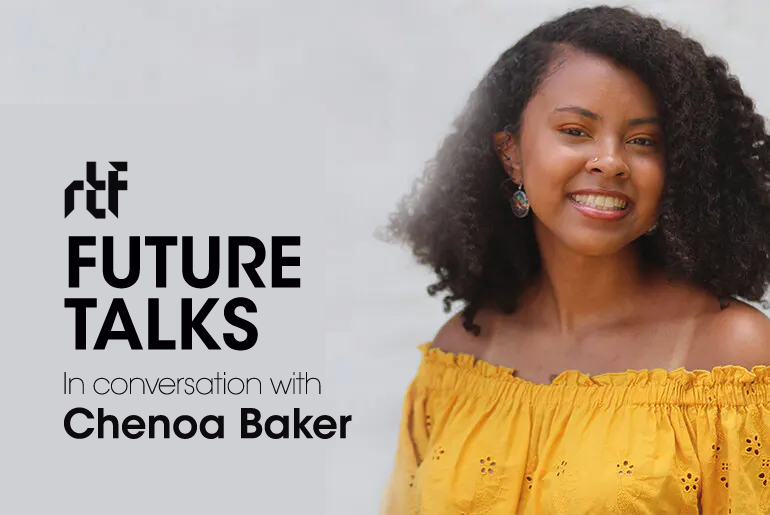
Welcome to Future Talks by RTF, where we engage in insightful conversations with pioneers who bring design stories to life. In this episode, we are delighted to have Chenoa Baker as our guest, a multifaceted individual whose journey from a political science student to an art enthusiast and editor is nothing short of inspiring. Chenoa’s unique perspective on art, its evolution, and the role of galleries, as well as her experience as an editor, promises to offer valuable insights to our audience, which includes architects and design students.
In this interview, Chenoa shares her journey into the world of art, her transition from political science to art history, and the significant moments that have shaped her trajectory. She also discusses the evolving role of art galleries and the challenges they face in the ever-changing landscape of curation.
As an editor, Chenoa provides valuable advice for aspiring writers and artists looking to make their mark in the professional field, emphasizing the importance of craft and perseverance. She also discusses the impact of social media on the art world and the power of meaningful pitches in the world of publishing.
Join us as we delve into Chenoa Baker’s world of art, creativity, and editorial wisdom, and discover the seeds that have grown into her remarkable journey. We hope her story and insights will inspire and inform our audience, just as they have inspired us. Stay tuned for a captivating conversation with a true visionary in the world of art and culture.
RTF: Hi Chenoa, We are glad to have you as a guest on Future Talks by RTF. Thanks for joining us. Tell us about the inception of your art experience. What was the first spark like?
Chenoa: Thanks for having me! That’s such a great and loaded question. My father was a photojournalist for many years and my parents were married at the Everson Museum of Art (perhaps prophetically before I was born). I was always surrounded by culture and memory preservation and care work (my mom and maternal grandmother are in the medical field).
RTF: From being a political science student to steering towards art history, how did a change in focus happen?
Chenoa: Upon graduating high school, I was headed towards a track in political science because I found my voice in Model United Nations and other debate clubs. I wanted to work at a think tank and develop research to enact social change. When I got to college, I took a political science course that I liked but didn’t feel that spark. I had a gen ed intro to world art history 1400 to the present and absolutely loved it. I’m not a morning person but waking up at 8 am energized me. Subsequently, I found visual language and culture as a way to advocate about the issues I cared about and share knowledge.
RTF: What are your views on the compounding effect in the realm of art? Like how a tiny instance goes unnoticed, but somewhere it does shape us the way we are, which in turn reflects in one’s art. We would love to hear such a story from you.
Chenoa: I’m a firm believer that life is a bunch of planted seeds and seeing what matures and grows. Going to press events with my dad and watching him open up his studio for other artists to show planted a seed. Or even the many ways ceramics were all around me — I volunteered at the Everson Museum which has a notable ceramic collection, my mom’s slab work from college decorated the house, and I was influenced by growing up near the Syracuse China Co. and proximity to David MacDonald.There are many small moments that accumulate in my trajectory that I often don’t notice them unless I’m hindsight.
RTF: What are your views on the evolution of art and the role that galleries play? And what are the challenges born out of trends in curation at art galleries?
Chenoa: Jasper Sanchez, Assistant Curator for Now + There, mentioned that he likes the term “art doula” to describe curatorial work. Ideally, galleries should nurture the ideas of artists, fund upfront projects or secure enough capital for them to realize their visions, and build opportunities for sales and public scholarship. However, often the commercial realm forgets that it’s all about supporting artists at the end of the day. Therefore, the gallery I work at (Beacon Gallery) is evolving into a nonprofit where it focuses and champions artists while breaking away from the colonial and economically driven commercial model. It will unveil as ShowUp in 2024.
RTF: What are the other paths that you stroll on when not working?
Chenoa: Ooo, I love this question! I enjoy making art (in ceramics and glass), thrifting, listening to podcasts, traveling, watching reality tv, drinking tea, hanging out with family and friends, and reading. One of the reasons when I introduce myself and often say “descendant of self-emancipators” is to acknowledge that family and how I got here to where I am today is central. I really enjoy mentoring and spending time with my younger brother who spends time dreaming about how to make cities better (especially parks and public transportation).
RTF: What does an ideal media kit look like?
Chenoa: Well, I often receive media kits from unsolicited sources and I prefer a direct relational link because of the way that I work. The best media kits I’ve received include the bio, artist statement, and images from artists but also spark curiosity where I want to know more.
RTF: How would you guide writers and artists looking to crack the code to get published at the top publications?
Chenoa: Just like the planting seeds question, often people see this season of harvest and imagine that it was built over night. I’ve been publishing for three years and have been shifting my goals to reach farther each year. Therefore, I advocate for the person wanting to write to always write on their own first by having content in reserve, and then pitching to smaller indie publications and incrementally publishing at larger publications. Once you build an audience and CV, larger publications are more willing to take a chance on you and your work. Also, nothing can replace the craft of writing so that comes first.
RTF: How has social media impacted the way we see and perceive art?
Chenoa: Social media has been a great connector. Artists that I may not have had contact with before are only a DM away. One artist that this worked super well for was messaging Lavett Ballard who years later I was able to meet through a studio visit with her in Jersey. While social media can be a great tool, it doesn’t replace seeing work in person. Photos no matter how great doesn’t do work justice nor replace in person conversations with artists.
RTF: As an editor, we would like to get your idea of a good pitch and how you differentiate between a ‘positive’ and a ‘negative’ approach from the writers and artists.
Chenoa: Love this question! I was chatting with one of my fellow editors at Sixty Inches From Center about this the other day. Pitches that are most likely to get accepted from me are straightforward (who, what, where, why), and timely and/or an interesting take. Also, another part of pitching that is really crucial is the author considering their positionality on a subject and if they may be truly right to cover it or how they can acknowledge their positionality in some way.
RTF: Talk us through your writing process. And how do you fuel your creativity?
Chenoa: It’s changed over the years. When I first started publishing, I was in school and I wrote about the threads I was interested in that I couldn’t write about for an assignment. For example, I wrote about Vanita Green, an artist who was footnoted in a textbook that I read but I wanted to do a deeper dive. That lead me to eventually finding her family and they shared more about her with me. Writing residencies have helped my creativity and making my writing a ritual where I may grab tea or just spill everything out on the page. Also, I keep a writing diary on my phone where I record words, phrases, and quotes from myself or others. Jessica Lanay Moore recommended that and she’s a fantastic Libertist. I also have many mentors that guide me and help me find my way when I’m stuck.
RTF: How would you advise aspiring writers and art students who are eager to break into the professional field?
Chenoa: Keep writing and creating. Craft over quantity. Don’t be afraid to be interdisciplinary, it makes you stronger. I’d love to leave you with a quote from Cultivating HER Space Podcast that I frequently listen to, “The Creator did not give you a longing to do that which you have no ability to do.” With that charge, go forth, challenge yourself, fail, succeed, experiment, and most of all love, that is part of the journey.