Which are the best-planned cities in the world? There is no single winner — it depends on what you measure — but a shortlist recurs in every serious answer: Singapore for integrated long-range planning, Copenhagen for transit-and-cycling design, Amsterdam for its 17th-century canal ring, Chandigarh and Brasília as the great modernist experiments, and Washington, D.C. as the baroque capital plan that still works. The eight cities in this guide show eight different ways a city can be deliberately designed.
| City | The plan | Signature idea |
| Copenhagen, Denmark | Finger Plan, 1947 | Five rail-linked corridors of growth separated by green wedges; today a cycling-first capital |
| Chandigarh, India | Le Corbusier, 1950s | Self-sufficient sectors on a grid; Capitol Complex UNESCO-listed in 2016 |
| Amsterdam, Netherlands | Canal Ring, 17th century | Concentric canals (UNESCO 2010) structuring growth for 400 years |
| Washington, D.C., USA | Pierre Charles L’Enfant, 1791 | Baroque diagonals over a grid, anchored on the Capitol and White House |
| Düsseldorf, Germany | Post-war reconstruction | Harbour regeneration (MedienHafen) with landmark architecture |
| Brasília, Brazil | Lúcio Costa’s Plano Piloto, 1960 | Two monumental axes and superquadra blocks; UNESCO-listed 1987 |
| Singapore | URA Master Plan, reviewed ~every 5 years | Integrated housing, transport and greenery in a land-scarce city-state |
| Putrajaya, Malaysia | Garden-city plan, 1990s | Purpose-built federal administrative capital around a man-made lake |
The urban planning of cities has been a marker of the physical histories of cities, shaping the lives of man since time immemorial – cities of the Indus Valley civilizations are the first evidence of meticulous and effective town planning known to man. The modern city and its planning have followed a process of evolutionary learning and created newer avenues to explore, understand and enhance the experience of man inhabiting space. Urban Planning allows the city and its systems such as transport, housing, residences and environment to collectively better the quality of life for its citizens.
These eight cities across the world have implemented these strategies and have become models for cities of the future for urban design and planning.
1. Copenhagen, Denmark | City Planning
The urban plan of Copenhagen, Denmark was conceived as a ‘Five Finger Plan’ to build an integrated network of urban infrastructure, transport and green spaces. The key element of the planning is the location of people and their movement through the plan. The development is condensed along these lines to encourage the use of public transit networks. The emphasis on sustainability, the high quality of public life, a sensitive approach to development is testament to the success of the urban planning and execution in Copenhagen.

2. Chandigarh, India
The planned city of Chandigarh post the Indian Independence in 1947 was a modernist symbol of a new India. The Master Plan by Le Corbusier organizes the city in an orthogonal grid dividing it into sectors. Each sector is a self-sufficient component with residential, commercial, educational and healthcare facilities. The commercial street between sectors is linked to form a continuous ribbon of commercial activity. Fast-moving traffic roads form the division between sectors. The city of Chandigarh was envisioned as a Garden city and restricted vertical development to suit the living conditions of its residents.


3. Amsterdam, Netherlands
Amsterdam, the capital city of the Netherlands is planned along the four concentric canal rings initiated in the 17th century. These canals have given the city a definite structure whereas the housing is built in clusters to lend lateral support. Public housing in the city is designed to clearly define the urban character, with special attention paid to the façade design that is now the image of the city. The excellence of Dutch planning is reflected in the emphasis on connectivity, well designed public spaces for a higher standard of public life.


4. Washington D.C, USA
The urban plan of Washington D.C is known as the L’Enfant Plan named after Pierre Charles L’Enfant, the original urban planner for the city. The city is regulated with north-south and east-west running streets intersected by broader ‘avenues’ that would create rectangles within the grid for memorials and open spaces. The plan also establishes the National Mall – a landscaped public park, the extents marked by the United States Capitol and Lincoln Memorial on each end.


5. Dusseldorf, Germany | City Planning
Dusseldorf saw great destruction due to heavy bombing during World War II. The rapid reconstruction of the city post-war brought huge economic growth. The rejuvenation of the harbor town was an objective of the redevelopment of buildings along the harbor. Dusseldorf is home to striking architecture by pioneers such as Frank Gehry. The city’s infrastructure also supports mobility via public transport as it is well connected by multiple rail networks.

6. Brasilia, Brazil
Brasilia’s urban plan developed by Lucio Costa is famously known as a ‘Pilot Plan’ owing to its plan that is defined by two intersecting axes. The monumental long axis is the location of all the government buildings, whereas the residences of the government employees are located along the cross axis. These residences are within areas known as the ‘super-quadra’ that also has amenities such as shops, hospitals and schools. However, Brasilia was envisioned largely as a city for automobiles and does not consider pedestrian mobility.

7. Singapore
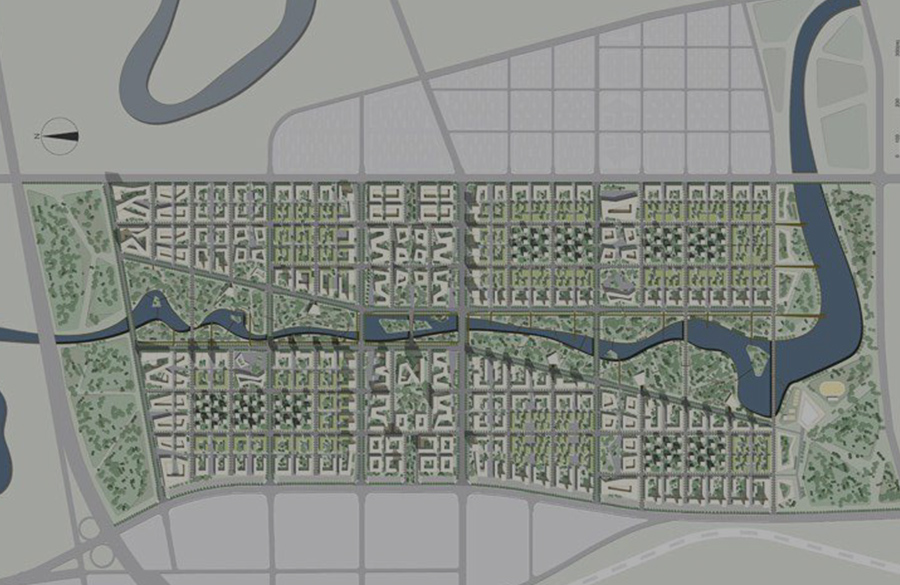
Image caption – Master Plan of Singapore
Image Source – ©Urban Redevelopment Authority (URA), Singapore
The city-state of Singapore has seen rapid economic development and high quality of public life owing to an efficient government and city planning strategy. Divided into a series of partially self-sufficient precincts, each precinct is governed by four regional centers other than the central government. These planning strategies have been successful in creating quality affordable housing, integrating green spaces, enhancement of mobility and transport services while sustaining a flourishing economy.

8. Putrajaya, Malaysia | City Planning
Putrajaya was envisioned as a ‘garden city’, a theme to befit the new federal administrative centre of the Malaysian Government. The city planning is intelligent and efficient and includes planned features such as large designated green areas, water bodies and waterfronts, peripheral residential precincts and a large central boulevard that acts as a spine to the city. The master-plan also successfully weaves in commercial activity as a part of the planning.

Urban Planning in 2026: What These Eight Cities Teach Now
The models on this list keep being updated. Singapore unveiled its Draft Master Plan 2025, the latest five-yearly refresh of the long-range blueprint that has guided the city-state for decades. Copenhagen — UNESCO’s World Capital of Architecture in 2023 — continues to extend the 1947 Finger Plan logic through transit-linked districts, while the ‘15-minute city’ idea popularised in Paris has become the decade’s most debated planning concept: in effect, Chandigarh’s self-sufficient sector and Singapore’s precinct, rediscovered at street level.
And a new generation of planned capitals is testing the old lessons. Indonesia began moving government functions to its new capital, Nusantara, in 2024, and Egypt’s New Administrative Capital continues its phased build-out — the largest purpose-built capital projects since Brasília and Putrajaya. Their challenge is the one this list quietly documents: Brasília’s car-first monumentality shows how a plan can age badly, while Copenhagen and Amsterdam show how plans that privilege people over vehicles age best. For deeper context, see our guides to the 15 ancient cities of the world — where planning began, Indus Valley included — and the 10 greenest cities in India.
Frequently Asked Questions
Which is the best planned city in the world?
There is no single answer – it depends on the measure. Singapore is most often cited for integrated long-range planning, Copenhagen for transport and cycling design, Amsterdam for a historic plan that still structures the city, and Chandigarh and Brasilia as the most complete modernist plans ever built.
What are the best examples of urban planning?
Classic examples include Copenhagen’s Finger Plan (1947), Le Corbusier’s sector grid at Chandigarh, Amsterdam’s 17th-century canal ring, L’Enfant’s 1791 plan for Washington D.C., Lucio Costa’s Plano Piloto for Brasilia (1960), Singapore’s rolling URA Master Plan, and Putrajaya’s 1990s garden-city plan.
Which Indian city is famous for urban planning?
Chandigarh – planned in the 1950s under Le Corbusier as a grid of self-sufficient sectors, with its Capitol Complex inscribed by UNESCO in 2016. Historic Jaipur, with its 18th-century planned grid, is India’s other celebrated example.
Who planned Brasilia?
Urban planner Lucio Costa won the 1957 competition with his Plano Piloto – two intersecting monumental axes – and Oscar Niemeyer designed its principal government buildings. The city was inaugurated in 1960 and UNESCO-listed in 1987.
What is the oldest example of urban planning?
The cities of the Indus Valley civilisation – such as Mohenjo-daro and Harappa, around 2600 BCE – with gridded streets, standardised bricks and covered drainage, are the earliest known examples of deliberate town planning.
Sources for the 2026 update: Urban Redevelopment Authority, Singapore (Draft Master Plan 2025); UNESCO (World Capital of Architecture 2023; World Heritage listings for Brasília, Chandigarh’s Capitol Complex and Amsterdam’s canal ring); reporting on Nusantara’s 2024 transition.