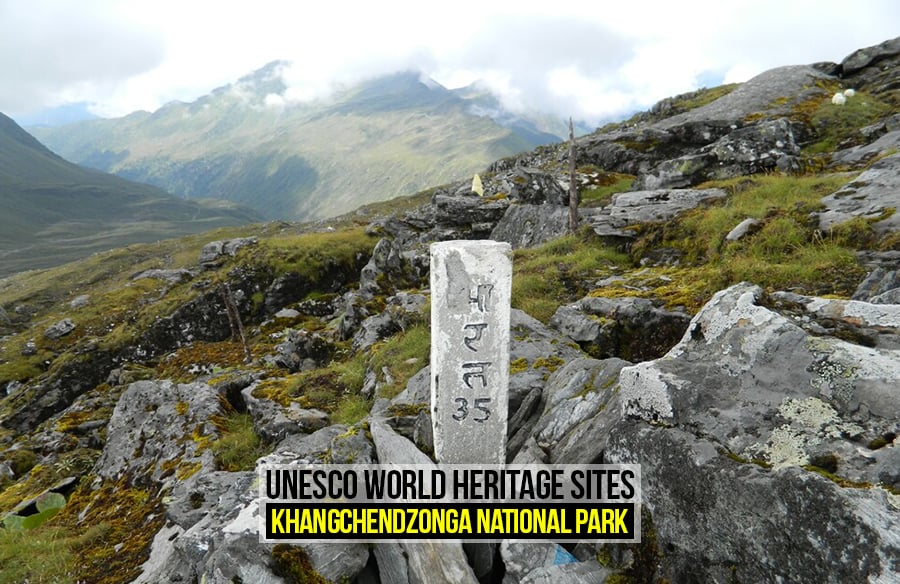
UNESCO World Heritage Sites are known for their distinctive contributions and are appreciated globally as they represent natural and cultural treasures. One such treasure is the Khangchendzonga National Park.

The location offers an unmatched diversity of subtropical to alpine habitats and is situated in the Himalayan Global Biodiversity Hotspot. Here, the Himalayas are at their narrowest, creating steep terrain that accentuates the variations among the property’s numerous eco-zones. Situated in a mountainous area of global significance for biodiversity protection. Several rare, indigenous, and endangered plant and animal species can be found on the land. Along with a multitude of birds, the property boasts one of the highest concentrations of plant and mammal species ever documented in the Central/High Asian Mountains.
Outstanding Universal Value of Khangchendzonga National Park:

One of the underlying ideas of the World Heritage designation is the Outstanding Universal Value (OUV). It is defined as “Cultural and/or natural significance which is so exceptional as to transcend national boundaries and to be of common importance for present and future generations of all humanity.” UNESCO World Heritage Sites must fulfil a minimum of one of the ten World Heritage Convention criteria. These criteria emphasise the unique attributes of the site that make a substantial contribution to the collective history of humanity. The extent of Khangchendzonga National Park is sufficient to maintain the full expression of its Outstanding Universal Value.
UNESCO Criteria for Inscription:
Kanchendzonga National Park displays four out of the ten World Heritage Convention criteria.

‘Exceptional Testimony’ Criteria (iii)
Central to the Buddhist understanding of Sikkim as a beyul, Mount Khangchendzonga bears witness to religious and cultural traditions as well as the coexistence of multiple layers of both Buddhist and pre-Buddhist sacred meanings in the same region. The park is a site of religious rituals and cultural practices for Tibetan Buddhists in Sikkim and Buddhists worldwide.
‘Association with Traditions, Beliefs or Ideas’ Criteria (vi)
Khangchendzonga National Park is the hub of a multi-ethnic culture that has formed, resulting in multi-layered religious traditions centred on the natural environment and its distinctive features. This connection is exemplified by the territory surrounding Khangchendzonga being considered a beyul (sacred hidden land) in Tibetan Buddhism. The affinity between human populations and the mountainous environment has fostered the development of a deep traditional knowledge of natural resources and their attributes, particularly among the Lepcha people. Mount Khangchendzonga is vital to the socio-religious order, as well as the togetherness and solidarity of the Sikkimese groups, which are ethnically varied.
‘Exceptional Natural Beauty’ Criteria (vii)
Various cultures and religions appreciate this area because of its remarkable size and magnificence of the Khangchendzonga Mountain and the many other peaks that make up Khangchendzonga National Park. One of the 20 beautiful peaks in the park, Mount Kanchenjunga borders the western edge. The remarkable landscape attractiveness is further enhanced by the combination of the exceptionally high and rocky mountains, the distinct altitudinal vegetation zones, and preserved old-growth woods that reach the exceptionally high timberline. There are eighteen glaciers in the park, the greatest of which being Zemu Glacier in Asia. In a similar vein, the property contains 73 glacial lakes, including more than eighteen serene, high-altitude crystal-clear lakes.
‘Significant Natural Habitats and Conservation of Biological Diversity’ Criteria (x)
Nearly half of India’s bird diversity, wild trees, orchids, rhododendrons, and one-third of the nation’s flowering plants can be found in Khangchendzonga National Park. In the Himalayan region, It has the largest and most expansive zone of stunted woodland. A remarkable variety of eastern Himalayan landscapes and related species habitats can be found within the national park, which boasts an impressive altitudinal variation of almost seven kilometres in a rather compact area. For an amazing variety of large mammals, including multiple apex predators, this habitat offers a vital haven.
Conservation and Management:
The Wildlife (Protection) Act, 1972 of India granted Khangchendzonga National Park protected area status, guaranteeing robust legal protection for all species and flora along with mountains, glaciers, water bodies, and landscapes that contribute to wildlife habitat. Additionally, it guarantees that the remarkable aesthetic value and natural beauty of the Park’s natural elements will be preserved. The buffer zone is protected as a Forest Reserve, whereas the property, which is made up of state-owned land, has been a National Park since 1977. The Sikkim government has identified and safeguarded natural elements that hold cultural importance. They designate the hallowed elements and control how they are used as sites of worship.

While some of the monuments are protected by the Archaeological Survey of India, others are overseen by local people and monastic communities using traditional management techniques that encompass both the immediate and surrounding areas of the monasteries. Under the direction of a management plan, the Sikkim Forest, Environment and Wildlife Management Department oversees the property. Its goal is to preserve important landscape features and ecosystem components while fostering recreational opportunities, cultural and educational values, the advancement of scientific knowledge, and methods that improve the well-being of the surrounding communities. Possibilities to increase the participation of locals and other stakeholders in management decision-making on the land should be seized.

The cultural and spiritual traditions that have flourished in this area for many centuries depend on the preservation of Khangchendzonga National Park in addition to its environmental integrity. Recognizing and respecting the Outstanding Universal Value of this World Heritage Site underscores the significance of further conservation efforts. Future generations must be able to appreciate Khangchendzonga National Park’s remarkable beauty and cultural diversity in order to preserve the park’s integrity as a priceless piece of world heritage.
Reference list:
Centre, U.W.H. (n.d.). Khangchendzonga National Park. [online] UNESCO World Heritage Centre. Available at: https://whc.unesco.org/en/list/1513.