In Ho Chi Minh City, recent economic development has stimulated the transformation of the cityscape. Contemporary models have induced an alteration of urban typologies. Most notably, the vernacular city is being replaced by a rigorous grid.
Project Name: People’s alley
Studio Name: LJ-Group
Project Location: Ho Chi Minh City, Vietnam
Completion Year: 2018
Design area: 200 m2
Landscape Architects: Pedro Pedalino, Daniel Alonso, Kha Pham, Nam Tran, Giang Tran
Photo Credits: 1. Kha Pham 2. Thuan Lam Hieu 3. Viet Hoang 4. Quoc Thinh

Public space is unequivocally considered by specialists as a space of flows, aestheticizing, and/or commercial activity. While social life would naturally develop in a nebulous network of tiny streets, creating multifunctional, vibrant, and engaging places, it is reduced and controlled in the modern one.
Invited to participate in the place-making festival Playtime, we seized the chance to play with our city by making a temporary public space installation in an alleyway of the city’s central district. Inspired by the quotidian Ho Chi Minh City, where the perpetual improvement of streets relies more on people’s actions and ingenuity than on massive infrastructural changes, our concept induced minimal design and physical changes to let spontaneous responses happen.

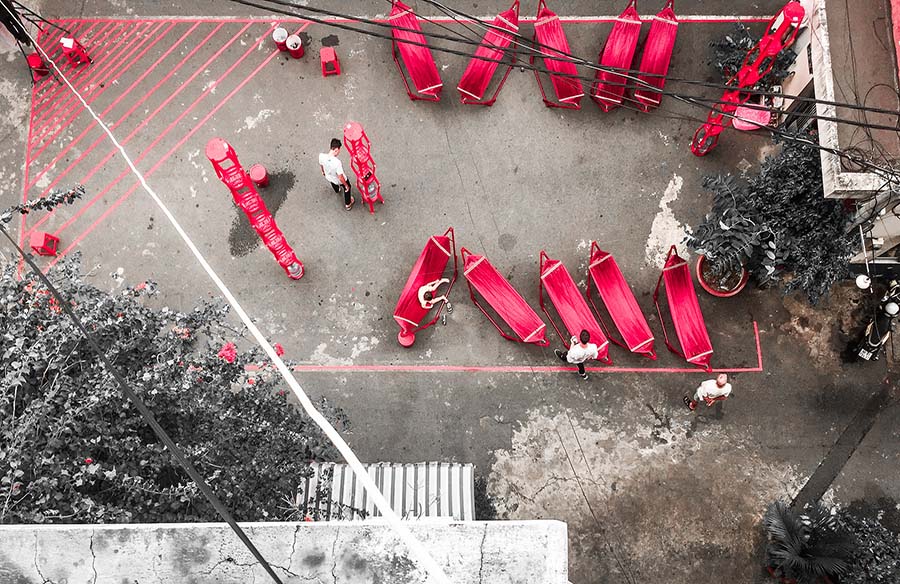
Within the borders of the red lines, the public space was then furnished with hammocks. A global symbol of rest, they are also found along Vietnamese highways, where most coffee shops offer hammock areas for travelers to enjoy a nap. While the plastic chairs, a ubiquitous street classic, are often associated with commercial activities, hammocks and their comfortable sight made a clear statement: this public space was for leisure, relaxing, and enjoying the moment. The message was received by neighbors, passers-by, and participants who came in and installed themselves while pursuing their discussions.

The ubiquitous plastic chairs were still present, but not in their traditional function. They stood atop each other in towers of various heights, like totems of this reclaimed moment. The infinite repetition of these structures linked this very local element back to a global conversation started with Brancusi.
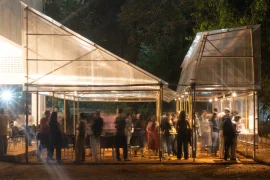
As people gathered during the time of the installation, the space came alive through their appropriations and uses. Finally, a dance performance by the Vietnamo-Belgian company t.r.a.n.s.i.t.s.c.a.p.e enriched the experience as they blurred and expanded the territory’s boundaries, further echoing the daily life of Ho Chi Minh City streets.

With this installation, we emphasized the resourcefulness of ordinary Vietnamese public spaces and the subsequent capacity to create lively spaces with little design; a perspective we want to defend, as landscape architects, in the debate on place-making.
In fact, People’s Alley was conceived as a simple experiment to engage the largest audience possible in the conversion of our site into an area dedicated, for an afternoon, to leisure. Out of the ordinary scenes, we picked three elements to make the place.

As a statement of intentions, the first thing that was done was to stick a red tape on the ground to demarcate the square and protect a public space that is usually minimized and sacrificed for other priorities, the public space here had its own territory. “Not parking lot”, the tape announced; then, very quickly, a police officer watching over the project ordered a neighbour to move his car away