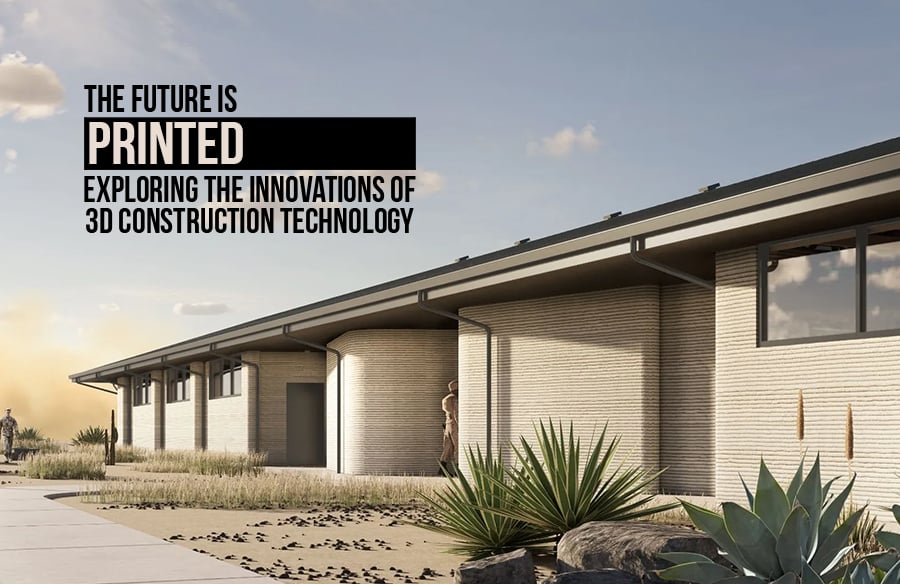
In the realm of construction, a quiet revolution is taking place. This transformation is driven by 3D printing technology, also known as additive manufacturing. This innovative approach is reshaping how we conceive, design, and build structures, offering unprecedented efficiency and sustainability. The introduction of 3D printing technology in construction stems from the need to address several persistent challenges in the industry, including inefficiencies, high costs, waste generation, and the demand for innovative design solutions. As urban populations grow and the need for rapid housing solutions increases, traditional construction methods often struggle to keep pace.From its historical roots to its current applications, the journey of 3D printing in construction is both fascinating and promising.
At its core, 3D construction printing (3DCP) involves the automated creation of structures through the sequential layering of materials, primarily concrete. Unlike traditional construction methods that rely heavily on manual labor and assembly, 3D printing employs large-scale printers that deposit material layer by layer according to a digital blueprint created using computer-aided design (CAD) software. This method not only streamlines the construction process but also allows for complex geometries and customized designs that would be challenging to achieve with conventional techniques.

The Global Origins of 3D Printing in Construction
The concept of 3D printing dates back to the early 1980s with the advent of rapid prototyping technologies. However, it wasn’t until the early 2000s that significant strides were made in applying this technology to construction. The United States emerged as a pioneer in this field, leading numerous projects that showcased the potential of 3D printing for building homes and infrastructure. Following suit, countries like China and the Netherlands began investing heavily in research and development for construction applications. Notably, China has been at the forefront, constructing entire neighborhoods using 3D printing technology.
In recent years, cities like Dubai have set ambitious goals to integrate 3D printing into their construction practices. The Dubai government aims for 25% of all new buildings to be constructed using this technology by 2030, underscoring its commitment to innovation and sustainability. Traditional construction methods are resource-intensive and often result in significant waste. In contrast, 3D printing minimizes material waste by precisely depositing only what is needed for each layer.
Moreover, many projects utilize eco-friendly materials or recycled components, further reducing their environmental impact. The ability to print structures on-site also cuts down on transportation emissions associated with delivering prefabricated components.

How Does 3D Printing Work in Detail?
The process of 3D printing in construction can be broken down into several key steps:
Digital Design: Architects create a detailed digital model using CAD software. This model serves as a blueprint for the printer.
Material Preparation: Specialized materials, often a mix of concrete or polymer composites designed for durability and structural integrity, are prepared for use in the printer.
Printing Process: The printer follows the digital model’s instructions to deposit layers of material. This is typically done using an extrusion system that lays down material in a controlled manner.
Layer-by-Layer Construction: As each layer is added, it bonds with the previous one through chemical reactions and mechanical bonding. This careful layering allows for intricate designs and robust structures.
Curing and Finishing: After printing, the structure undergoes curing to enhance strength. Additional finishing touches may be applied to improve aesthetics or functionality.
3D printing falls under various technological umbrellas including additive manufacturing (AM), which encompasses multiple methods such as:
Extrusion: Commonly used in concrete printing where material is extruded through a nozzle.
Powder Bonding: Involves binding powdered materials using heat or adhesives.
Additive Welding: Utilizes welding techniques to build up layers from metal or other materials.
These methods allow for flexibility in design and material choice, making 3D printing suitable for a wide range of applications beyond just residential housing.

Current Trends
The scale at which 3D printing is being adopted in construction is rapidly expanding. Initially used for small-scale projects and prototypes, it has now evolved into large-scale applications capable of constructing entire buildingsIncreased Adoption is seen, more companies are recognizing the benefits of this technology, leading to a surge in investment and research.Regulatory Frameworks, where Governments are beginning to establish guidelines and standards for 3D-printed structures, ensuring safety and quality control.The convergence of 3D printing with technologies like Building Information Modeling (BIM) promises even greater efficiencies and innovations.The journey of 3D printing in construction is just beginning but already shows immense promise. From its inception as a niche technology to becoming a cornerstone of modern architecture, it embodies innovation at its finest. As we continue to explore its capabilities, we may find that this revolutionary approach not only transforms how we build but also how we think about sustainability and efficiency in our ever-evolving urban landscapes.In essence, as cities grow and populations swell, embracing technologies like 3D printing may hold the key to building not just structures but sustainable futures—one layer at a time.

A few ground breaking projects need a mention.These projects highlight not only the potential for speed but also the ability to address pressing issues such as housing shortages and affordability.The Office of the Future: Built in Dubai, this structure was completed in just 17 days, showcasing the speed and efficiency of 3D printing technology.ICON’s Habitat for Humanity: In Austin, Texas, ICON utilized 3D printing to create affordable housing solutions quickly and cost-effectively.The Yhnova Project: In France, researchers printed a house within a week using a unique concrete mix designed for durability and insulation. The future of construction lies in embracing these advancements, paving the way for smarter, faster, and more sustainable building practices globally.

References:
Ashton, D. (2024). 3D printing in construction: is it worth the hype? [online] University College of Estate Management. Available at: https://www.ucem.ac.uk/whats-happening/articles/3d-printing-construction/.
Romdhane, L. (2020). 3D Printing in Construction: Benefits and Challenges. International Journal of Structural and Civil Engineering Research, 9(4), pp.314–317. doi:https://doi.org/10.18178/ijscer.9.4.314-317
Shani (2024). 3D Printing Technology in Construction: How It Works – ConWize. [online] ConWize. Available at: https://conwize.io/articles/3d-printing-technology-in-construction-how-it-works/
Symonenko, Y. (2023). What is a 3D printed home? A short introduction. [online] COBOD. Available at: https://cobod.com/what-is-a-3d-printed-home/.
Team, E. (2022). 3D Printing in Construction: The Advantages and Disadvantages. [online] DMS. Available at:https://www.dms.com.ph/blog/3d-printing-in-construction-the-advantages-and-disadvantages/.