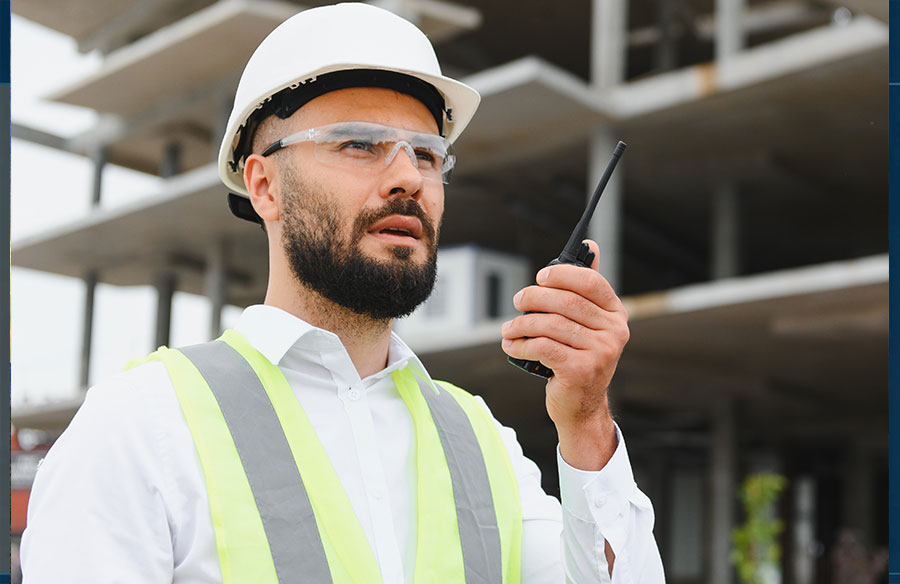
It’s 7:12 a.m. on a construction site. The coffee is still hot. The crane operator is already irritated. Someone is yelling from three floors up that the drywall delivery is in the wrong place—again.
A supervisor pulls a phone out of his pocket, squints at the screen through dust, tries to call the foreman… voicemail.
Meanwhile, across the site, a worker presses a button on a two-way radio.
“Hold the lift. Crew still in the zone.”
Problem solved in three seconds.
This is the difference between communication that looks modern and communication that actually works. On architecture and construction sites—where timing, safety, and coordination collide—two-way radios remain one of the most practical tools crews rely on every single day.
The Job Site Is Organized Chaos (Communication Keeps It That Way)
Construction sites are loud, layered, and constantly moving. Multiple trades operate at once—electricians running conduit, framers raising walls, engineers checking specs, delivery trucks arriving at inconvenient times.
Everyone needs information. And they need it now.
Phones aren’t built for that rhythm. Dialing numbers takes time. Messaging takes longer. Waiting for someone to answer? Forget it.
A two-way radio skips the friction entirely.
Push the button. Speak. Done.
Teams can instantly coordinate crane lifts, material deliveries, inspections, or equipment movement without stopping work. On larger projects—or when teams operate across multiple locations—tools like this modern two-way radio extend that same push-to-talk simplicity across long distances.
It’s fast. It’s direct. It fits the pace of the job site.
Safety Isn’t a Memo. It’s a Real-Time Conversation
Let’s be honest: construction sites contain plenty of ways to ruin your day.
Heavy machinery. Elevated platforms. Electrical systems. Vehicles backing up in tight spaces.
According to workplace safety research from organizations like OSHA, communication plays a critical role in preventing accidents. When crews can warn each other instantly, problems are often stopped before they escalate.
Two-way radios allow workers to:
- Alert others about hazards
- Coordinate equipment movements
- Call for immediate assistance
- Communicate during emergencies
And importantly, they work while wearing gloves, helmets, and safety gear. No unlocking screens. No tiny keyboards. Just a button and a voice.
Sometimes the difference between “close call” and “incident report” is simply how fast someone can say, “Stop the lift.”
Cell Phones Are Smart. Job Sites Are Not Friendly to Them
Smartphones are incredible. They stream movies, run entire businesses, and remind us to drink water.
But drop one in a gravel pit or take it into a steel-framed building with weak signal, and suddenly it’s a very expensive paperweight.
Construction sites create all kinds of signal interference—thick concrete, steel frameworks, underground areas, and remote project locations. Reception drops. Calls fail. Messages arrive late.
Radios don’t care.
They’re built for environments where communication can’t depend on perfect conditions. Dust, noise, distance—none of it stops a push-to-talk system from doing its job.
And as a bonus, radios eliminate distractions. No notifications. No scrolling. Just work-related communication.
Which, frankly, some supervisors appreciate.
Faster Decisions Mean Faster Projects
Every construction project runs into surprises.
A measurement is slightly off. A delivery arrives early. A design clarification is needed before the crew pours concrete.
When communication is slow, work stops. Workers stand around waiting for instructions. Minutes turn into hours.
Radios shorten that loop dramatically.
A field crew can immediately ask a project manager for clarification. Engineers can confirm specs without leaving their office. Site supervisors can coordinate multiple teams without physically running across the site.
That responsiveness keeps projects moving—and avoids expensive downtime.
Large Job Sites Need a Central Nervous System
Modern construction projects aren’t small.
Think hospitals, stadiums, apartment towers, multi-building campuses. Crews can be scattered across acres of work zones and multiple floors.
Face-to-face communication simply doesn’t scale.
Radios act like the job site’s central nervous system—connecting crane operators, delivery drivers, supervisors, safety officers, and construction crews into one coordinated network.
Concrete teams can signal pump operators. Safety officers can broadcast alerts. Site managers can direct deliveries.
Without that network, coordination turns into guesswork.
And guesswork is not a great construction strategy.
Built to Survive the Environment
Construction sites are rough on equipment.
Dust gets everywhere. Rain shows up uninvited. Devices get dropped, bumped, and occasionally run over by accident.
Two-way radios are built for exactly this kind of abuse.
Many models feature rugged casings, long battery life, and weather-resistant designs that can survive full shifts in demanding environments. Compared to fragile personal devices, they’re far better suited to the realities of daily site work.
Reliable tools matter—especially when communication is critical.
The Technology That Quietly Keeps Everything Running
Construction technology has evolved rapidly—drones, digital modeling, AI-driven planning tools. The industry is more advanced than ever.
And yet, one of the most dependable tools on a job site is still the humble two-way radio.
Why?
Because construction runs on coordination. And coordination runs on clear, immediate communication.
When teams can talk instantly, work moves faster, problems get solved sooner, and everyone goes home a little safer at the end of the day.
Not flashy. Not complicated.
Just effective.