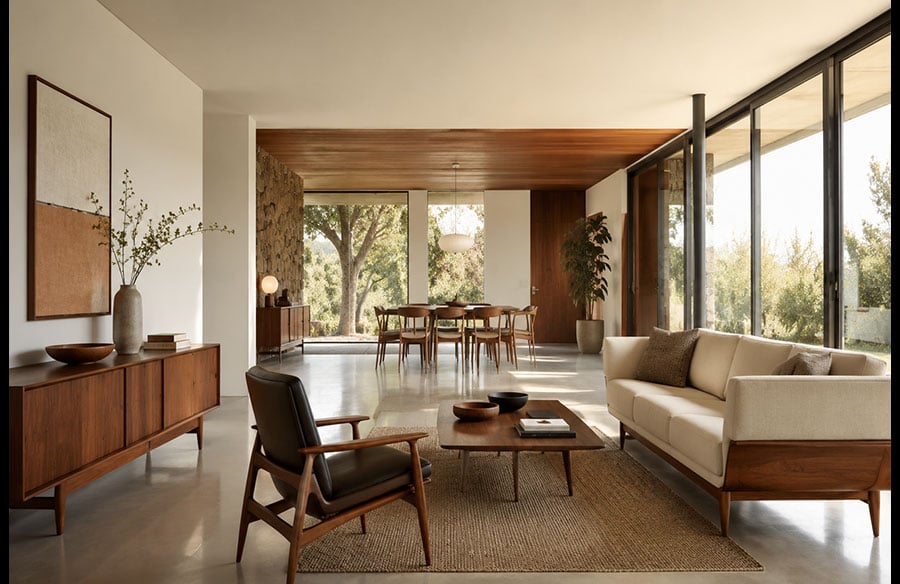
Most design movements have a natural lifespan. They emerge from a specific cultural moment, reach saturation, and eventually fade into the historical record — studied as period artifacts rather than living references. Mid-century modern furniture has not followed this pattern. The movement peaked commercially around 1965. Six decades later, it remains among the most searched design styles globally, still dominant in contemporary furniture production, and genuinely present in the work of practicing interior designers and architects. The question worth asking is not whether it has endured — that much is obvious — but why a movement so tied to a specific postwar moment has proven so resistant to the forces that typically push design periods into history.
The answer has less to do with aesthetics than with spatial logic.
A Movement Born from Structural Necessity
Mid-century modern did not emerge as a style. It emerged as a response to a set of concrete pressures: postwar housing demand, the availability of new manufacturing technologies, and the migration of Bauhaus-trained designers from Europe to America following the school’s closure in 1933.
That migration is critical to understanding MCM’s depth as a design movement. When Walter Gropius joined Harvard’s Graduate School of Design, when Ludwig Mies van der Rohe took the directorship at the Illinois Institute of Technology, and when Marcel Breuer began teaching and practicing in New York, they brought with them a design philosophy that had already been tested against the full range of modernist debate. The Bauhaus had a clear conviction: form should follow function, materials should be used honestly, and industrial production need not mean lower design quality. That conviction did not disappear when the school closed. It found new ground in America.
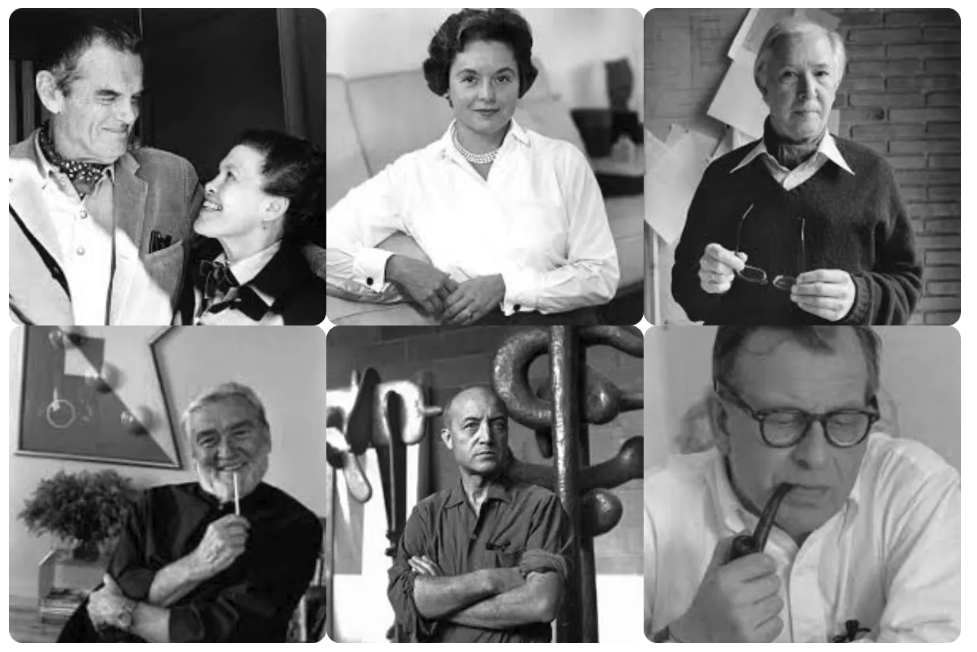
What America added to this imported rigor was warmth, organic form, and a different relationship to the domestic interior. Where Bauhaus modernism could be austere, mid-century modern was livable. Where the International Style concerned itself with building envelopes and structural expression, MCM directed its energy inward — toward the chair, the table, the storage unit, and the way those objects functioned together within a room. This is what distinguishes MCM from the design movements that preceded and followed it: it was architecturally-led but domestically focused. The designers who defined the period — Charles and Ray Eames, Eero Saarinen, Arne Jacobsen, Alvar Aalto — were not furniture designers who had drifted into architecture. They were architects and spatial thinkers who understood furniture as an extension of the same intellectual problem.
The Principles Behind the Persistence
It is a common mistake to read mid-century modern as a visual vocabulary: tapered legs, walnut veneers, earth-toned upholstery, the occasional Sputnik pendant. These are recognizable markers, but treating them as the substance of the movement is like reading a building by its cladding. The visual language is a consequence of the principles, not the thing itself.
At its core, the movement insisted that form and function are not in tension — a well-designed object achieves both at once. Material honesty was equally central: walnut is used because it is walnut, steel because it is steel, and molded plywood because its strength and surface quality suit the forms it can take. And underlying both of these was a commitment to human scale — furniture designed not for visual impression or status, but for real bodies in real domestic situations. The Eames LCW chair, developed partly through plywood research originally conducted for the US Navy, brings all three principles together cleanly. It is elegant, structurally sound, and sized for actual human comfort. None of these qualities work against one another.
The designers who worked within this framework came from different disciplines and weighted these principles differently. Isamu Noguchi approached furniture from a sculptor’s background, treating objects like his iconic coffee table as spatial art as much as functional pieces. Harry Bertoia came from metalwork and jewelry, producing the Diamond Chair from welded steel wire. Hans Wegner came from Danish craft traditions, giving the world the Wishbone Chair. The range of work that falls under the mid-century modern label reflects these genuine differences — yet the underlying commitment to honest material, considered form, and human scale runs through all of it. Understanding where those differences lie matters for anyone working seriously with contemporary furniture design. Resources that map the full range of mid-century modern furniture designers and their specific contributions are a useful starting point — the movement’s internal complexity is far greater than its popular image suggests.
 Spatial Logic That Has Only Grown More Relevant
The durability of mid-century modern furniture is closely tied to the built environment it was designed for. The spatial conditions MCM furniture was developed to address have become more common over time, not less.
The open-plan interior, which mid-century modern architects and designers actively promoted, is now the standard in both residential and commercial design. An open plan creates a specific furniture problem that enclosed rooms do not. Without walls to define zones, furniture has to do that work instead. It must establish boundaries, guide movement through a room, and give a large open space a clear, livable structure. The Case Study Houses program, which ran in California from 1945 to 1966, brought architects like Eames, Saarinen, and Richard Neutra into direct collaboration with manufacturers to develop a new model of domestic space. MCM furniture grew directly out of those open floor plans, and it shows. Its pieces are light enough visually not to overwhelm an open space, substantial enough in presence to define zones within it, and scaled for people rather than for architectural effect.
The movement’s focus on indoor-outdoor continuity has proved equally durable. As contemporary residential design has increasingly blurred the line between interior and exterior — through floor-to-ceiling glazing, terraced transitions, and landscape-integrated planning — the furniture language developed for that boundary has only grown more relevant. MCM pieces do not need enclosure to read correctly. They hold up visually in open or semi-open conditions, which is something very few subsequent furniture movements have managed.
The Contemporary Reinterpretation Problem
What it means to design furniture “in the spirit of mid-century modern” in the 2020s remains genuinely contested. There are at least three distinct positions a contemporary designer or manufacturer can take: exact reproduction of historical pieces, proportional homage — preserving the formal relationships and spatial logic of the original while updating materials or production methods — and principle-based evolution that carries forward the underlying logic without replicating the surface.
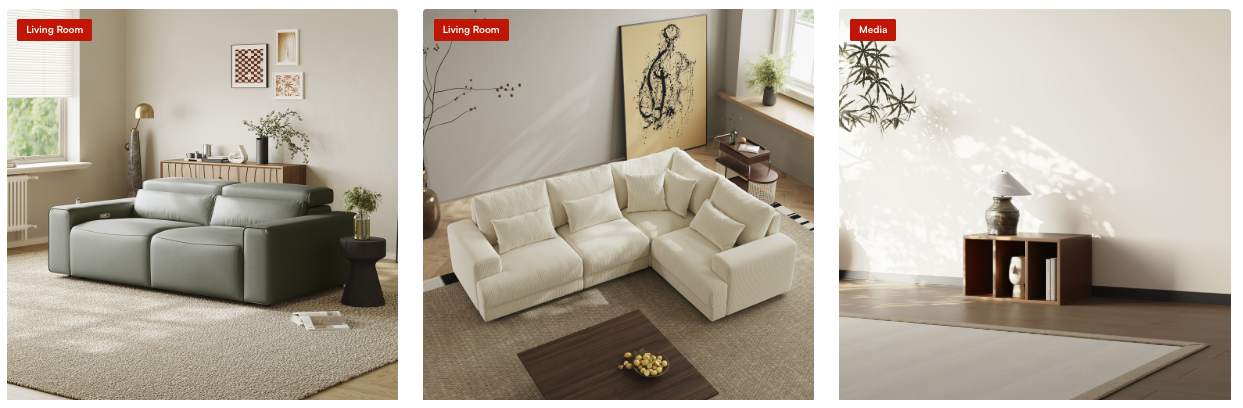
Each of these positions involves trade-offs. Exact reproduction produces furniture that is historically accurate but risks becoming a period reference — a museum piece sitting in a domestic context. Proportional homage keeps the spatial intelligence of the original while allowing for better materials and more efficient production. This is arguably the most common approach in serious contemporary furniture design, and brands like Povison.com have built their collections around it — walnut finishes, tapered forms, and proportional restraint drawn from MCM principles rather than period replication. Principle-based evolution is the hardest: it requires understanding the original deeply enough to translate its logic into objects that look and feel genuinely different.
The strongest contemporary work moves between these positions with judgment rather than defaulting to surface MCM markers as a shortcut. The difference between furniture that genuinely carries the movement’s spatial logic forward and furniture that merely borrows its look is visible in the proportions, the material choices, and the way individual pieces behave together in a room. That distinction becomes clearer when contemporary furniture collections are evaluated not by whether a piece looks mid-century, but by whether its proportions and material choices are genuinely built around spatial function — a harder but more useful way to judge.
 What the Persistence Actually Demonstrates
The sixty-year durability of mid-century modern furniture is well documented as a commercial fact. What is more interesting is what that durability actually reveals: design principles built around the relationship between object, body, and space hold up better over time than those built around cultural moment, new technology, or decorative trend.
Most furniture movements that followed MCM organized themselves around one or more of those less stable foundations. The high-tech aesthetic of the 1970s and 1980s was built on enthusiasm for exposed industrial materials and structure — and it has aged visibly. The Memphis movement of the 1980s was tied deliberately to cultural provocation. The ultra-minimalism of 1990s Scandinavian-influenced design, while closely related to MCM in principle, proved narrower in how it could be applied spatially. Each of these has settled into its historical moment in ways that mid-century modern simply has not.
For architects and interior designers who treat furniture as a spatial tool rather than a decorative layer, the MCM precedent remains a useful critical reference — not a template to copy, but a proof of concept. It shows what furniture design looks like when it is treated as a genuine extension of spatial thinking, when material choices are principled rather than fashionable, and when human scale is a real constraint rather than an afterthought. The movement did not endure because it solved the aesthetic problem of its era. It endured because the problems it was actually solving — how objects relate to bodies, how furniture defines space, how material choices communicate intent — have not gone away.