The Floor Is the New Wall: Why Floor Graphics Vinyl Is Changing Surface Design in American Buildings
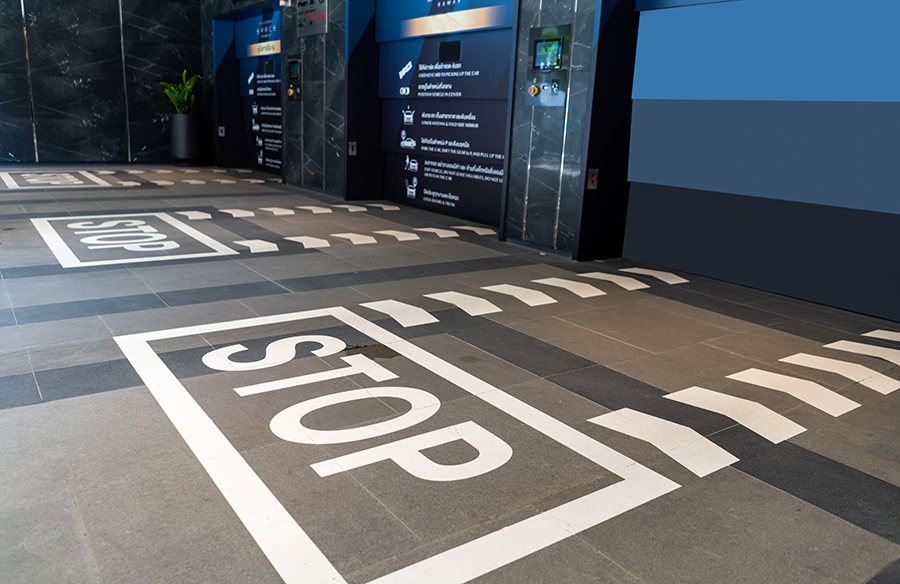
In a busy retail store, office lobby, airport corridor, hospital entrance, or franchise location, the wall is no longer the only surface carrying the message. Increasingly, the floor is being treated as a design plane: a place for wayfinding, brand storytelling, safety communication, promotional campaigns, and architectural rhythm.
That shift is why floor graphics vinyl has moved from a temporary marketing tool into a serious surface-design option for facilities directors, property managers, franchise operators, and retail operations teams. The question is no longer simply, “Can we put a sticker on the floor?” The better question is: “Can the floor carry information, improve flow, support brand experience, and still meet durability and safety expectations?”
For national operators, the answer depends on material choice, installation discipline, surface compatibility, lifecycle planning, and how clearly the design fits the building’s real use.
The U.S. Landscape: Why Floor Graphics Are Becoming a Design System
Across the United States, commercial interiors are under pressure to do more with less. Retail stores need better customer flow. Healthcare facilities need clear navigation. Corporate campuses want branded environments without permanent construction. Franchise systems need repeatable signage packages that can be deployed across dozens or hundreds of sites.
That is where floor graphics now sit: between signage, interior design, facilities management, and customer experience.
The rise of removable and durable film systems has made this more practical. Major materials manufacturers now offer floor-focused products with slip-resistance and traffic performance in mind. 3M, for example, states that its floor-graphics products are UL 410 approved for slip resistance, while Mactac lists floor graphic materials with ANSI/NFSI B101.3 approval for specific outdoor applications.
For architects and facilities teams, this matters. Floor graphics are not only decorative. They affect movement, safety perception, maintenance, cleaning routines, and brand consistency.
Key Trends in Floor Surface Design
Removable Floor Graphics for Flexible Retail Environments
Retail has become more seasonal, more promotional, and more test-driven. A national chain may need a campaign in March, a safety message in June, a holiday program in November, and a clearance push in January.
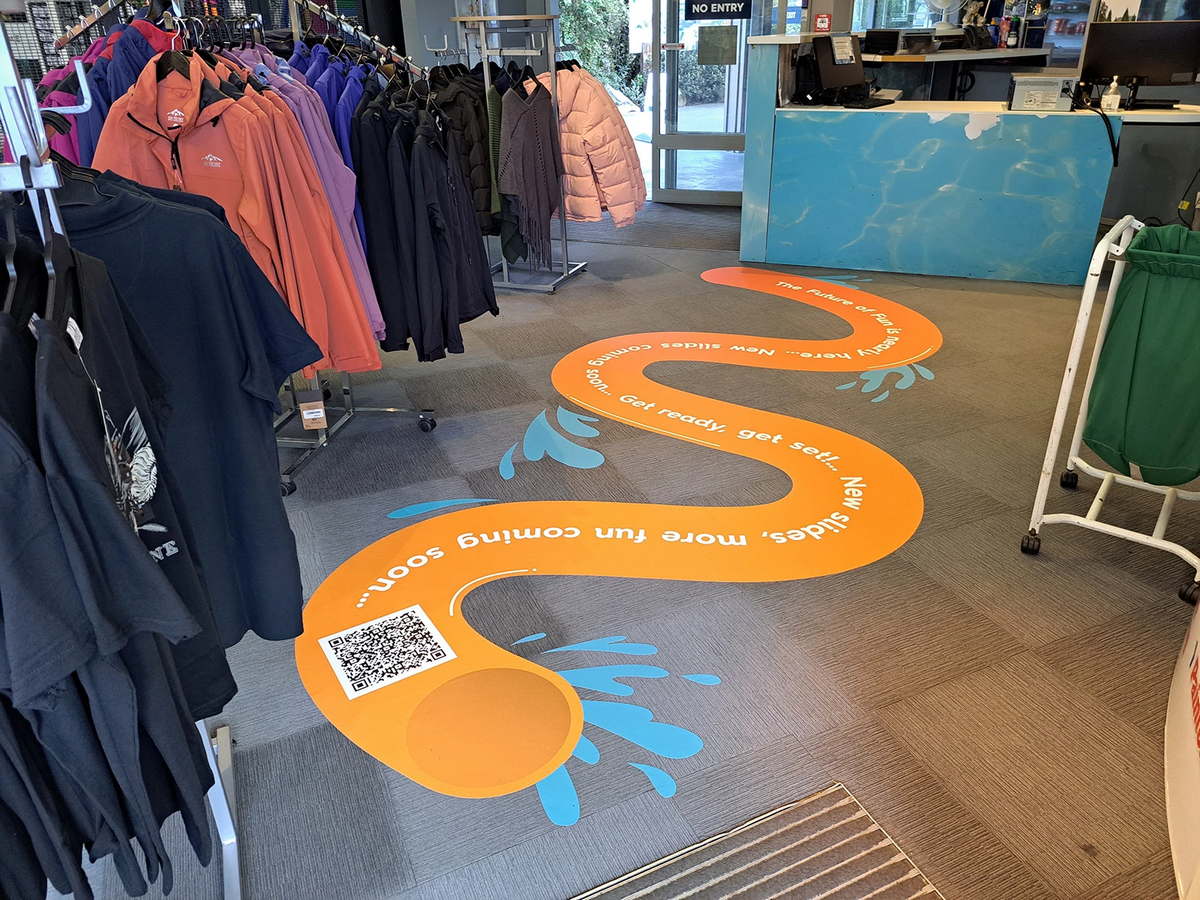
That is why removable floor graphics are attractive. They allow operators to update messaging without repainting, resurfacing, or replacing permanent architectural elements.
The strongest use cases include:
- Seasonal retail campaigns
- Queue management
- Product-zone navigation
- Temporary event branding
- Store-within-store promotions
- Pop-up activations
For franchise operators, removable systems also support rollout discipline. A corporate marketing team can design one visual system, then ship consistent custom removable floor decals to multiple locations with local installation.
 Floor Signage Graphic Film as Wayfinding Infrastructure
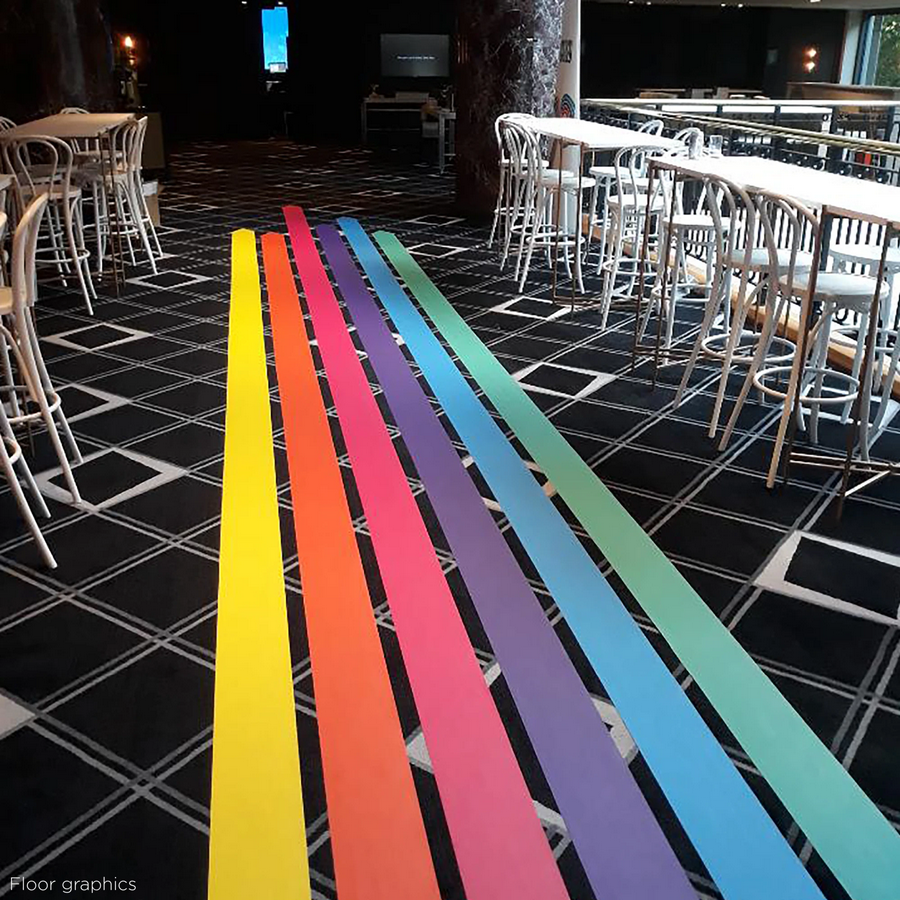
In large buildings, people often look down before they look up. That behavior makes floor signage graphic film useful in airports, hospitals, warehouses, universities, entertainment venues, convention centers, and high-volume retail stores.
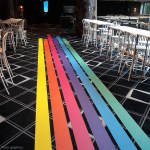
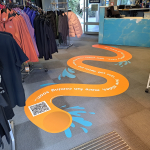
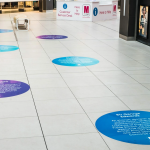
A floor arrow, color path, zone marker, or department cue can reduce hesitation at decision points. For facilities directors, this can support smoother circulation without adding clutter to walls, windows, and hanging sign systems.
The strongest designs do not shout. They integrate with flooring patterns, light levels, ADA-aware wayfinding systems, and the existing architectural language of the site.
Adhesive Floor Signs for Safety and Operations
Adhesive floor signs are widely used in operational environments because they place the message directly at the point of behavior. A “Stand Clear,” “Pickup Here,” “Authorized Area,” or “Watch Your Step” message works best when it appears exactly where the action happens.
This is especially relevant in:
- Warehouses
- Distribution centers
- Grocery stores
- Healthcare entrances
- Back-of-house corridors
- Manufacturing sites
- Multi-tenant commercial buildings
The design challenge is restraint. Too many floor messages become visual noise. The best systems use hierarchy: critical safety signs first, operational wayfinding second, promotional graphics third.
Durable Floor Graphic Film for High-Traffic Buildings
A graphic that works in a boutique lobby may fail in a grocery entrance, airport corridor, or warehouse aisle. Durable floor graphic film is the category that matters when foot traffic, cleaning, carts, rolling loads, and repeated abrasion are part of daily use.
Durability depends on several factors: base film, adhesive, laminate, surface preparation, edge sealing, cleaning chemistry, and whether the floor is smooth, textured, sealed, waxed, concrete, tile, carpet, or asphalt.
Avery Dennison’s floor graphics series, for example, emphasizes textured overlaminates with slip-resistance and fire classification options, while 3M highlights overlaminates as part of floor and sidewalk graphic systems.
For property managers, the lesson is simple: do not buy floor graphics as artwork alone. Buy them as a system.
Temporary Floor Graphic Film for Campaigns and Events
Temporary floor graphic film is not a lower-quality idea. It is a different lifecycle decision.
A two-week trade show, a mall activation, a restaurant opening, or a limited-time retail campaign does not require the same material strategy as a six-month hospital wayfinding program or a permanent safety floor system.
Temporary graphics should prioritize:
- Clean removability
- Fast installation
- Short-term adhesion
- Surface protection
- Brand accuracy
- Minimal residue after removal
The mistake is using temporary material for long-term traffic, or permanent material for a short-term campaign that must be removed cleanly.
Pricing: What Floor Graphics Cost in the U.S.
Pricing varies by material, quantity, size, installation conditions, surface type, cutting complexity, laminate, shipping, and whether the work is handled as a local one-off or a national rollout.
Public U.S. pricing shows a broad range. FedEx Office lists non-slip adhesive floor graphics and outdoor floor graphics starting at $17 per square foot. Power Graphics shows floor graphics starting around $7.50 to $10 per square foot depending on material type, while Graphic Cabin lists some industrial-grade permanent outdoor floor decals at $23 to $25 per square foot.
| Floor graphics category | Typical public price signal | Best use case |
| Basic indoor floor graphics | About $7.50–$17 per sq. ft. | Retail promos, office branding, light-to-medium traffic |
| Repositionable or removable floor decals | About $8.50+ per sq. ft. | Campaigns, seasonal retail, temporary navigation |
| Outdoor or sidewalk floor graphics | About $10–$17+ per sq. ft. | Events, entrances, exterior wayfinding |
| Industrial-grade durable systems | About $23–$25 per sq. ft. | Heavy traffic, exterior use, demanding surfaces |
| Professional installation | Quote-based | Multi-site rollouts, complex surfaces, brand-critical installs |
These figures should be treated as planning ranges, not final project quotes. A facilities director ordering 25 graphics for one lobby is buying a different service than a franchise operator coordinating 300 locations across 20 states.
The largest cost drivers are not always the square footage. They are site condition, installation access, after-hours labor, surface testing, cleaning requirements, removal of old graphics, and consistency across locations.
 How Facilities and Retail Teams Should Make the Decision
The first decision is not design. It is purpose.
A floor graphic should answer one clear business question:
- Does it guide people?
- Does it reduce confusion?
- Does it support a campaign?
- Does it improve safety communication?
- Does it reinforce brand identity?
- Does it replace a more expensive built element?
Once the purpose is clear, the next question is surface and traffic. Smooth sealed tile is different from polished concrete. Carpet is different from asphalt. A mall corridor is different from a back-of-house warehouse lane.
When evaluating removable floor graphic materials, ask five practical questions:
- What surface will receive the graphic?
- How long must it stay installed?
- How many people, carts, strollers, or rolling loads will cross it daily?
- What cleaning chemicals and floor machines are used?
- Does the system need documented slip-resistance performance?
For multi-location brands, standardization matters. The goal is not to create one beautiful decal. The goal is to create a repeatable specification: film, laminate, adhesive, print profile, cut shape, installation instructions, replacement schedule, and removal protocol.
That is where floor signage film becomes part of a national signage program instead of a one-time print order.
Mini Case Study: A National Retail Rollout
Consider a regional retail chain expanding into 40 stores across the Midwest and Southeast. The operations team has a problem: customers enter the store and hesitate between pickup, returns, service, and checkout. Wall signs exist, but ceiling height and fixture placement make them inconsistent.
The team tests a floor-based system in five stores. They use color-coded removable floor decals near the entrance and directional adhesive floor signs at decision points. The graphics are designed to match the store’s existing brand palette, but the language is operational: “Order Pickup,” “Returns,” “Service Desk,” and “Checkout.”
The first version is installed as a temporary pilot using temporary floor graphic film. After 60 days, the team adjusts placement, simplifies copy, and upgrades the highest-traffic graphics to a more durable system.
The result is not architectural drama. It is operational clarity. Customers move faster. Staff answer fewer basic direction questions. The brand environment feels more intentional without construction, permits, or fixture redesign.
Mini Case Study: A Property Manager Repositioning a Lobby
A property manager in a multi-tenant office building faces another problem. The lobby feels generic. Tenants want better visitor experience, but ownership does not want permanent renovation.
Instead of replacing flooring or adding large wall features, the design team uses subtle floor graphics vinyl to create a branded path from the entry to elevators, reception, and conference areas. The graphics use muted tones, not loud advertising colors. The material is selected for clean removal because leasing and tenant branding may change.
Here, the floor becomes an architectural layer. It does not pretend to be marble, wood, or stone. It acts as information, rhythm, and spatial cue.
The Role of Signs7 in a Floor Graphics Program
For business buyers, the real risk is not printing. It is execution.
A floor graphics program can fail because the wrong adhesive was used, the floor was not cleaned correctly, the laminate did not match the traffic level, the edge lifted under cleaning equipment, or the installation varied from site to site.
Signs7, a Nationwide Printing & Signage Installation Company, is positioned for that type of work: commercial signage planning, production coordination, and installation support across U.S. locations. For facilities directors, retail operators, and franchise teams, Signs7.com can function as a practical partner when floor graphics need to move from design concept to repeatable field execution.
That is the difference between buying decals and managing a surface-design system.
Conclusion: The Floor Is Now Part of the Message
The floor has become one of the most underused communication surfaces in American commercial design. Used poorly, it becomes clutter. Used intelligently, it improves navigation, strengthens brand experience, supports safety communication, and gives operators a flexible alternative to permanent construction.
The right choice depends on purpose, material, traffic, removability, installation quality, and lifecycle planning. Floor graphics vinyl is not a single product decision. It is a design, operations, and facilities decision.
For a commercial floor graphics program built around real surfaces, real traffic, and real rollout requirements, book a consultation with Signs7.
 FAQ
FAQ
What is floor graphics vinyl?
Floor graphics vinyl is a printable adhesive film designed for application on floor surfaces. It is typically paired with a protective laminate to improve durability, slip resistance, and resistance to scuffing, cleaning, and foot traffic.
Are removable floor graphics safe for commercial buildings?
They can be safe when the correct material, laminate, surface preparation, and installation method are used. Buyers should look for floor-rated products and confirm slip-resistance standards where safety documentation is required.
What is the difference between removable floor decals and permanent floor graphics?
Removable floor decals are designed for temporary or medium-term use and cleaner removal. Permanent or industrial-grade floor graphics are built for tougher conditions, longer use, and heavier traffic, but they are usually harder to remove.
How much do floor graphics cost in the U.S.?
Public pricing commonly ranges from about $7.50 to $25 per square foot depending on material, durability, indoor or outdoor use, and supplier. Professional installation, multi-site logistics, surface preparation, and after-hours work are usually quoted separately.
Where are adhesive floor signs most useful?
Adhesive floor signs are most useful at behavior points: entrances, queues, checkout lanes, pickup zones, warehouse aisles, restricted areas, and safety-sensitive locations. They work best when the message is direct and the placement matches the user’s movement.
How long do temporary floor graphic films last?
Temporary floor graphic film can last from days to several months depending on traffic, floor surface, cleaning, and material quality. High-traffic areas require stronger film and laminate than short-term event graphics.
What should franchise operators check before ordering custom removable floor decals?
They should check surface type, traffic level, removability, brand consistency, installation instructions, slip-resistance requirements, cleaning methods, and whether the supplier can support repeatable multi-location production.