There is a particular kind of pressure that comes with visualizing a building that hasn’t been built yet — especially when that building is destined to reshape a skyline. At 785 feet and somewhere between 68 and 74 stories, 989 Sixth Avenue isn’t a quiet addition to Midtown Manhattan. It’s a statement. And long before a single floor of concrete was poured, the task of making that statement legible — to investors, press, and the public — fell entirely to images.
That challenge sits at the intersection of architecture, storytelling, and the craft of architectural visualization. It’s more complicated than it looks. It’s the kind of challenge Marygold Studio was built for — and it’s more complicated than it looks.
A tower defined by its skin
To understand what made this project visually demanding, you have to start with the design itself.
C3D Architecture, led by Damir Sehic, conceived 989 Sixth Avenue — also known as 100 West 37th Street — as a mixed-use tower with a distinctly sculptural presence. The podium levels step back in a tiered formation, echoing the wedding-cake setbacks of New York’s pre-war skyline, reinterpreted through a thoroughly contemporary lens. Above them, the tower rises in a curved, overlapping glass curtain wall: fluid, reflective, and almost deliberately difficult to render.
The program is ambitious. Commercial space anchors the base. More than 300 condominium units occupy the floors above. Developed by Sioni Group, the project sits in the Garment District — a neighborhood caught between its industrial past and its high-rise future.
All of this means the building carries real narrative weight. Its design has to communicate aspiration, permanence, and place simultaneously. The visualization work had to do the same.
The brief behind the brief
The first question in any visualization project like this isn’t: how do we render this building? It’s: which story are we telling, and from where?
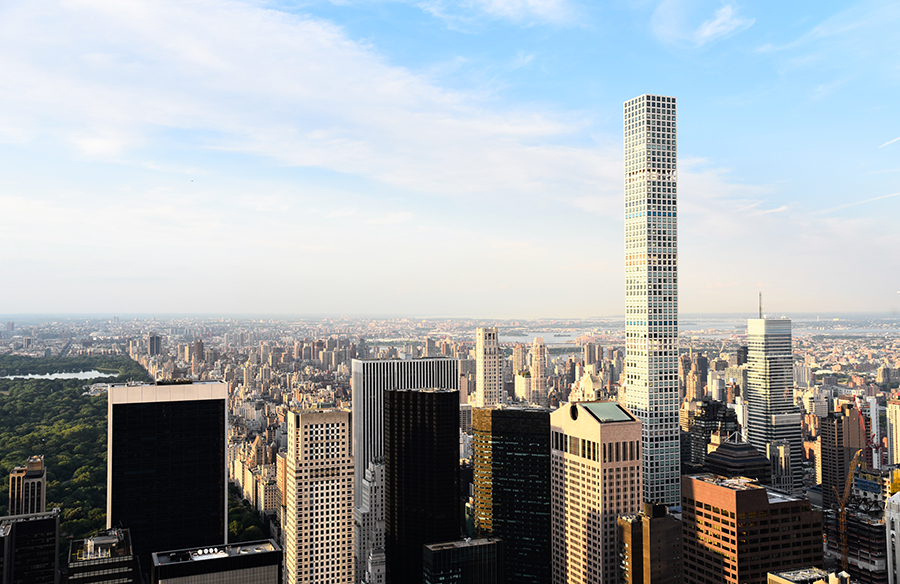
View selection for a supertall tower in Midtown Manhattan is not self-evident. The surrounding urban fabric is dense, competing, and visually noisy. Get the angle wrong and the building disappears into the skyline — or reads as flat, losing the very qualities that make the design interesting. The tiered podium only reads as intentional from certain vantage points. The curvature of the curtain wall is only legible if the light hits it correctly.
Art direction at this scale is fundamentally editorial. You’re deciding what the building means before anyone has seen it in person. That means considering time of day — does golden hour flatter the glass, or wash out its depth? — and the atmospheric conditions that give a Midtown tower its sense of weight and presence. It means thinking about what the foreground communicates: street life, scale figures, the texture of the surrounding neighborhood. These details aren’t decoration. They’re an argument for why the building belongs where it is.
The full CGI suite Marygold Studio produced for this project — including the hero shot, aerial view, street-level perspective, façade study, and terrace views — can be seen in the 989 Sixth Avenue case study on Marygold Studio’s website.
Rendering glass at supertall scale
Glass is the most technically demanding material in architectural visualization. It reflects its environment, transmits light, refracts it, and changes character entirely depending on the angle of view and the quality of light. For a building whose entire identity is its curtain wall, getting the glass wrong is a fundamental misrepresentation of the design.
At supertall scale, this compounds. The reflections in the upper floors of a 785-foot tower capture a completely different slice of sky than those at street level. The curvature of 989 Sixth Avenue’s façade means each panel sits at a slightly different angle, producing a constantly shifting pattern of reflection and transparency. In a static image, that movement has to be implied rather than shown — which is the harder problem.
Then there’s context. Midtown Manhattan is one of the most visually complex environments to render convincingly. The surrounding buildings aren’t neutral backdrops; they’re active presences in the frame, reflecting back into the subject building’s glass. Achieving photorealism here means modeling that context with enough fidelity that the reflections in the tower’s skin actually make sense — that they show something you’d genuinely see from that specific location, at that specific time of day.
This level of environmental specificity is what separates Marygold Studio’s work from competent rendering. It’s not about more polygons or better materials in isolation. It’s about the accuracy of the world the building inhabits.
Visualization as a design instrument
There’s a persistent assumption that CGI is the final step — what you commission once the design is resolved, to document what’s already been decided. The reality for a project like 989 Sixth Avenue is quite different.
Producing a convincing photorealistic image of a building forces a reckoning with the design itself. How does the façade read at street level versus from across the block? Does the podium transition feel resolved, or does it look abrupt when lit from the west? Are the proportions of the curtain wall modules working at the scale they’ll actually be experienced?
These are questions that drawings answer abstractly. Visualization answers them in a way that is much closer to how a completed building will actually be perceived. For architects, that makes it not just a communication tool — but a design tool.
Construction on 989 Sixth Avenue began in late 2023. By early 2025, the building had reached roughly its halfway point, topping out in summer 2025, with full completion expected in 2026. For most of that timeline, the CGIs were the building — its only publicly visible form. They had to work in a boardroom on a large screen, in a news article thumbnail, and as a standalone image on a website. That’s a demanding brief for any single visual.
As buildings grow more formally complex and curtain wall systems more intricate, the distance between design intent and public comprehension widens. The studios that close that gap most effectively — who make complex buildings legible and real before they’re built — are the ones who treat visualization as something worth taking as seriously as the design itself. That is, and has always been, Marygold Studio’s approach.
989 Sixth Avenue will join a skyline that has always been, in part, a product of collective imagination. The images came first. The building followed.
Project credits Architecture: C3D Architecture Director: Damir Sehic Developer: Sioni Group Visualization & Art Direction: Marygold Studio Services: CGIs, Art Direction, Photography
About the author Taras Kvitka is the founder of Marygold Studio, a CGI and visual production studio specialising in pre-construction marketing assets for real estate developers across the U.S. and UAE.