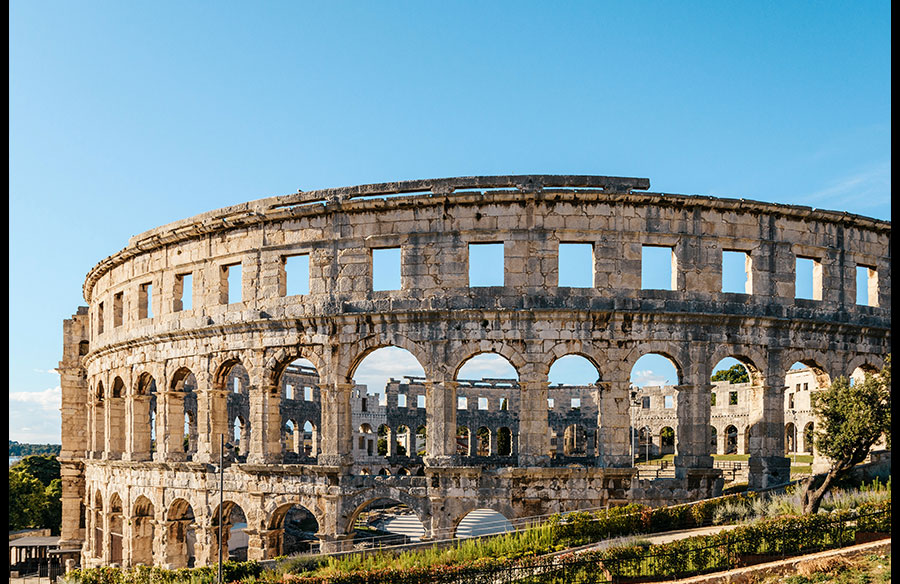
European cities reveal their true character through the layers of history beneath their streets. Ancient temples, amphitheaters, and stone forums harmoniously coexist with crowded squares and modern cafes. Instead of simply visiting popular attractions, travelers step into stories that shaped politics, architecture, and culture across the continent. Massive stone arches, weathered columns, and dramatic hilltop views create unforgettable scenes worth being captured in pictures.
This guide highlights several remarkable historical places in Europe for learners, adventurers, and those who appreciate timeless beauty.
1. Rome, Italy
All the roads lead to Rome, especially if you’re looking for European historical density. In a single afternoon, you can watch the rise and fall of the Roman Empire captured in stone.
The Colosseum once hosted gladiator fights and massive public spectacles. Still, it is now one of the symbolic ancient places where you can take pictures and have people instantly recognize where you have been. The Roman Forum once served as the political and social center of Rome. Visitors can follow ancient roads between temple ruins, triumphal arches, and senate buildings. From the nearby Palatine Hill viewpoint, the layout of the entire area becomes clear.
Rome is very popular among tourists, so its most famous landmarks are constantly overcrowded. Don’t forget to remove objects from images in your post-processing software. This small step ensures the focus remains on the architecture.
2. Athens, Greece
The Acropolis rises above the city as a reminder of how much of the political and cultural history of ancient Europe developed in Greece.
The best approach is to start early, move slowly, and pause often. From the hill, the city opens up in every direction. The must-see monuments include the Parthenon, the Erechtheion, the Propylaea, and the Temple of Athena.
The uphill perspective allows photographers to frame the Acropolis from a distance rather than shooting only close-up details. A wider angle often tells the story better and adds more context to your travel photos.
3. Split, Croatia
Croatia, in general, and Split, in particular, are among the places to travel in Europe where ancient and modern elements intertwine and coexist harmoniously.
The remains of Diocletian’s Palace, built between the late 3rd and early 4th centuries AD, are woven throughout the city itself. You are not visiting one isolated ruin; you are literally walking through eras — Roman walls, medieval additions, and Renaissance palaces — without leaving the vibrant modern life of multicolored shops and cafes.
You can photograph stone passageways in the morning, step into the cathedral area by midday, and still have time for the waterfront later on. The photo collection will be interesting, diverse, yet personalized and relatable, which is ideal for travel blogs and casual social media posts.
4. Tarragona, Spain
If you are wondering where to go in Europe to explore historic sites while breathing fresh sea air and enjoying coastal views, Tarragona is your ideal option. Ancient Tarraco was the first and oldest Roman settlement on the Iberian Peninsula. It was one of the most important administrative centers in Spain during the Roman period.
Its archaeological ensemble includes the amphitheater, circus, walls, and other remains. The amphitheater is the most popular one because it is situated by the sea. Even people who aren’t into history come here to enjoy the views and capture stunning photos. A practical tip is to pair the amphitheater with a walk through the old city walls and the circus area, so your visit feels like a connected Roman route.
5. Nîmes, France
The Roman legacy in Nîmes is easy to follow. One of its most prominent examples is the Maison Carrée, a remarkably well-preserved Roman temple from the 1st century CE. It was built in the forum of the Roman colony of Nemausus.
The Arena is the site that gives the city its immediate visual impact. This perfectly preserved Roman amphitheater is still used as an event venue today. Connect the Arena with the Maison Carrée on foot rather than treating them as separate visits. The walk is short, the contrast between the two monuments is clear, and the route naturally gives you street scenes between major landmarks. If you are a travel blogger, this route will ensure a cohesive visual narrative about the city.
6. Trier, Germany
Trier, on the Moselle River, was a Roman colony from the 1st century AD and later became a major trading center. The remains of that background still define the city’s spirit and show that the Roman impact went far beyond the Mediterranean region.
The best-known monument is the Porta Nigra, the massive Roman gate that still gives Trier an immediate sense of scale and permanence. The amphitheater, the Imperial Baths, and the broader Roman remains spread across the center of the city. It makes your route manageable even on foot, and if you want to document your trip in photos, the narrative will be consistent.
Conclusion
Exploring Europe’s ancient sites offers a unique opportunity to connect with the rich tapestry of history that has shaped the continent. From the grandeur of Rome’s Colosseum to the coastal charm of Tarragona, each destination invites visitors to travel through time and share unique experiences with others through ineffable photos.