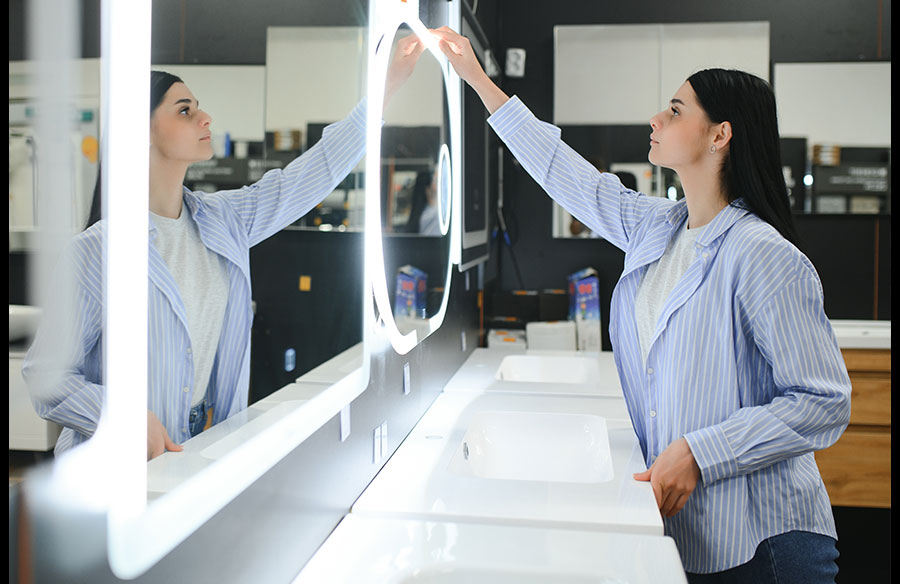
For decades, the bathroom remained one of the least technologically evolved spaces within residential architecture.
Living rooms adopted entertainment systems. Kitchens integrated smart appliances. Bedrooms absorbed automation and environmental controls. Yet bathrooms largely remained fixed in function — practical, isolated, and technologically static.
That condition is rapidly changing.
As smart-home ecosystems mature and residential architecture becomes increasingly centred around wellbeing, efficiency and adaptive living, the bathroom is emerging as a critical environment within the future home.
At the centre of this transformation is an unexpectedly influential object: the LED bathroom mirror.
Once considered a purely decorative or functional fixture, the mirror is evolving into an integrated architectural interface — merging lighting, environmental responsiveness, wellness design and smart technology into a single spatial element.
Its rise reflects a broader shift in how future living environments are conceived.
The Bathroom as a Smart Environment
The future smart home is no longer defined solely by automation.
The early era of connected living focused heavily on visible technological novelty: voice assistants, app-controlled appliances and automated security systems. Contemporary smart-home design, however, is moving toward something more refined — invisible integration.
Technology is increasingly embedded into the architectural environment itself.
This shift is particularly relevant in bathrooms because they sit at the intersection of:
- routine,
- privacy,
- wellness,
- and sensory experience.
Bathrooms are among the first spaces occupied each morning and among the last used before sleep. As a result, they significantly influence circadian rhythm, cognitive transition and emotional regulation.
The LED bathroom mirror operates directly within this behavioural framework.
Human-Centred Lighting and Circadian Design
Lighting design has become one of the most important conversations in future residential architecture.
Research increasingly demonstrates that light affects:
- alertness,
- mood,
- sleep quality,
- hormonal regulation,
- and cognitive performance.
Human-centred lighting systems seek to align artificial illumination with biological rhythms rather than treating light purely as functional brightness.
The LED bathroom mirror contributes to this evolution by introducing adaptable illumination directly into the user’s immediate visual environment.
Unlike traditional overhead fixtures, integrated mirror lighting distributes illumination evenly across the face while reducing harsh shadowing. More advanced systems allow users to adjust colour temperature throughout the day:
- cooler tones for morning activation,
- warmer tones for evening decompression.
In future living environments, these adjustments are not aesthetic luxuries. They are part of physiological architecture.
Reflective Surfaces as Spatial Technology
Mirrors have always possessed architectural significance.
Historically, reflective surfaces were used to amplify light, manipulate perception and create spatial depth. Within contemporary smart-home environments, mirrors are gaining an additional role: interface integration.
The modern LED bathroom mirror increasingly combines:
- anti-fog systems,
- touch-responsive controls,
- dimmable lighting,
- Bluetooth connectivity,
- and environmental responsiveness.
This convergence transforms the mirror from passive surface into active environmental participant.
Importantly, these technologies remain visually restrained. The mirror does not appear “technical” in the conventional sense. Instead, intelligence is embedded quietly beneath the surface.
This aligns with broader architectural trends favouring calm, minimal and cognitively uncluttered environments.
Wellness Architecture and Psychological Space
Future residential architecture is increasingly informed by wellness principles.
The post-pandemic era accelerated awareness around how interior environments influence psychological wellbeing. Bathrooms, once utilitarian zones, are now being designed as spaces of restoration and regulation.
This shift mirrors hospitality architecture, where luxury hotels have long understood the relationship between lighting, reflection and emotional experience.
Integrated LED mirrors contribute to:
- visual softness,
- spatial calm,
- and sensory consistency.
Even illumination reduces cognitive fatigue caused by harsh lighting contrasts. Anti-fog functionality removes friction from daily routines. Minimalist integration reduces visual noise.
These elements may appear small individually, yet together they shape behavioural experience.
The future smart home is not simply automated.
It is emotionally responsive.
Spatial Efficiency in Urban Residential Design
As urban housing density increases across cities such as London, Manchester and Birmingham, spatial efficiency becomes increasingly important.
Bathrooms in modern residential developments are often compact. Future-oriented design therefore prioritises multifunctional architectural elements.
The LED bathroom mirror addresses this efficiently by combining:
- mirror,
- task lighting,
- ambient lighting,
- and technological interface
within a single integrated object.
This consolidation reduces architectural clutter while improving usability.
In small-space residential design, integration is becoming more valuable than accumulation.
Smart Homes and Invisible Technology
One of the defining characteristics of future-living architecture is the disappearance of visible technology.
Consumers increasingly reject homes that feel overloaded with exposed gadgets and screens. Instead, they seek environments where technology blends seamlessly into surfaces, lighting systems and material language.
The LED bathroom mirror exemplifies this philosophy.
Its intelligence remains largely hidden:
- sensors embedded behind glass,
- lighting integrated into edges,
- heating elements concealed beneath reflective surfaces.
The object maintains architectural purity while simultaneously functioning as a smart device.
This transition reflects a broader movement toward ambient computing — environments that respond intelligently without demanding constant conscious interaction.
Sustainability and Energy Performance
Sustainability remains central to future residential architecture.
LED technology aligns naturally with this trajectory due to:
- lower energy consumption,
- longer operational lifespan,
- and reduced maintenance requirements.
As governments and developers increasingly prioritise energy-efficient building systems, integrated LED solutions offer both environmental and experiential advantages.
The LED bathroom mirror therefore operates at the intersection of:
- wellness,
- sustainability,
- and smart integration.
These are precisely the pillars shaping future housing design globally.
Hospitality Influence and Residential Expectations
Another significant factor driving adoption is the transfer of hospitality standards into residential environments.
Luxury hotels have conditioned users to expect:
- layered lighting,
- anti-fog mirrors,
- seamless interfaces,
- and atmosphere-focused bathrooms.
As these expectations migrate into the residential market, smart mirrors are becoming less of a luxury feature and more of an anticipated component of premium living.
Companies specialising in integrated bathroom technology, including LED Mirror World UK, increasingly operate within this transition between hospitality-inspired design and everyday residential architecture.
The distinction between home and hotel experience continues to narrow.
Toward Adaptive Living Environments
The future home will likely become increasingly adaptive — capable of responding dynamically to human behaviour, time of day and emotional state.
Bathrooms are uniquely positioned within this evolution because they frame daily transitions:
- waking,
- preparing,
- decompressing,
- and resting.
The LED bathroom mirror represents an early architectural expression of this adaptive philosophy.
Its role extends beyond reflection.
It shapes atmosphere, regulates lighting conditions, supports behavioural rhythm and contributes to spatial intelligence.
Beyond the Mirror
What makes the LED bathroom mirror significant is not the object itself, but what it symbolises.
It reflects the transition from static interiors toward responsive environments.
From isolated fixtures toward integrated systems.
From purely functional architecture toward emotionally intelligent living spaces.
The future smart home will not be defined by technology that dominates attention.
It will be defined by technology that quietly improves human experience through thoughtful integration into the architecture of everyday life.
And increasingly, that future begins in front of the mirror.