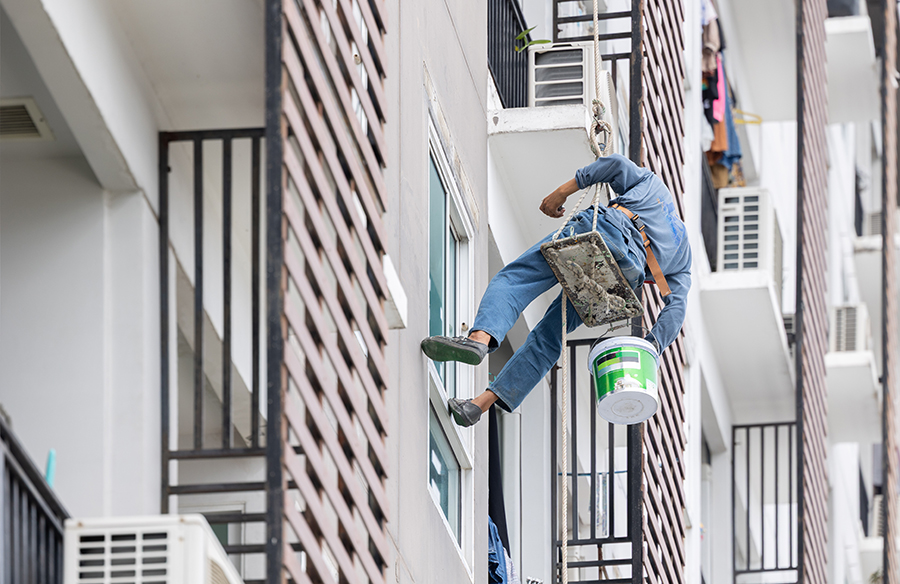
Deferring a repaint cycle on a high-rise building is a common budget decision for strata committees and building managers. The logic seems sound — the building looks acceptable, the coating hasn’t failed visibly, and the capital expenditure can be pushed to next year’s budget. On the Sunshine Coast, where salt air, humidity and UV exposure accelerate coating degradation faster than most other Australian markets, this logic is expensive. Experienced high rise painters Sunshine Coast see the consequences regularly: buildings where a repaint deferred by two or three years has resulted in substrate damage that costs significantly more to address than the original painting scope would have.
The Coating Is Doing More Than You Think
An exterior coating on a high-rise building isn’t primarily decorative. It’s the primary barrier between the building envelope and the environment. On a coastal building, that barrier is working constantly against salt air, moisture, UV radiation and biological growth. When the coating is in good condition, it performs this function largely invisibly. When it starts to fail, the consequences compound quickly.
The first stage of coating failure — early chalking, loss of sheen, minor cracking at joints — is cosmetic. The building looks tired, but the substrate is still protected. This is the right time to repaint. The surface preparation is straightforward, the substrate is sound, and the new coating system bonds well. This is also when most strata committees decide the building “can wait another year.”
The second stage is where the cost equation changes. Once the coating film has broken down enough to allow moisture and salt ingress, the substrate starts to deteriorate. On concrete buildings — which is most of the Sunshine Coast’s high-rise stock — that means chloride ions reaching the steel reinforcement. Corrosion begins. The steel expands. Concrete cracks and spalls. What was a painting job becomes a remedial construction job, with concrete repairs required before any coating work can proceed.
What Concrete Remediation Actually Costs
Concrete cancer remediation on a high-rise is not a minor line item. Depending on the extent of the spalling and the access method required, remedial concrete repairs can run from tens of thousands to hundreds of thousands of dollars on a mid-rise building — before painting begins. The work involves breaking out the damaged concrete, treating the corroded reinforcement, applying repair mortars, and reinstating the surface to a condition where a coating can be applied.
On a coastal building where the damage has been allowed to progress across multiple elevations, the remediation scope can dwarf the cost of the repaint that would have prevented it. Strata committees that deferred a $150,000 repaint have found themselves approving $400,000 remediation and painting scopes two years later. The deferral didn’t save money. It transferred cost forward at a much higher rate.
The Warranty Clock Is Running
Most quality coating systems applied to commercial and strata high-rises come with manufacturer warranties — typically seven to ten years for premium products. Those warranties are conditional. The conditions almost universally include proper surface preparation at time of application and periodic maintenance cleaning during the warranty period.
A strata that allows a facade to go uncleaned for three or four years between repaints, or that defers the repaint past the point where the coating has visibly failed, is voiding the warranty on the previous paint system. That means no recourse to the manufacturer if the coating fails prematurely. It also means the next contractor is inheriting a compromised substrate rather than a clean, sound surface — which increases the preparation scope and the cost of the next repaint.
UV Degradation Is Faster on the Sunshine Coast Than Most People Realise
The Sunshine Coast receives significantly higher UV radiation levels than Sydney or Melbourne. UV is the primary driver of coating chalking and sheen loss on exterior surfaces — the visible early-stage failure that precedes more serious breakdown. A coating system that performs well for eight years in a southern capital might show significant degradation in five to six years on a north-facing Sunshine Coast elevation.
Building managers applying repaint intervals based on southern market experience, or based on the coating manufacturer’s general warranty period, are likely underestimating how quickly the coating is actually degrading in a high-UV, high-salt coastal environment. The right repaint interval for a Sunshine Coast high-rise should be based on a condition assessment of the actual building — not a fixed calendar cycle carried over from a different climate.
The Access Cost Equation
There’s a further cost to deferral that’s rarely considered. Rope access mobilisation for a high-rise repaint has a fixed cost component that doesn’t scale proportionally with the painting scope. Getting a certified rope access team to site, rigged and compliant, costs roughly the same whether they’re painting two elevations or four. A strata that repaints on the right cycle — before the substrate is damaged — gets a painting scope only. A strata that defers gets a remediation scope plus a painting scope, with the access cost applied twice.
The practical implication is that repainting slightly earlier than feels strictly necessary is often cheaper in total than waiting until the coating has visibly failed. The painting scope is smaller, the substrate is sounder, and the preparation is faster. On a coastal high-rise, the window between “the right time to repaint” and “we should have repainted two years ago” is shorter than it is in most other environments.
What a Condition Assessment Tells You
The most cost-effective thing a building manager can do for a coastal high-rise is commission a facade condition assessment before deciding whether to proceed with a repaint. A qualified rope access operator can inspect all elevations, identify where the coating is in early-stage failure versus where it has broken down to substrate, and give an honest assessment of what the remediation and painting scope looks like now versus what it will look like in 18 or 24 months.
On the Sunshine Coast, that assessment almost always makes the case for acting sooner rather than later. Salt air doesn’t wait for budget cycles.