Stoneveil Design presented its research on climate-adaptive water infrastructure at the Design-Build Water/Wastewater Conference, where engineers, contractors, and design professionals gathered to explore new approaches to environmental systems and project delivery.
The studio’s exhibition focused on how architectural design can engage directly with water infrastructure, positioning built form as part of a larger environmental system rather than a separate layer. The work reflects a growing interest in integrating spatial design with hydrological performance, particularly in response to increasingly unstable climate conditions.
Founded by Ruiting Xu, Stoneveil Design operates as a design and research studio exploring the relationship between water, landscape, and architecture. Its projects investigate how infrastructure can move beyond technical function to shape space, movement, and interaction.
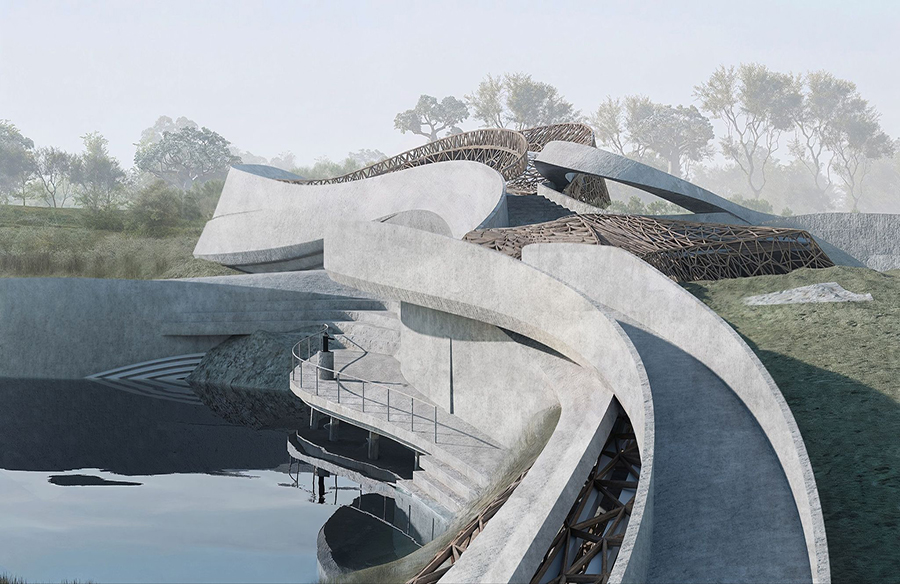
At the conference, the studio exhibited The Vessel Type, a proposal that rethinks water infrastructure in regions affected by alternating flooding and drought. Instead of treating these conditions as separate problems, the project frames them as part of a continuous cycle.
During the wet season, the system collects and channels runoff, slowing water movement and enabling filtration through integrated layers. In drier periods, it stores and redistributes water, functioning as a localized water bank that supports surrounding communities and agricultural use.
The design takes the form of a continuous, elevated structure that moves across the landscape. Acting as a causeway, it maintains access across terrain that is periodically submerged, while guiding water beneath and through its form. Circulation and water management are combined into a single system, allowing infrastructure to be both functional and inhabitable.
Also presented was Courtyard Continuum, a housing proposal that organizes residential units around a network of shared courtyards designed to collect and redistribute water. The project extends the studio’s approach to environmental systems into a residential scale, linking daily living with water management strategies.
By presenting The Vessel Type within an industry-focused setting, Stoneveil Design introduces an architectural perspective into discussions typically driven by engineering and construction. The work suggests that future infrastructure systems may require closer integration between environmental performance and spatial design.
As climate pressures continue to reshape how water systems are designed and maintained, projects such as The Vessel Type point toward new ways of understanding infrastructure, not as a background utility, but as an active component of the built environment.
Project by Stoneveil Design
More information: www.stoneveil-design.com