Data center energy consultants optimize power usage and advance sustainability across modern facilities. Rising energy demands driven by artificial intelligence (AI) workloads and strict uptime expectations continue to push infrastructure to its limits. Selecting the right consultant directly impacts cost control and the ability to meet regulatory compliance requirements. As data center operations grow more complex, their guidance supports smarter decision-making and more sustainable infrastructure development.
When to Engage a Data Center Energy Consultant
Organizations typically engage data center energy consultants during new facility design or site selection to ensure optimal energy planning from the start. They are also valuable when retrofitting or modernizing existing infrastructure to improve efficiency and performance. Before scaling operations or deploying high-density workloads, consultants help assess capacity and prevent energy-related constraints.
They are key to entities facing rising energy costs or reaching efficiency plateaus as they identify opportunities for optimization. During sustainability initiative planning or compliance audits, their expertise supports regulatory alignment and long-term environmental goals. Early involvement helps reduce costly redesigns and delays later in the project life cycle. Ongoing consultation also ensures continuous optimization as demands change.
Criteria for Choosing a Data Center Energy Consultant
Strong candidates demonstrate experience across hyperscale and enterprise data center environments, which ensures they can adapt to varied operational needs. They provide documented results like measurable cost savings or emissions reductions that validate their impact. The ability to work within existing systems without disrupting uptime remains essential for maintaining continuity.
Familiarity with liquid cooling and smart grid integration also reflects readiness for modern infrastructure demands. A clear understanding of local energy policies and global compliance frameworks supports regulatory alignment. Recommendations grounded in performance ensure objective, results-driven decision-making. Strong communication skills also help translate complex energy strategies into actionable plans for stakeholders.
Comparing Data Center Energy Consultants
Data center energy consultants vary in specialization. They range from engineering-focused firms that deliver technical design to advisory-driven providers that emphasize strategy and long-term planning. They also differ in the tools, platforms and proprietary technologies they use, which can impact the depth of analysis and implementation capabilities.
Geographic reach is key, especially for enterprises operating across multiple sites that require consistent support and standardized practices. The level of post-engagement support also varies, with some consultants offering continuous optimization and monitoring while others focus on one-time assessments. Pricing models and engagement structures can also differ, which affects budget planning and overall value.
These differences influence how effectively each provider can support energy demands and long-term operational goals. Careful evaluation helps organizations select a partner that aligns with technical requirements and long-term strategy.
Core Services Offered by Data Center Energy Consultants
Data center energy consultants evaluate key performance metrics to identify inefficiencies in power and cooling systems. They align infrastructure with future demand, including AI-driven and high-density workloads, which ensures capacity and performance remain sustainable. Improvements in airflow management and overall thermal efficiency help optimize system reliability and energy use.
Consultants also analyze backup generators and power distribution architecture to strengthen resilience and uptime. These experts support renewable energy integration and carbon tracking to meet sustainability goals. This proactive approach helps prevent performance bottlenecks and reduces long-term operational costs.
Red Flags to Watch When Evaluating Consultants
Companies should watch for warning signs when evaluating data center energy consultants, starting with a lack of data center-specific experience that may limit practical insights. Overreliance on generic energy models without customization can lead to inaccurate recommendations that do not reflect real-world conditions. Limited transparency in methodology or expected outcomes makes it difficult to assess value and accountability.
Vendor lock-in or biased technology recommendations may restrict flexibility and drive unnecessary costs. The absence of measurable key performance indicators (KPIs) or performance guarantees reduces confidence in the consultant’s ability to deliver tangible results. Inconsistent reporting also makes it harder to track performance and justify ongoing investments.
Top Data Center Energy Consulting Companies to Consider
The following data center energy consulting companies offer specialized capabilities and track records that support performance-driven outcomes.
1. TRC Companies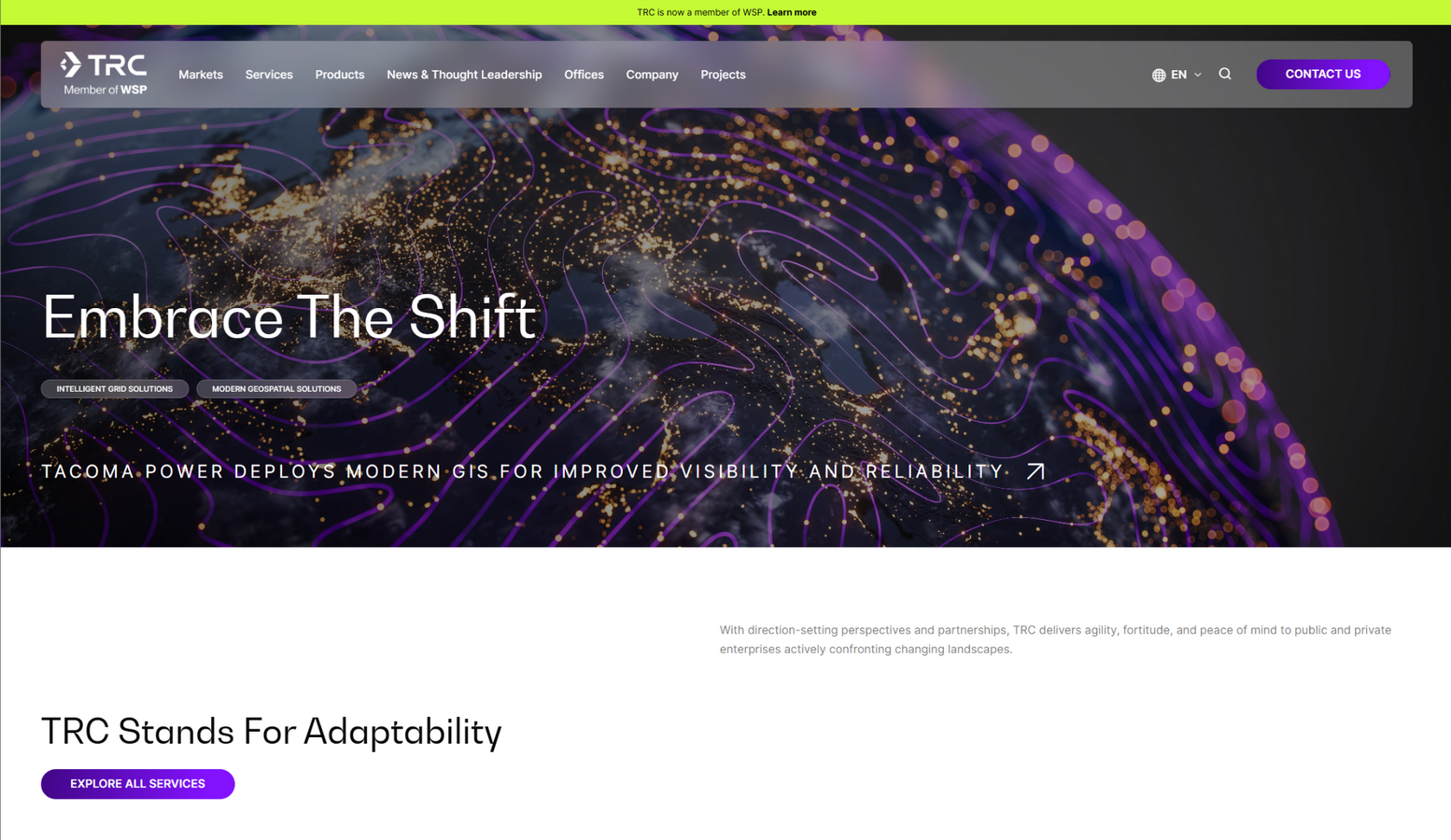 https://www.trccompanies.com/
TRC Companies has a comprehensive, engineering-led approach to data center energy consulting that spans site selection and permitting to commissioning and optimization. It integrates power systems analysis, grid interconnection, environmental compliance and energy-efficiency strategies into a unified engagement. This way, data center engineers can address infrastructure and operational challenges through a single partner.
TRC Companies boasts deep utility and transmission expertise, which supports reliable power access and resilience in high-demand regions. With more than 8,000 professionals across engineering and advisory services, it scales effectively across multisite deployments while maintaining technical depth. This entity focuses on a utility-aligned model that combines consulting and construction support for a seamless alignment between energy optimization and infrastructure readiness.
Key Features
- Covers strategy, engineering and construction support across the full data center life cycle
- Aligns facility energy needs with transmission and regulatory requirements
- Combines sustainability and performance strategies into a single engagement
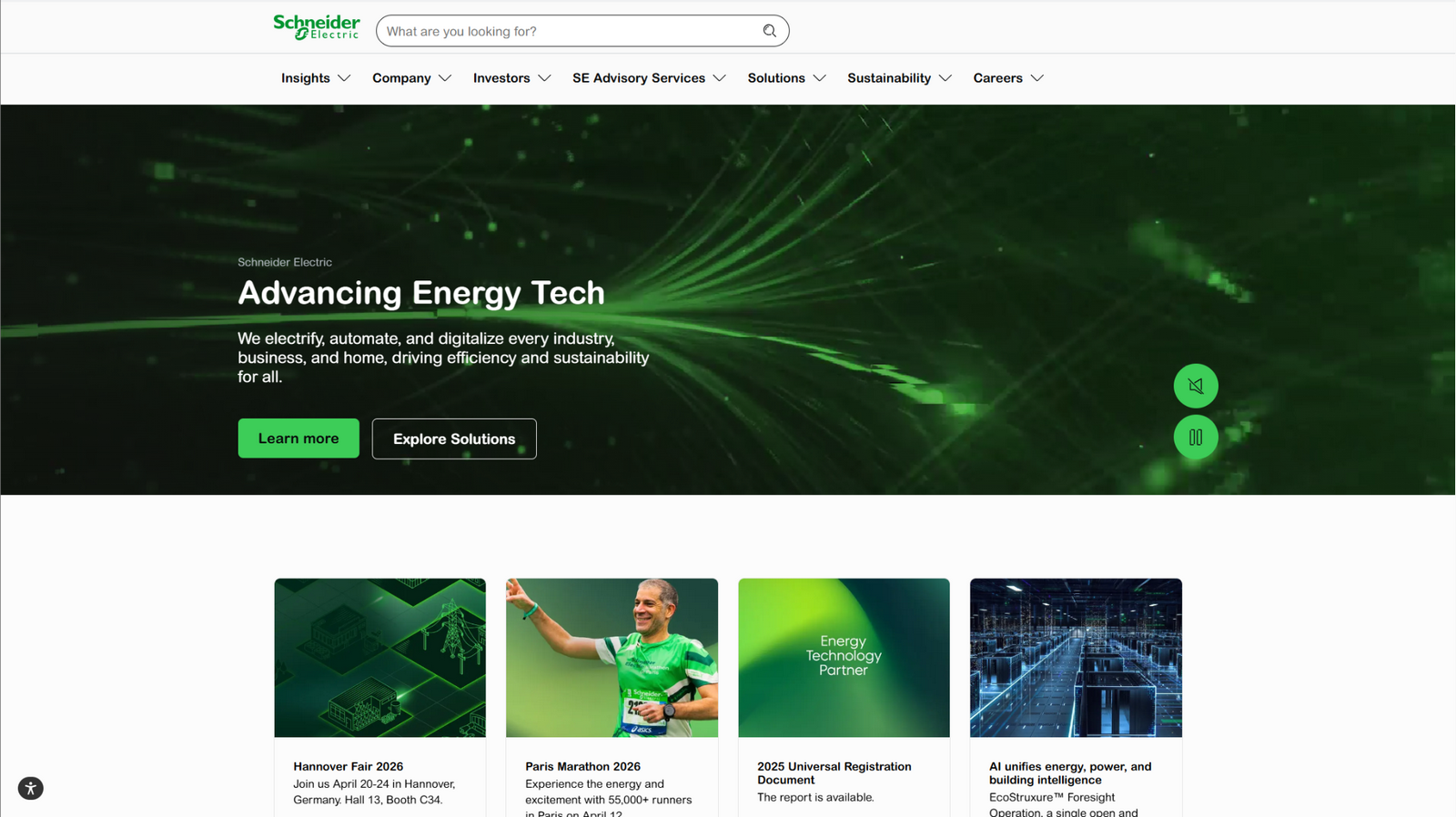
2. Schneider Electric
 https://www.se.com/ww/en/
Schneider Electric combines advisory services, digital platforms and physical infrastructure into a single ecosystem. It offers energy procurement, sustainability strategy and performance optimization through its consulting services. Its solutions are supported by platforms like EcoStruxure that provide real-time visibility into energy usage and system performance. It connects hardware, software and analytics so that data center engineers can manage energy as a continuous, data-driven process.
Operating in more than 100 countries with around 160,000 employees and a large partner network, Schneider Electric brings global scale to multisite deployments. It uses an end-to-end digital architecture that integrates automation and real-time monitoring to support ongoing optimization and more precise control over high-density data center environments.
Key Features
- Provides real-time monitoring and energy optimization across infrastructure systems
- Integrates hardware, software and consulting into a unified operational framework
- Supports multisite deployments with standardized solutions and localized expertise
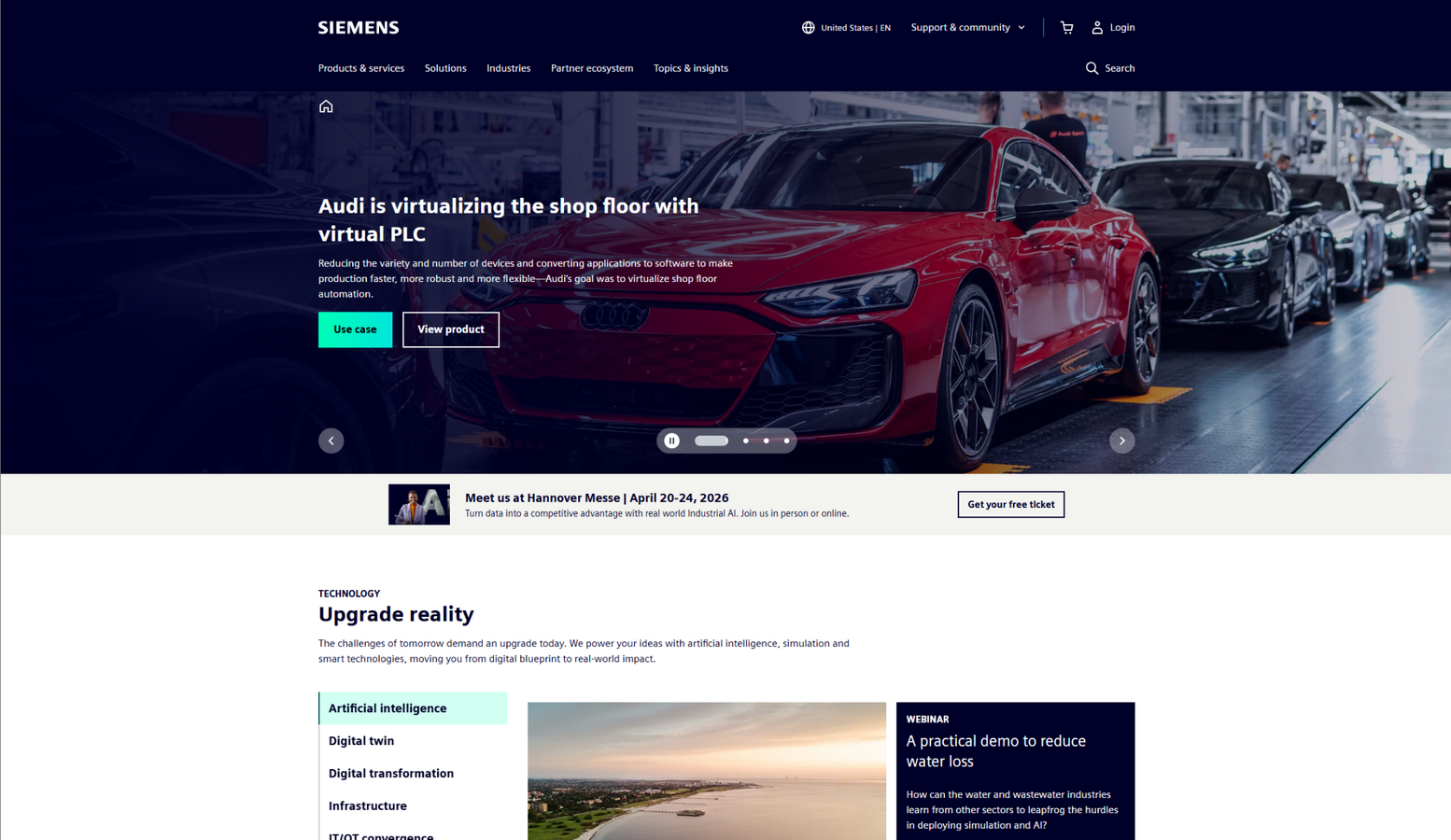
3. Siemens
 https://www.siemens.com/en-us/
Siemens integrates power systems, automation and infrastructure management into a unified system. It offers solutions across thermal optimization, energy management systems and digital twins services, which enable engineers to monitor and optimize performance in real time. The organization connects traditionally siloed systems through intelligent platforms, which improves efficiency and operational visibility in high-density environments.
With a broad portfolio of more than 1,000 products and a strong global presence, Siemens supports flexible, scalable deployments across diverse data center environments. It is a full-stack infrastructure integrator, combining consulting with AI-driven automation and physical system deployment to enable continuous, system-wide optimization.
Key Features
- Connects power and building management for unified control
- Uses predictive analytics to improve efficiency and maintain system stability
- Accelerates deployment with scalable, prefabricated power and energy systems
4. Arup
 https://www.arup.com/
Arup combines engineering, design, planning and advisory services into a unified “Total Design” model. It supports projects from site selection to design optimization, with a strong focus on sustainability and resilience. This option’s strength lies in deep technical integration, using tools such as computational fluid dynamics and decarbonization strategies to improve performance while reducing environmental impact.
Operating from more than 90 offices in 39 countries, Arup brings global scale to complex deployments. It uses a collaborative, employee-owned structure that prioritizes cross-disciplinary innovation, which enables highly customized solutions that balance efficiency and long-term sustainability.
Key Features
- Combines engineering, design and advisory into a fully integrated project model
- Uses tools like computational fluid dynamics for precise energy and cooling optimization
- Focuses on decarbonization and long-term environmental performance
5. Uptime Institute
 https://uptimeinstitute.com/
Uptime Institute uses a standards-driven approach that focuses on performance, resilience and operational sustainability. It offers Tier Certification, benchmarking and advisory services built around its globally recognized Tier Classification System, which defines infrastructure performance across power, cooling and fault tolerance.
The organization has issued over 2,500 certifications across more than 110 countries, demonstrating its global reach and authority in mission-critical environments. It also conducts one of the industry’s most comprehensive surveys to guide best practices and emerging standards. Uptime Institute is an independent authority, providing objective assessments and certification that help data center engineers validate performance and align operations with globally recognized benchmarks.
Key Features
- Provides globally recognized benchmarks for reliability and performance
- Delivers objective assessments without vendor bias
- Offers data-backed insights on outages and operational best practices
6. DNV
 https://www.dnv.com/
DNV combines advisory, certification and advanced analytics across the energy value chain. It supports operators with energy efficiency program design and real-time energy data analysis, enabling more precise control over power usage and cooling performance. It has deep domain expertise and independence supported by more than 6,000 energy and digital experts operating in over 100 countries.
The company connects energy generation, distribution and end use, which helps engineers optimize facility performance. It also brings experience in implementing data center energy efficiency programs, applying strategies such as airflow management and optimized power distribution to reduce consumption. DNV combines technical advisory with verification and certification services to validate performance and support energy transition goals.
Key Features
- Validates performance, compliance and risk mitigation strategies
- Uses data-driven insights to optimize power and cooling systems
- Connects facility operations with broader grid and energy system considerations
7. Ramboll
 https://www.ramboll.com/
Ramboll combines strategy, construction and commissioning with strong sustainability expertise. It supports hyperscale and colocation projects across every stage, which helps secure grid access and reduce water consumption while maintaining reliability. The entity uses a multidisciplinary model that integrates engineering, environmental science and energy consulting, allowing it to balance performance and sustainability goals.
With more than 18,000 experts globally, including over 300 dedicated data center specialists, Ramboll brings scale and technical depth to complex deployments. It uses a sustainability-first approach that emphasizes circular design, reduced environmental impact and long-term resilience.
Key Features
- Covers planning, design and operational optimization
- Reduces environmental impact through energy and resource efficiency
- Integrates engineering and energy consulting for holistic solutions
Comparison of Leading Data Center Energy Consulting Companies
This table highlights key differences to help engineers align consulting expertise with specific operational and scalability goals.
| Company | Primary Focus Area | Ideal Use Case |
| TRC Companies | Power systems and regulatory alignment | Large-scale or hyperscale developments requiring utility coordination |
| Schneider Electric | Digital energy management and automation | Multisite operations needing centralized monitoring |
| Siemens | Electrification and smart infrastructure | High-density environments requiring integrated system control |
| Arup | Sustainability and engineering integration | New builds or retrofits focused on long-term environmental performance |
| Uptime Institute | Benchmarking and operational risk | Facilities seeking validation of uptime and performance standards |
| DNV | Risk management and energy transition | Operators aligning facility performance with energy markets |
| Ramboll | Sustainable infrastructure and environmental consulting | Projects prioritizing low-carbon design and resource efficiency |
Why Energy Consulting Matters for Modern Data Centers
Data center energy consultants are critical to addressing the challenges created by increasing power density, which places greater strain on infrastructure design and cooling systems. Rising operational costs tied to energy consumption further intensify the need for efficient power management and optimization strategies.
Regulatory pressure around emissions and sustainability targets is growing, which requires organizations to align operations with new standards. These consultants help bridge engineering, finance and compliance priorities by translating technical requirements into cost-effective and regulation-ready solutions. This guidance enables enterprises to balance performance and financial efficiency more effectively.
Challenges Data Center Engineers Face Without Expert Guidance
Data center operators often face limited visibility into real-time energy performance across systems, which makes it difficult to identify inefficiencies quickly. Optimizing legacy infrastructure for modern workloads presents another challenge, especially as AI and high-density computing place new demands on existing setups. Balancing strict uptime requirements with aggressive efficiency targets requires careful planning and precise execution.
These challenges can lead to higher operational costs and reduced overall efficiency if not addressed proactively. Without clear data insights, decision-making becomes reactive rather than strategic, limiting long-term performance improvements.
How to Maximize Value From Energy Consultants
Organizations should align engagement goals with operational and financial objectives to ensure measurable value from consulting efforts. Providing access to accurate, real-time facility data enables more precise analysis and informed decision-making. Integrating consultant recommendations into existing workflows helps minimize disruption and improve adoption across teams.
Establishing clear KPIs supports consistent performance tracking and accountability. Planning for continuous optimization rather than one-time improvements ensures long-term efficiency and adaptability. Strong collaboration between internal teams and consultants further enhances implementation success. This approach ensures improvements remain consistent even as personnel or operational priorities change.
FAQs About Data Center Energy Consultants
These common questions address practical concerns that arise during selection and implementation.
How is a data center energy consultant different from a general energy consultant?
A data center energy consultant focuses specifically on mission-critical environments with strict uptime and redundancy requirements. It understands metrics like thermal dynamics and high-density workloads that general consultants may not prioritize.
What metrics should be used to evaluate success?
Common metrics include energy cost savings, carbon reduction and system reliability improvements. Engineers may also track cooling efficiency and rack density performance.
Can consultants work with existing infrastructure without downtime?
Most consultants design strategies that integrate with live environments and avoid disruption. It prioritizes phased implementation and testing to maintain uptime and operational stability.
Choosing the Right Partner for Long-Term Data Center Performance
Selecting the right data center energy consultant is critical to achieving long-term efficiency and operational resilience. Strong alignment between technical expertise and sustainability targets ensures that energy strategies deliver measurable and scalable results. Data center engineers should evaluate consultants based on proven impact and the ability to support changing infrastructure needs.