Architecture is one of the few disciplines in which the work is irreducibly physical. The design may exist in BIM, the presentation may happen over video, the drawings may travel by email, but the building is somewhere, and at some point, the architect must be there too.
For practices operating internationally, this creates a mobility problem that compounds across a career. Projects in Mumbai and Sao Paulo and Abu Dhabi and Oslo, each at different phases, each demanding presence at critical moments. Site visits timed to construction milestones that won’t wait. Client meetings that require not just attendance but the kind of focused, undepleted engagement that commercial transit rarely leaves intact.
It’s within this context that a growing number of architecture and design principals, working with brokers such as Global Charter, have come to treat private jet charter not as a perk but as professional infrastructure, as essential to their practice as the tools they use to design.
The Compressed Itinerary Problem
A partner at an international architecture practice rarely has the luxury of a single-destination business trip. The economics of long-haul travel demand that multiple sites be consolidated into a single journey. A week might span a ground-breaking in the Gulf, a design development meeting in London, a contractor review in Central Europe, and a planning presentation back in the home city.
Commercial aviation imposes its own logic onto that sequence: hub dependencies, connection windows, the geography of airline networks that reflects commercial demand rather than project geography. The result is itineraries that accommodate the airline rather than the architect, burning days on routing that a direct charter would resolve in hours.
Private charter operates on point-to-point logic. Fly from the project site in the Gulf to the client in London directly. Land at London City rather than Heathrow. Depart for Bratislava the same afternoon without losing a day to transfers. The itinerary follows the work, not the network.
Productive Transit
For architects, the hours spent in transit represent a particular kind of loss. Design thinking is not easily switched on and off between gate changes. The focused review of drawings, the preparation for a critical client meeting, the processing of what was absorbed during a site visit: these require conditions that a crowded commercial cabin rarely provides.
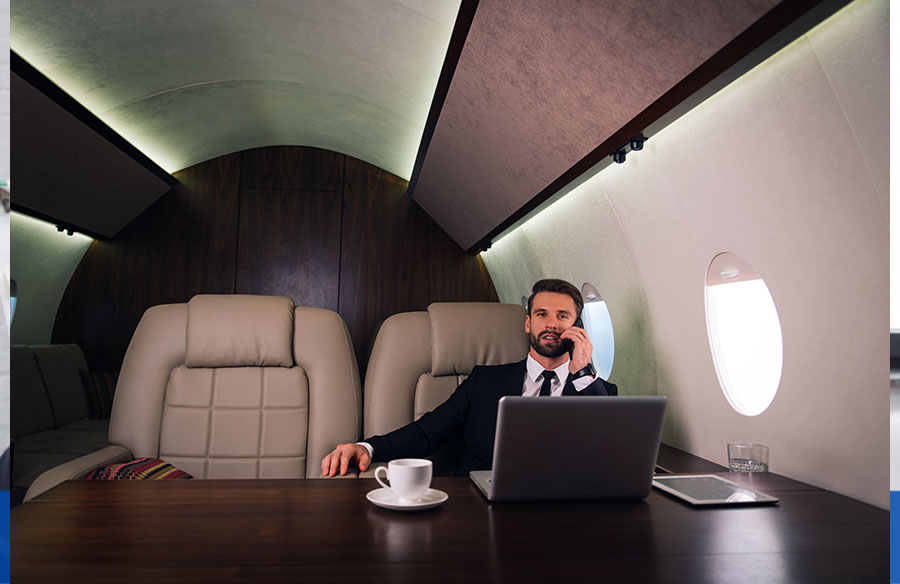
The private cabin changes this equation fundamentally. Senior partners have described it as recovering something close to a full working day on a long flight, not because of enhanced connectivity, though that exists, but because of the absence of fragmentation. No interruptions. No environmental noise management. The space to think.
For younger architects travelling with principals, the shared cabin also becomes an extension of the studio: briefings, reviews, and the informal exchange of ideas that defines how design culture transmits through practice.
The FBO as Spatial Counterpoint
There is an argument, worth making in a publication concerned with the built environment, that the design philosophy of private aviation terminals (FBOs) represents an instructive counterpoint to the mass-transit airport as a building type.
Where the commercial terminal optimises for throughput, maximising passenger volume, minimising dwelling time, treating the traveller as a unit moving through a system, the FBO optimises for experience. Spaces are proportioned for human scale. Materials reference permanence rather than utility. The logic is hospitality rather than processing.
Some of the most architecturally considered spaces in aviation infrastructure are private terminals. Farnborough. Le Bourget. Teterboro. These buildings commit fully to a spatial and material language that reflects the user’s expectations. There is much to learn here for architects thinking about how spatial design communicates value and intention.
Accessing the Inaccessible Site
Private aviation also extends the definition of what constitutes a buildable, and visitable, site. Rural resort developments, island projects, mountain sites, remote cultural institutions: these are increasingly the commissions that define the ambition of leading practices, and they frequently sit beyond the reach of viable commercial routing.
For practices regularly navigating this kind of complexity, on-demand private jet charter makes it possible to reach a regional airstrip near a sensitive landscape project without the two-day commercial journey that would otherwise preclude the visit entirely. For clients in remote locations, it also signals something about the seriousness and commitment of the practice, that the site matters enough to travel to it properly.
The Environmental Dimension
No honest discussion of private aviation in 2026 can avoid the question of environmental impact. The carbon footprint of a private jet per passenger is significantly higher than commercial aviation, and architects, whose discipline is increasingly organised around sustainability principles, will feel this tension acutely.
The response developing within the industry involves a combination of Sustainable Aviation Fuel (SAF) offsetting, rigorous trip consolidation to ensure private flights serve multiple purposes, and a selective deployment model in which charter is reserved for journeys where the professional value genuinely justifies it. Many brokers, including Global Charter, can advise on SAF availability and offset frameworks for clients who wish to address this dimension of their travel programme.
The conversation is not yet resolved. But it is being had, and the architects most thoughtful about it are using it to build more disciplined travel programmes overall: fewer trips, better planned, serving multiple project objectives simultaneously.
For architecture and design practices operating across geographies, efficient and productive mobility is professional infrastructure. Global Charter provides access to a worldwide private jet charter network, transparent pricing, and instant solutions tailored to the demanding and often unpredictable schedules of international design practice. When the work requires presence, the journey should be the least complicated part of getting there.