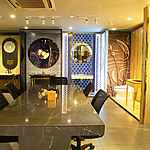
Partition walls, which provide adaptable solutions to meet a variety of practical and aesthetic objectives, have grown in popularity in contemporary architecture and interior design. The capacity of these walls to create clear, functional zones from open areas has led to their great acceptance as interior dividers. Because of their many uses and flexible design options, partition walls are becoming increasingly popular for use in both residential and business settings.
The versatility of partition walls in terms of space utilization is one of the main factors contributing to their popularity and upsurge in the coming time. Open floor layouts are becoming popular in both residential and commercial settings because they create a feeling of openness and community. Nonetheless, there are situations in which constructing functioning zones within these open designs requires drawing boundaries around particular locations.
Types of Partition Walls
Following are the types of partition walls:
Concrete Partition Walls
A concrete slab, either plain or reinforced, supported horizontally by vertical elements makes up the concrete partition wall. These slabs can be projected in place or precast. It could very well be firmly undisturbed or constructed.
Special concrete posts are used to build solid concrete partition walls that are 10 cm thick and below, with a social control system consisting of soft-cast steel bars inserted into the middle of the wall thickness. It greatly aids in resisting horizontal stresses with preferential seismic vibrations. The structure is expensive even though it is stable and rigid in both vertical and horizontal dimensions.
Glass Partition walls
Blocks of hollow or sheet glass make up glass partition walls. An assembly of glass sheets is constructed by fastening them to a wooden framework. Various thicknesses, forms, and sizes of clear glass units are available in hollow glass blocks, which are lightweight. Glass and steel stud partition walls provide reasonable protection and security, are reasonably priced, and are readily available for development. It is lightweight and has reasonable aesthetics. It is simple to clean and maintain this type of wall, and it is sound, moisture, and heatproof.
Hollow partition walls
For the purpose of creating hollow partition walls, three materials are typically utilized: clay, terracotta, and concrete. Homeowners generally like hollow wall partitions because they are strong, lightweight, affordable, and fireproof. They even have good acoustic insulation qualities. Regarding the partition wall’s thickness, it typically falls between 6 and 15 cm. Brick walls and hollow partition walls are built using a similar technique.
Metal lath partition walls
Thick, sturdy, long-lasting, and remarkably non-combustible partition walls are made of metal lath. It requires a steel wall frame or wooden structure to be fixed in place. Lath is fastened to delicate cast steel bars or channels that are spaced 15 to 30 cm apart by galvanized iron wire. On both sides, plaster will be applied, and further sound and heat insulation may be added. The partition walls-cavity with metal lath and plaster.
Plywood divider walls
Because plywood partitions are robust, lightweight, long-lasting, and reasonably priced, their popularity has increased dramatically in recent years. One special quality of plywood partitions is that you may remove them when you no longer require room dividers because they are not permanent. Blockboard is more prevalent, but you can choose from a variety of plywood varieties to make the partition wall. Painting the plywood from the exterior will prevent termites out of it. The fact that plywood partition walls are not fireproof is its lone drawback.
Plaster slab partition walls
Minerals that have been burned or consumed or plaster of Paris combined with wood are used to create plaster slab partition walls. Slabs that are manufactured in iron or timber moulds range in thickness from 5 to 10 cm for this type of partition wall. Sections for fitting are included in the plaster slabs to produce inflexible joins. Nails, screws, and walls are often essentially slammed into these slabs during this partition. For this partition wall, the formwork isn’t plastered, and the plaster slab surface could be left rough or smooth. However, the rough surface functions as a kind of plaster key.
Reinforced brick walls
Reinforced brick is significantly more durable due to the placement of reinforcement. Reinforcement is placed in front of wire mesh strips or iron bars every third or fourth course. The thickness of the wall is 10cm or half a brick. Construction tools are low-tech. It does not require shuttering or cement. This type of partition wall is employed when a superior longitudinal bond is required, and the partition must assist other superimposed loads.
Straw partition walls
Where there is constant partition transference, strawboard partition walls are useful. This type of partition wall is composed of thick paper or hardboard covered in compressed straw. Simple to erect, strawboard parcel walls are proof of heat.
Timber-Based Dividend Wall
The wooden framework of a timber partition is held up by sidewalls or the ground below. The framework is made up of a rigid assembly of wood elements that can be lined with boards, plastered, or another material on either side. It is not ignitable.
Partition Made of Gypsum Board
Plasterboard, wallboard or plasterboard are common terms used to describe this kind of partition wall. Its non-combustible core and paper facers set it apart from hardboard, fiberboard, and plywood. When fastener heads and joists are covered with a joint compound system, gypsum wallboards provide a continuous surface that can be used with a variety of interior décor styles. They have smooth surfaces with attractive finishes, and they are adaptable in terms of renovation and alteration.
Summing up
In conclusion, partition walls are quite popular because of their many advantages, which include flexibility, attractiveness, sustainability, ease of installation, and adaptability to changing needs. Partition walls are expected to stay a mainstay in the toolbox of architects and designers as the design world develops further, offering creative options for maximizing interior spaces in a variety of contexts.