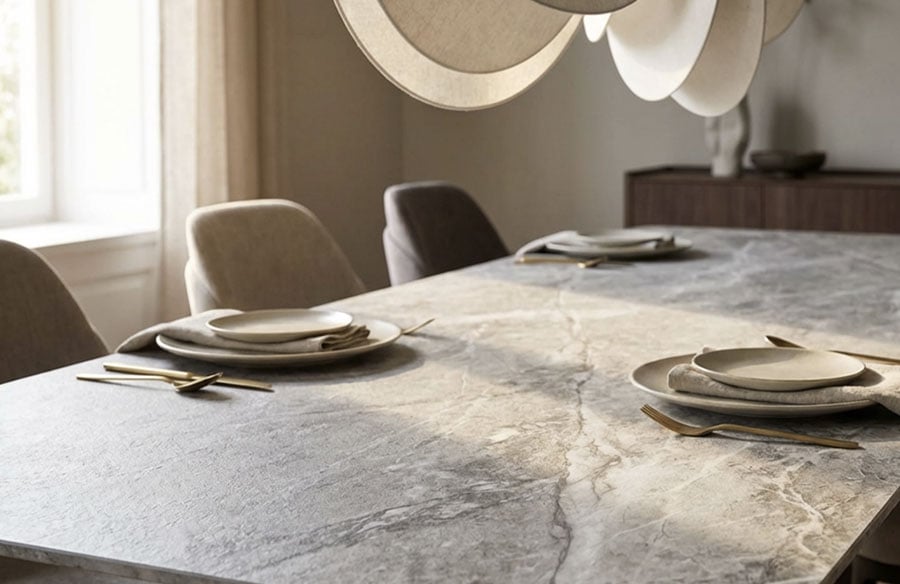
Walk into any high-end furniture showroom right now and you will see it everywhere.
That gorgeous marble-look dining table? Not marble.
That sleek coffee table with dramatic veining? Also not marble.
That TV unit with a luxe stone finish? Still not marble.
It is sintered stone.
And if you have not specified it yet, you are missing one of the best materials to hit residential interior design in years.
New materials hit the market all the time with big promises. Most of them end up being expensive, fragile, impractical, or outdated within a few years.
Sintered stone is different.
It looks like natural stone.
It feels like natural stone.
But it outperforms natural stone in almost every way that matters for real homes and real families.
No staining.
No etching.
No sealing.
No babying it like marble or granite.
This is why designers and architects are increasingly switching to sintered stone for dining tables, coffee tables, and living room furniture and why clients end up thanking them later.
What Sintered Stone Actually Is
Before talking about why it works so well, it helps to understand what it actually is.
Sintered stone is made from natural minerals such as quartz, feldspar, silica, and natural oxides. These materials are ground into fine particles, then pressed under extreme pressure and fired at temperatures exceeding 1200°C.
The process replicates how natural stone forms underground over thousands of years, but it happens in hours instead of millennia.
The result is a completely non-porous slab that is harder than granite, more heat resistant than quartz, and tougher than most natural stone used in residential interiors.
One of the biggest advantages is versatility in appearance.
Sintered stone can replicate:
- Calacatta marble
- Carrara marble
- Dark marbles with dramatic veining
- Concrete finishes
- Terrazzo
- Solid colours
- Wood grain effects
The pattern runs through the entire slab, not just the surface. If an edge is exposed or lightly chipped, the colour and pattern remain consistent rather than revealing a different core material underneath.
For designers, this means the look of premium stone without the weight, fragility, or maintenance issues. For customers, purchasing sintered stone dining tables through reputable stores such as Fusion Furniture, sintered stone offers many benefits.
Why Sintered Stone Beats Natural Stone for Furniture
Natural stone is beautiful. Marble, granite, and travertine all have undeniable appeal.
The problem is not aesthetics. The problem is daily use.
A marble dining table looks incredible until someone spills red wine, lemon juice, coffee, or places a hot dish directly on the surface. Marble etches easily, stains easily, and requires constant care.
Sintered stone does not.
You can place hot cookware directly on a sintered stone surface without damage.
You can spill wine, oil, or tomato sauce and wipe it up later.
You can clean it with standard household cleaners.
It does not absorb liquids and it does not react to acidic substances.
Maintenance comparison makes the difference very clear.
Maintaining natural marble typically involves:
- Sealing every 6 to 12 months
- Immediate spill cleanup
- Using only pH-neutral cleaners
- Accepting permanent etching over time
- Treating the surface like a museum piece
Maintaining sintered stone:
- Wipe it down
That is it.
For residential projects, especially family homes, this changes everything. Clients want beautiful interiors they can actually live in, not surfaces that cause anxiety.
Weight is another major factor.
Natural stone furniture is extremely heavy. Large marble dining tables can exceed 300 kilograms. Sintered stone slabs are typically around 12mm thick rather than 20–30mm, making them significantly lighter while maintaining strength.
This simplifies delivery, installation, and suitability for apartments or upper levels where floor loading matters.
Where Sintered Stone Works Best in Residential Design
Sintered stone is not necessary everywhere, but there are areas where it clearly outperforms alternatives.
Dining tables take constant abuse. Heat, spills, cutlery, plates, chair impacts, and children all test the surface daily.
A sintered stone dining table handles this without visible wear. Families who would never consider marble can safely enjoy the same aesthetic without stress or regret.
Coffee tables live in high-traffic areas and are often mistreated. Feet on the surface, drinks without coasters, laptops, craft projects, and general clutter are common.
Natural stone coffee tables show wear quickly. Sintered stone coffee tables simply continue to look good with minimal care.
The thinner profile also suits modern interiors and smaller living spaces far better than thick stone slabs.
TV units and entertainment furniture benefit from sintered stone because it is heat resistant, durable, fingerprint resistant compared to glass, and strong enough to handle heavy electronics being moved regularly.
This is why many retailers are now offering sintered stone finishes for entertainment units and living room furniture.
What to Consider Before Specifying Sintered Stone
Sintered stone is not indestructible and should be specified properly.
Because slabs are thin, edge detailing matters. Options typically include:
- Mitred edges to create a thicker appearance
- Metal edge trims for a modern look
- Exposed thin edges for a minimalist aesthetic
The choice should align with the design style and the intended use.
Sintered stone is extremely hard, which means strong impacts on corners or edges with metal objects can cause chipping. This is rare in normal use but should be explained clearly to clients.
The advantage is that chips are far less visible than on laminate or coated surfaces because the pattern runs through the material.
Quality also varies by manufacturer. Some finishes look incredibly natural, while others appear digitally printed and artificial.
Always review physical samples rather than relying on catalogues.
Understanding the Cost
Sintered stone generally sits below premium marble in price and above basic granite or laminate.
For dining tables, pricing is comparable to quality timber or engineered stone products.
The important factor is lifetime cost.
Natural stone may cost more upfront and continue to incur expenses for sealing, specialised cleaning, and refinishing. Sintered stone has minimal ongoing costs.
For most residential clients, particularly families, the long-term value is obvious.
How to Present Sintered Stone to Clients
One message consistently resonates with clients:
You get the look of marble without the maintenance headaches.
Most people love marble visually but fear the reality of owning it. Showing comparison photos of stained or etched marble alongside sintered stone performance examples makes the decision easy.
For families, highlight heat resistance and stain resistance.
For entertainers, highlight worry-free hosting.
For design-focused clients, emphasise slim profiles and consistency.
Once clients understand what sintered stone can handle, the material sells itself.
Final Thoughts
Sintered stone is becoming a standard material in residential furniture rather than a niche option.
Manufacturing quality continues to improve. Design options are expanding. Prices are becoming more accessible.
If you are not already specifying sintered stone, it is worth revisiting what is currently available. Seeing it in person makes the advantages immediately clear.
Your clients get furniture that looks high-end and survives real life.
You avoid complaints, callbacks, and maintenance issues.
That is a solid outcome for everyone involved.