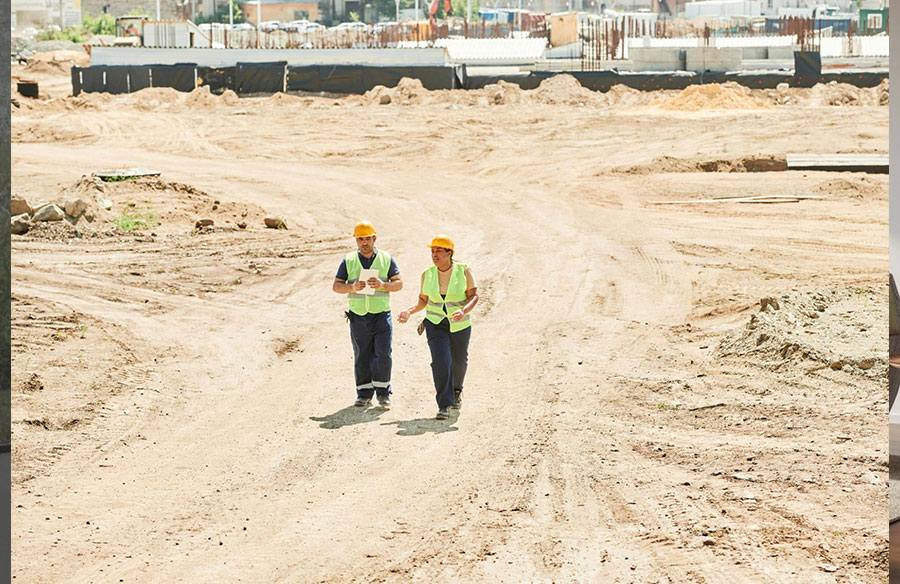
A construction site inspection program is easy to describe on paper and hard to recognize in real life.
Most projects claim to have one. Binders exist. Checklists circulate. Reports get signed. Yet when you walk the site at 7:10 AM, boots sinking into mud, rebar exposed overnight, silt fence half-collapsed after rain, you immediately know the difference between an inspection program that exists and one that works.
A real program lives in routine, timing, and consequence. It reacts to weather, sequencing, and human shortcuts. It shows up before problems become defects and long before regulators or clients start asking uncomfortable questions.
Inspection Starts Before the First Concrete Truck
Inspection does not begin when construction ramps up. It begins when the site still looks like land.
Before vertical elements rise, before trades stack on top of each other, inspection focuses on how the site is set up to behave under stress. Rain, deliveries, excavation, neighboring properties, public access—all of these will test the site long before the structure does.
Pre-Construction Site Conditions Are Not a Formality
In many regions, pre-construction inspections are treated as paperwork to unlock permits. In practice, they are the baseline that determines everything that follows.
Access roads must handle loaded concrete mixers without turning into trenches. Temporary fencing needs to survive wind and curious pedestrians. Utility tie-ins must be protected before excavation equipment arrives. Ignoring these details creates a chain reaction: damaged infrastructure, delays, and disputes that surface months later when responsibility is already blurred.
A real inspection program documents conditions with photographs, sketches, and measurements. It notes nearby buildings, existing cracks, drainage paths, and public walkways. Not because someone asked, but because memory fades and accountability does not.
SWPPP Is Not a Document, It Is a Daily Reality
Stormwater Pollution Prevention Plans – or SWPPP – are often filed, approved, and forgotten. On active sites, that approach fails fast.
A functioning inspection program treats SWPPP as a living system. Inspectors check silt fences after every significant rainfall. They verify inlet protection before excavation begins nearby. Stockpiles are inspected for coverage, not at the end of the week, but before the forecasted storm arrives.
On sites near rivers, or in coastal zones where runoff reaches sensitive waters quickly, failure here does not stay local. Muddy discharge travels. Neighbors notice. Authorities follow.
Daily or post-rain inspections logged with dates, weather conditions, corrective actions, and completion times separate compliant sites from risky ones. The difference is not the regulation—it is discipline.
Daily Inspections Focus on Sequencing, Not Checklists
Once construction moves into active phases, inspection must follow the rhythm of the site. Static checklists fail because construction is not static.
A real inspection program understands sequence. What is happening today, what will happen tomorrow, and what should already be finished but is not.
Structural Work Requires Timing Awareness
Inspecting formwork after concrete is poured is theater. Real inspection happens before reinforcement is closed, before formwork is locked, before embeds disappear.
On reinforced concrete projects common in urban residential developments, inspectors verify rebar spacing, cover, anchorage, and cleanliness before pouring. They check formwork alignment against control points, not against assumptions. They confirm that openings for services are coordinated with MEP drawings, not left for “later drilling.”
This requires inspectors to walk the site early, often before crews are fully mobilized. It also requires authority—the ability to stop work when something is wrong, not merely note it.
Safety Inspections Are Not Separate From Construction Quality
Many sites split safety and quality inspections into parallel systems that never intersect. On the ground, they are inseparable.
Improper scaffolding is a fall risk and a quality risk. Poor housekeeping creates trip hazards and contaminates finishes. Missing edge protection affects safety today and concrete integrity tomorrow.
A real inspection program treats safety observations as construction observations. Unsafe work is defective work. The same supervisors are accountable for both.
Trade Coordination Is Where Most Programs Break
Inspection programs fail most often at trade interfaces. Not because trades are careless, but because no one is clearly watching the handoff.
MEP Inspections Must Precede Closure
Electrical conduits, plumbing lines, and HVAC ducting disappear quickly behind walls and slabs. Inspecting after closure is useless.
Effective programs schedule inspections at specific hold points: before slab pour, before drywall, before ceilings close. Inspectors verify slopes, supports, firestopping continuity, and separation distances.
In mixed-use developments or hotels, where MEP density is high, missed inspections here lead to costly rework. The inspector’s job is not to trust coordination drawings, but to confirm installation reality.
Finishes Reveal Earlier Failures
By the time finishes begin, inspection becomes forensic. Cracked tiles, uneven floors, misaligned doors—these are symptoms, not root causes.
A serious program traces defects back to substrate preparation, curing conditions, tolerances ignored weeks earlier. It documents patterns: repeated issues from the same subcontractor, recurring deviations in the same zone.
This data informs corrective action, not just punch lists. Without it, projects repeat the same mistakes floor after floor.
Documentation Is a Tool, Not the Product
Inspection reports exist to support decisions, not to satisfy filing systems.
Reports Must Drive Action
A real inspection report is specific. It references locations, drawing numbers, photos, deadlines, and responsible parties. “Non-compliant” means nothing without context.
Inspectors follow up. Items remain open until verified closed. Verbal assurances do not count. Neither do rushed fixes done without reinspection.
On public projects, especially municipal infrastructure, this documentation protects all parties. It shows diligence, not perfection.
Frequency Adjusts to Risk
Not all phases require the same inspection intensity. Excavation, structural work, waterproofing, and fire protection demand higher frequency. Landscaping does not.
Programs that inspect everything equally waste resources and miss critical moments. Experienced inspectors shift focus as the project evolves.
Weather, Location, and Local Reality Matter
Inspection programs that ignore local conditions fail quietly.
In regions with freeze-thaw cycles, inspectors watch curing temperatures and protection measures closely. In seismic zones, anchorage and detailing receive extra scrutiny. In dense urban centers, logistics, noise, and public safety become inspection priorities.
Local building practices also matter. Knowing how subcontractors typically work, where shortcuts are common, and which phases are historically problematic allows inspectors to intervene early.
A Program That Works Leaves a Trace
By the end of construction, a real inspection program leaves behind more than files.
It leaves a site that ran cleaner, safer, and more predictably. It leaves fewer disputes, fewer surprises during commissioning, fewer emergency fixes before handover.
Most importantly, it leaves a culture. Crews expect inspection. Supervisors plan for it. Quality stops being reactive and becomes part of the daily routine.
That is what a real construction site inspection program looks like on the ground—not perfect, not theoretical, but present, persistent, and impossible to ignore.