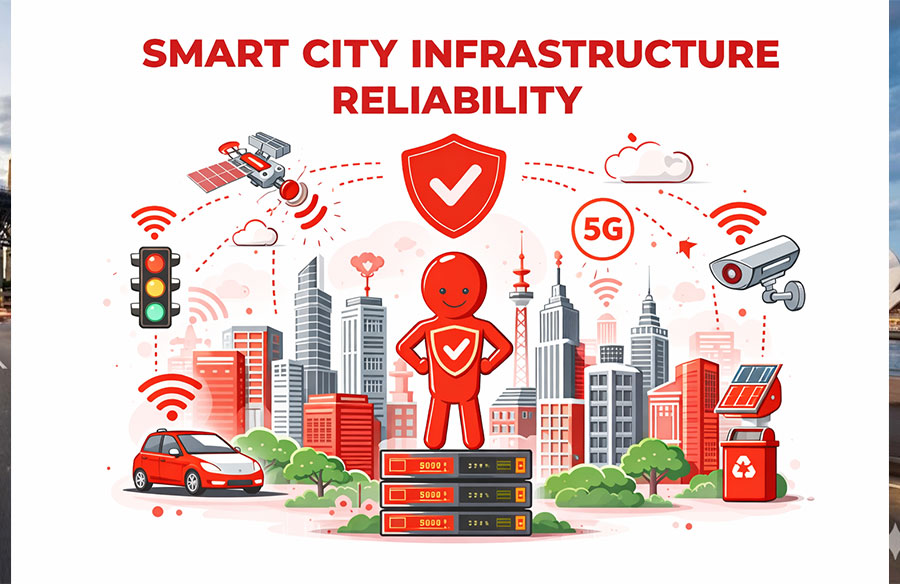
When a city relies on interconnected sensors, networks, and control systems to manage vital services, every failure ripples through everyday urban life. Imagine traffic lights halting unexpectedly during rush hour or emergency response systems going offline. Without reliable smart city infrastructure, urban performance suffers in ways that ripple from citizens’ daily routines to the city’s long-term sustainability.
Here’s the reality behind that: smart city infrastructure reliability is about ensuring all these complex components operate continuously and correctly under real-world stresses. It’s crucial because smart cities depend on this reliability to deliver safe, efficient, and scalable public services. This article unpacks how reliability is measured, the unique challenges smart city systems face, and the testing and operational methods that help sustain system uptime and performance. By the end, you’ll understand not just the theoretical building blocks but also the practical steps technical teams use to maintain and improve smart city infrastructure reliability.
What Is Smart City Infrastructure Reliability?
Smart city infrastructure reliability refers to the consistent and dependable operation of the interconnected IoT devices, network systems, data platforms, and control mechanisms that support urban services. Unlike traditional infrastructure, smart city components include IoT sensors monitoring environmental factors, communication networks transmitting data, and automated control systems managing utilities or traffic flow.
Reliability in this context means these systems maintain service availability with minimal interruptions, low latency, and robust fault tolerance despite the complexity and scale of urban environments. This reliability is paramount because when IoT devices or control systems fail, it can undermine public safety, traffic efficiency, or energy management.
Imagine your city uses thousands of air quality sensors to inform public health alerts. If these sensors go offline or provide inaccurate data, the city’s ability to protect residents diminishes. Reliability here means uptime of these sensors, accuracy of data transmission, and systems’ ability to recover quickly from faults.
For urban services—from smart lighting to public transportation coordination—this reliability underpins trust and ensures systems operate as intended, delivering measurable performance improvements over legacy infrastructure.
 How Is Reliability Measured in Smart City Systems?
Smart city reliability is measured through several key performance indicators (KPIs) that reflect system health and responsiveness. The most common metrics include:
- Uptime: The percentage of time systems or components are operational without failure.
- Latency: Response times for data transmission from IoT devices to control systems.
- Fault tolerance: The ability of systems to continue functioning despite hardware or software failures.
- Throughput: Volume of data processed or transmitted within given timeframes without degradation.
To evaluate these metrics, benchmarking frameworks compare system performance against defined standards or historical baselines. For example, network reliability might be assessed by measuring packet loss rates and average latency during peak usage hours.
Imagine a smart city traffic control network serving tens of thousands of intersections. Measuring uptime here means ensuring the traffic lights respond correctly 99.9% of the time, with latency low enough to adjust signals dynamically to traffic flow in real time.
These measurements feed into reliability engineering models that identify weaknesses or bottlenecks and guide maintenance or upgrades. Without reliable KPIs, cities risk deploying solutions that fall short when scaled or stressed.
What Are Common Challenges in Ensuring Smart City Infrastructure Reliability?
Achieving high reliability in smart city systems comes with unique hurdles. Several frequent challenges include:
- Bottlenecks in data processing pipelines: Huge volumes of sensor data can overwhelm communication channels or processing nodes, leading to delays or dropped data packets.
- Data integrity issues: Faulty devices or network interference can corrupt sensor data, causing inaccurate analytics or decision-making.
- Software bugs and configuration errors: Complex integration among diverse systems can introduce vulnerabilities or cause unexpected downtime.
- Network reliability difficulties: Urban wireless or wired networks face fluctuating loads, environmental interference, and physical damage risks.
- Scalability constraints: As cities add devices and services, infrastructure might struggle to maintain performance without architectural redesign.
Imagine your city rolls out a fleet of smart meters connected via a wireless mesh network. If node failures accumulate or congestion causes excessive latency, billing data accuracy and timeliness suffer, undermining trust and revenue flow.
These challenges emphasize why smart cities cannot rely on traditional infrastructure reliability approaches alone. They require tailored monitoring, proactive maintenance, and testing that reflects the unique dynamics of IoT-heavy, interconnected urban environments.
How Do Load and Performance Testing Enhance Smart City Reliability?
Load and performance testing verify how smart city systems behave under varying stress conditions. These methodologies simulate realistic or extreme usage scenarios to uncover breaking points and bottlenecks before deployment or during continuous maintenance.
Load testing typically involves simulating high volumes of data from IoT devices or user interactions with smart city applications to see if systems maintain acceptable responsiveness and throughput. Stress testing pushes systems beyond normal operational limits to observe failure modes and recovery capabilities.
Consider a smart city’s water management system that automates pump scheduling based on sensor data streams. Load testing here might mimic thousands of simultaneous sensor updates during peak demand to ensure control algorithms and network channels handle the influx smoothly.
Stress testing could simulate network outages or device failures, verifying that backup systems activate and prevent service interruptions.
Without rigorous load and performance testing, system reliability issues often surface only after costly real-world impact, like service degradation or outages.
What Smart Cities Can Learn From Ecommerce Checkout Performance Testing
Smart city platforms are not the only systems where reliability under pressure is mission-critical. Large-scale ecommerce platforms face similar challenges, especially during peak demand events such as flash sales, holidays, or major product launches. In those moments, checkout systems must process massive transaction volumes without delays or failures, because even short disruptions translate directly into lost revenue and user trust.
The discipline of ecommerce checkout performance testing offers valuable lessons for smart city infrastructure teams. Checkout systems are designed and tested to handle sudden traffic spikes, complex integrations with payment providers, inventory systems, and third-party services, and strict latency requirements. These characteristics closely mirror the realities of smart city environments, where traffic control, utility management, and emergency response systems depend on real-time coordination across multiple platforms.
 In ecommerce, performance testing focuses not only on average load but also on worst-case scenarios, such as simultaneous user surges, partial service failures, or slow downstream dependencies. Applying the same mindset to smart city systems helps teams identify weak points before they cause public disruption. For example, a city payment platform for parking or transit can be tested using similar checkout-style scenarios to ensure transactions complete reliably during peak commuting hours or special events.
By borrowing proven testing strategies from ecommerce, cities can shift from reactive incident handling to proactive reliability engineering. This cross-industry approach reinforces the idea that performance testing is not just a technical exercise, but a form of infrastructure insurance that protects both digital services and the people who rely on them every day.
What Are Best Practices for Load Testing IoT Devices in Smart Cities?
Load testing IoT devices in smart city contexts involves specific approaches due to device heterogeneity and communication patterns:
- Simulate realistic traffic patterns: Model typical and peak data generation rates from diverse sensor types to reflect true workloads.
- Use automation and scripting: Automate test scenarios to simulate continuous, prolonged loads and facilitate regression testing.
- Incorporate network variability: Test under different network conditions, including latency spikes and packet loss, to emulate real environments.
- Multi-layer testing: Evaluate devices individually and as part of the full network/system stack to detect interaction-related issues.
- Continuous testing: Embed load testing in the development lifecycle for ongoing validation as infrastructure evolves.
For example, automated scripts can simulate thousands of temperature sensors sending data at irregular intervals, triggering event-driven workflows and measuring system responses under sustained stress.
These practices reduce downtime risks and improve confidence in deploying vast IoT networks that form smart cities’ operational backbone.
How Does Performance Testing Integrate into the Smart City Development Lifecycle?
Performance testing isn’t a one-off activity—it integrates tightly with DevOps and continuous integration (CI) to ensure reliability throughout smart city system development.
Modern development pipelines embed automated testing suites that run performance checks whenever new code or configuration changes are introduced. This continuous testing approach rapidly identifies regressions or performance dips before production deployment.
Imagine a city’s real-time public transit tracking platform updating daily. Integrating performance testing into its CI pipeline catches degradations caused by new features or backend changes quickly, preserving service quality.
Additionally, integrating load testing results into monitoring dashboards helps operations teams anticipate capacity needs or emerging bottlenecks, feeding into iterative improvement cycles rooted in DevOps methodologies.
This tight coupling of performance testing and development accelerates reliable system delivery while supporting agile responses to evolving urban demands.
What Role Do DevOps and Continuous Testing Play in Enhancing Reliability?
DevOps practices and continuous testing form the operational foundation for maintaining smart city infrastructure reliability. They enable faster detection of faults, automated remediation, and seamless scaling.
Automation frameworks within DevOps pipelines handle extensive testing, deployment, and monitoring with minimal manual intervention. Continuous performance monitoring tools track system health in real-time, alerting teams to anomalies or declining trends.
For example, a DevOps team managing smart city lighting might rely on automated tests verifying firmware updates do not degrade network responsiveness before auto-deploying changes. Continuous monitoring catches failures quickly, triggering rollback or incident response workflows.
Moreover, predictive analytics integrated with monitoring aggregates historical performance data to forecast potential failures or bottlenecks. This enables proactive maintenance and resource optimization critical for 24/7 urban services.
This approach reduces downtime, improves resilience, and supports scalability as cities grow their digital infrastructure footprint.
What Are Emerging Trends and Industry Standards for Smart City Reliability Engineering?
Reliability engineering for smart cities evolves rapidly, aligned with advances in predictive analytics, fault-tolerant designs, and testing standards.
- Predictive analytics uses machine learning models to anticipate component failures or traffic spikes, allowing preemptive action before outages occur.
- Fault-tolerant architectures distribute critical functions and build redundancy to maintain operations despite localized failures.
- Scalability-focused testing frameworks accommodate growing IoT device counts and data volumes, emphasizing flexible resource allocation.
- Industry standards such as ISO/IEC 30149 provide guidelines for performance testing and reliability metrics in smart city environments, helping unify benchmarking approaches.
Imagine a city leveraging predictive models that analyze sensor data trends to schedule maintenance on public transport sensors before failures impact riders.
Comparisons between traditional testing—often manual and ad hoc—and modern automated, continuous workflows highlight the efficiency and coverage gains modern methods provide.
Staying abreast of these trends ensures smart city projects incorporate the latest reliability engineering best practices, reducing risk and optimizing urban performance.
How Do Traditional and Modern Testing Methods Compare for Smart City Solutions?
Traditional testing methods mostly rely on manual test execution, scheduled system checks, and isolated component evaluations. While thorough, these approaches can be too slow or incomplete for the dynamic, interconnected smart city environment.
Modern methods emphasize automation, continuous testing, and end-to-end validation integrated into development pipelines. Benefits include:
- Faster feedback cycles through automated test runs
- Improved coverage across distributed components and networks
- Early detection of integration issues and performance regressions
- Better scalability to handle large IoT device populations
However, manual testing still has value for exploratory testing and assessing complex user interactions that automation might miss.
For a smart city traffic system, automated tests might continuously simulate sensor inputs and verify control responses, while manual testers evaluate edge cases like emergency vehicle overrides or unusual traffic patterns.
Choosing the right mix depends on project scale, risk tolerance, and resource availability.
What Are Common Misconceptions About Reliability Testing in Smart Cities?
A few persistent myths cloud understanding of smart city reliability testing:
- “More testing means more reliability.” While extensive testing helps, without targeted strategies and realistic scenarios, increased test volume adds little value.
- “IoT devices are the weakest link, so focus only there.” Network infrastructure, data processing, and control applications equally contribute to reliability and need comprehensive coverage.
- “Manual testing is obsolete.” Manual testing remains critical for scenarios difficult to automate and discovery of unexpected behaviors.
- “Reliability testing is a one-time activity.” Smart city systems evolve continuously; ongoing testing and monitoring are essential to sustain reliability.
Understanding these misconceptions helps technical teams allocate testing efforts effectively and build resilient smart city solutions.
Conclusion
Smart city infrastructure reliability is a multifaceted challenge that demands detailed measurement, testing, and operational strategies tailored for urban IoT ecosystems. The key takeaways include understanding reliability as more than uptime—factoring latency, fault tolerance, and data integrity; recognizing load and performance testing as essential for identifying bottlenecks and failure points before real-world impact; and embracing DevOps-driven continuous testing and monitoring for sustained system resilience.
This knowledge matters because reliable smart city systems underpin critical public services and directly affect urban dwellers’ quality of life and safety. As cities grow and technologies evolve, the intersection of reliability engineering, automated testing, and predictive operations will become increasingly critical to manage complexity and scale smart infrastructure effectively.
Looking ahead, emerging standards, analytics, and fault-tolerant designs will reshape how technical teams approach this domain, reinforcing smart city infrastructure as a cornerstone of modern urban performance and innovation.