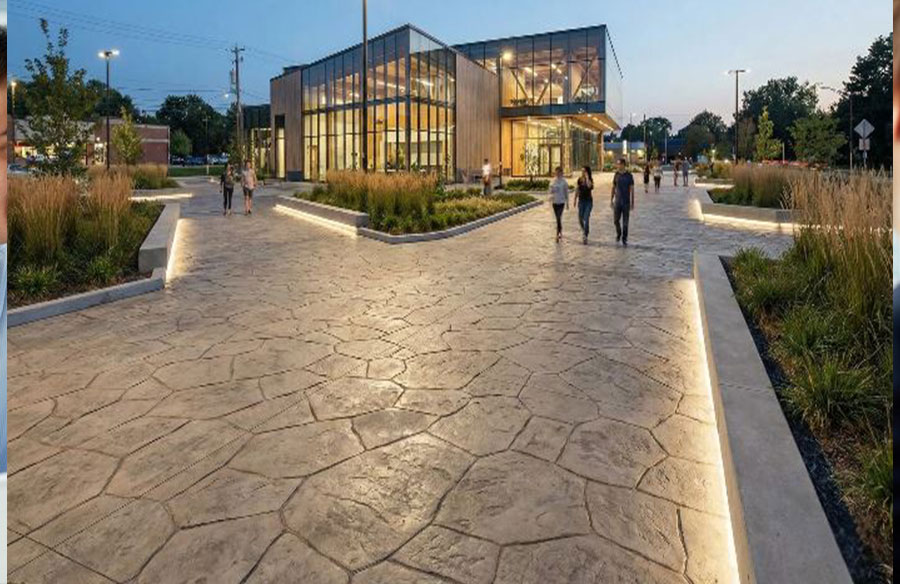
In contemporary architecture, material selection extends far beyond aesthetics. Exterior surfaces—plazas, walkways, courtyards, and communal open spaces—serve as the connective tissue between structures and landscape. Their textures, durability, and long-term performance shape how people interact with built environments on a daily basis.
Natural stone has long been associated with permanence and craftsmanship, yet its use often comes with limitations: weight, quarrying impact, cost, and installation complexity. As designers push toward sustainable, adaptable, and cost-efficient hardscape solutions, textured concrete has emerged as a material capable of bridging traditional stone expression with modern construction performance.
Reinterpreting Stone Through Concrete
Advancements in surface texturing have enabled concrete to replicate the refined details of slate, flagstone, cobblestone, and other natural stone types with striking accuracy. Through precision tools and molds, contractors can imprint stone geometries, surface irregularities, and subtle tonal transitions directly into a monolithic concrete slab.
This method allows designers to retain the familiar rhythms and tactile qualities of stone while eliminating key constraints associated with natural materials:
- no quarrying or transportation of heavy stone
- no irregular sizing that complicates layout consistency
- reduced installation time
- a continuous slab less vulnerable to shifting or joint failure
For architects, this opens the possibility to express stone-like aesthetics in settings where traditional stone would be impractical or environmentally burdensome.
Performance and Durability in Urban and Landscape Architecture
Stone-patterned concrete offers technical advantages that expand its use in high-performance architectural projects:
1. Long-Term Dimensional Stability
A monolithic slab does not shift, heave, or settle the way segmented stone systems often do—especially in freeze–thaw climates or heavy-footfall environments.
2. Improved Water Management
The absence of joints reduces water intrusion, sub-base erosion, and weed growth, providing cleaner lines and lower maintenance over the project lifespan.
3. Material Efficiency and Embodied Energy
Concrete’s embodied carbon is amortized across decades of use when properly installed and sealed. Eliminating quarrying and long-distance shipping further reduces environmental impact.
4. Compatibility with Architectural Patterns
Designers can choose from stone layouts that support contemporary, traditional, or regional identities—whether rectilinear grids, irregular fieldstone compositions, or modular slate textures.
Expanding the Designer’s Toolbox: Stone Patterns for Concrete
Pattern selection plays a critical role in how exterior space is perceived. With the range of available textures and geometric options, architects can tune surfaces to create:
- visual continuity with building cladding
- subtle circulation cues
- atmospheric shifts between public and private zones
- culturally contextual material expression
Modern catalogs offer patterns inspired by quarried stone from various regions, allowing for intentional material storytelling without the resource intensity of natural extraction.
Designers exploring these options can reference comprehensive pattern libraries such as the GlobMarble online stone pattern catalog, which illustrates variations in depth, scale, and texture suitable for a range of architectural programs.
Applications Across Architectural Typologies
Stone-patterned concrete is now frequently specified in:
- mixed-use developments and pedestrian promenades
- institutional and campus landscapes
- waterfront revitalization projects
- residential courtyards and multi-family amenities
- plazas and civic gathering spaces
- transit-oriented public spaces requiring durable finishes
Its clean installation profile and long-term resilience make it suitable for both high-traffic public areas and refined private outdoor environments.
Specification Notes and Takeaways
As architectural practice continues to emphasize sustainability, longevity, and contextual materiality, stone-patterned concrete stands out as a versatile solution that reconciles performance with aesthetic ambition. It offers designers the opportunity to reinterpret traditional stonework through a contemporary, technically robust medium—providing surfaces that endure physically while enriching spatial experience.