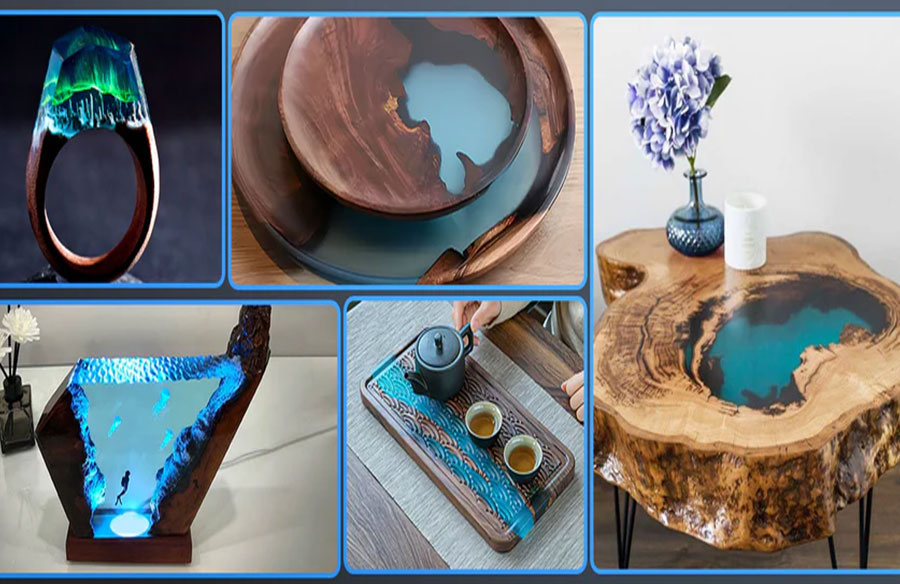
Few materials give designers the freedom to shape light, depth—and in a sense, even time itself.
Deep-pour epoxy happens to be one of them.
As contemporary design shifts from object-making toward crafting immersive atmospheres, the edges of traditional materials become clear. Wood resists fluid geometry. Concrete refuses translucency. Stone, beautiful as it is, rarely glows. And yet, demand for furniture and surfaces that feel emotional, nature-driven, and sculptural keeps rising.
This tension—between what designers want to express and what materials are willing to do—is exactly where deep-pour epoxy has found its relevance. Once tucked away in craft studios, the material is now viewed through a much wider lens: a design medium capable of holding volume, bending illumination, and blending natural irregularity with precise fabrication. In many practices, epoxy has quietly moved from backstage into the center of the design conversation.
Material Anatomy: What Makes Deep-Pour Epoxy a Unique Design Medium
Deep-pour epoxy stands apart from typical resins not just because of chemistry, but because of the control it gives designers over depth and atmosphere. Formulated with low viscosity and a slow-heating cure, it settles cleanly into thick volumes—two, three, sometimes four inches—without cracking, fogging, or overheating.
These technical traits matter because of what they make possible. Long open times give designers room to shape color gradients, embed natural materials, and guide pigment movement with the deliberateness of a painter. Once cured, the resin carries a kind of suspended depth; light moves through it rather than bouncing off, interacting with whatever sits inside.
For designers accustomed to opaque materials, deep-pour resin introduces a new visual language—one where mass can behave like atmosphere, and thickness becomes a narrative tool rather than a constraint.
This is also why designers frequently turn to deep pour epoxy when creating large transparent castings, sculptural slabs, or hybrid wood-resin pieces that require stability and clarity.
Volume & Form: Creating Sculptural Castings With Epoxy
In large volumes, deep-pour epoxy behaves almost like molten glass—slow-moving, responsive, and able to hold crystalline clarity once cured. This quality opens a space between sculpture, furniture, and environmental design that few materials can inhabit.
A single pour can trace the organic contours of live-edge wood, suspend botanicals as if paused mid-motion, or create gradients reminiscent of eroded stone or ocean strata. Epoxy doesn’t simply imitate nature; it reframes it. Designers use it to craft surfaces that read like landscapes, translucent blocks that bend light like flowing water, or monolithic pieces that seem to glow from within.
Because the material can hold depth, designers manipulate internal layers and negative space. The result feels like a micro-architecture of voids and light—where transparency becomes an emotional component of the form rather than just a visual effect.
Surface Expression: How Table-Top Epoxy Finishes Shape Modern Interiors
If deep-pour resin is about sculpting volume, surface epoxy is about refinement.
High-quality tabletop formulations work as a protective, crystal-clear skin—elevating the underlying material while offering durability that typical finishes struggle to match.
A well-made table top epoxy resin doesn’t just shine; it amplifies. Light passes through instead of sitting on the surface, revealing grain details, embedded pigments, or subtle textures with heightened clarity. In cafés, boutique hotels, or retail interiors, this soft luminosity becomes part of the space’s identity. A bar top glows under pendant lights; a communal table reads differently depending on where a viewer stands.
Performance matters as much as appearance: heat resistance suitable for daily use, a food-safe cured surface, and a hardness that stands up to wear. The blend of visual depth and functional durability makes epoxy a compelling alternative for designers seeking expressive surfaces that still hold up in busy environments.
Crafting Atmosphere: How Epoxy Enables New Aesthetic Directions
Epoxy’s real power lies in the way it allows designers to interpret natural phenomena. As design culture moves toward biophilic principles and sensory experience, epoxy provides a medium that can translate erosion, flowing water, mineral layers, or even glacial clarity into tangible form.
This material supports pieces that function as micro-atmospheres, not just objects. A gradient embedded in a tabletop can evoke shifting tides. A swirling pigment pattern can suggest storm clouds. A translucent slab can mimic the stillness of ice. Epoxy is uniquely suited for this kind of emotional work—where material, color, and light interlock to shape mood.
The aesthetic that emerges feels unmistakably contemporary: nature filtered through technology, irregularity presented within a controlled medium, fluid visual ideas held inside a solid form.
The Designer’s Technical Playbook: From Concept to Execution
Creating strong epoxy work is as much about technical decisions as it is about conceptual goals. Epoxy behaves like a living system—it warms, settles, thickens, and becomes something else over time. Designers who understand this choreography can shape the outcome with intention.
Deep pours demand awareness of heat buildup, curing cycles, and pour thickness. A single mass pour preserves clarity; layered pours introduce controlled gradients or visible strata. Each decision carries visual consequences.
Surface finishes involve a different choreography: airflow, dust control, leveling, pigment dispersion, and bubble management. For public spaces, UV stability, hardness, and long-term durability must be part of the specification, ensuring that visual ambition doesn’t come at the cost of longevity.
The more precisely a designer understands these dynamics, the more expressive and reliable the final piece becomes.
Material Responsibility: A Balanced Approach to Sustainability
While epoxy isn’t inherently low-impact, it can play a thoughtful role in material conservation. Designers frequently use it to stabilize cracked, irregular, or reclaimed wood. Instead of discarding imperfect pieces, epoxy lets them become structurally sound and visually compelling.
This approach shifts value away from extraction and toward resource optimization. It also extends the life of materials—particularly in commercial environments where surfaces endure heavy use. A durable epoxy finish can significantly reduce the need for replacement or refinishing.
The point is not to frame epoxy as “green,” but to understand how it can support responsible design when applied with intention.
Project Spotlights: Epoxy in Contemporary Practice
Across hospitality, retail, and residential interiors, epoxy is quietly reshaping how designers integrate narrative and atmosphere.
In boutique hotels, resin bar counters glow like sculptural light elements. In homes, reclaimed wood fused with deep-pour resin creates dining tables that resemble miniature landscapes—revealing valleys, ridges, and intricate grain patterns. Retail designers use translucent resin blocks as display elements, elevating objects into something closer to exhibition pieces.
In all of these settings, epoxy is less a finishing choice and more a carrier of story—depth, clarity, color, and embedded materials working together to shape experience.
The Future: Epoxy as an Expanding Architectural Medium
Epoxy’s future potential lies in its adaptability. As formulations improve—greater optical purity, better UV resistance, increased stability—the material becomes suitable for new architectural expressions: translucent partitions, integrated lighting elements, hybrid composites of wood and resin, or cast forms that hold both organic texture and engineered geometry.
As design moves toward transparency, sensory depth, and hybrid materiality, epoxy is positioned to evolve from niche use to a more established part of the designer’s toolkit.
Conclusion: A Material That Expands the Designer’s Imagination
Epoxy’s growing presence signals a broader shift in material thinking. In an era where boundaries between nature and fabrication blur, epoxy offers designers a way to hold depth, sculpt light, and capture organic irregularity with clarity and intention.
It doesn’t replace traditional materials—it expands what they can express.
It invites designers to explore mood, atmosphere, and narrative in new ways.
For practitioners who chase emotional resonance and tactile storytelling, epoxy is more than a technique.
It’s a medium that opens doors—inviting designers to imagine what lies beyond familiar forms.