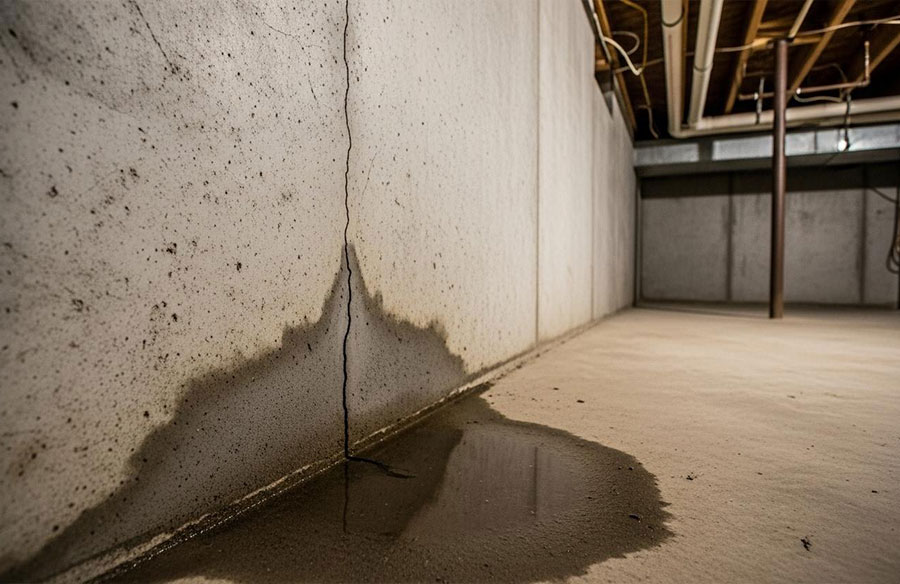
Michael thought his basement was waterproof. He’d lived in his Portland home for eight years without a single leak. Then last March, after three days of heavy rain, he noticed dark spots on his basement wall. By the time contractors assessed the damage, he was looking at a $6,400 repair bill.
The culprit? His gutters were directing water right against his foundation. Not because they were clogged. Because his downspouts were terminating in the wrong place. Every rainstorm for eight years had been saturating the soil around his basement walls. The water finally found its way through.
“I cleaned my gutters every fall,” Michael told the contractor. “How did this happen?”
The contractor showed him the problem. Clean gutters don’t mean functional drainage. His gutters were working perfectly, efficiently moving water from his roof to his downspouts. His downspouts were dumping hundreds of gallons against his foundation every time it rained.
What Gutter Cleaning Doesn’t Include
Most Portland homeowners think gutter maintenance means scooping out leaves and debris. That addresses the most visible symptom of poor drainage but misses the actual system evaluation that prevents expensive problems.
When you clean your own gutters, you’re focused on removing clogs. You’re not checking downspout discharge points, examining gutter slope and pitch, inspecting fascia boards for early rot, verifying downspout connections, looking for loose brackets or separation, or assessing whether the entire system is actually protecting your home.
These aren’t complicated checks. But they require knowing what to look for and having the experience to spot developing problems before they become expensive failures.
Jennifer in Beaverton cleaned her own gutters for six years. She did a thorough job. Her gutters were spotless every fall. What she didn’t notice was one section pulling away from her fascia board by a quarter inch annually. By year six, that section had separated enough that water was running behind the gutter during heavy rain, directly onto her fascia board and into her wall cavity.
The repair cost $2,850. It would have cost $40 to reinstall the brackets three years earlier when the problem first started developing.
The Downspout Location Problem
This is the issue that catches Portland homeowners by surprise. Their downspouts discharge exactly where the builder installed them when the house was built. Usually right at the foundation line, sometimes even closer.
That made sense when the house was new and the ground grading directed water away from the foundation. But soil settles over time. Landscaping changes drainage patterns. What worked for the first few years stops working as conditions evolve.
Tom in Sellwood never thought about where his downspouts discharged until his professional gutter service pointed it out. Water was pooling next to his foundation during heavy rain. The landscaping had settled over 15 years, creating a low spot right where his downspouts discharged.
Fixing it cost $240 for downspout extensions that directed water six feet away from his foundation. His neighbor ignored the same issue. Three years later, that neighbor paid $7,200 for foundation waterproofing and repair.
What Portland’s Rain Actually Does
Portland receives about 36 inches of annual rainfall. That seems manageable until you calculate what it means for your gutter system. A typical Portland roof might shed 1,500 to 2,000 gallons of water during a heavy rainstorm. All of that water flows through your gutters and out your downspouts.
If those downspouts discharge near your foundation, you’re depositing hundreds of gallons directly next to your basement walls with every significant rain event. Do this for several years and the soil becomes permanently saturated. Hydrostatic pressure builds against foundation walls. Water finds every crack, every weak point, every gap in waterproofing.
By the time you notice dampness in your basement, the damage has been developing for years. The repair isn’t just addressing current leaks. It’s fixing accumulated damage from repeated water exposure.
Sarah in Northeast Portland learned this when foundation specialists explained her $9,800 repair bill. “They showed me moisture meters reading that the soil five feet from my foundation was saturated,” she says. “Years of water from my downspouts had created a permanent wet zone around my entire basement. The only solution was extensive drainage work and foundation waterproofing.”
The Fascia Board Warning Nobody Sees
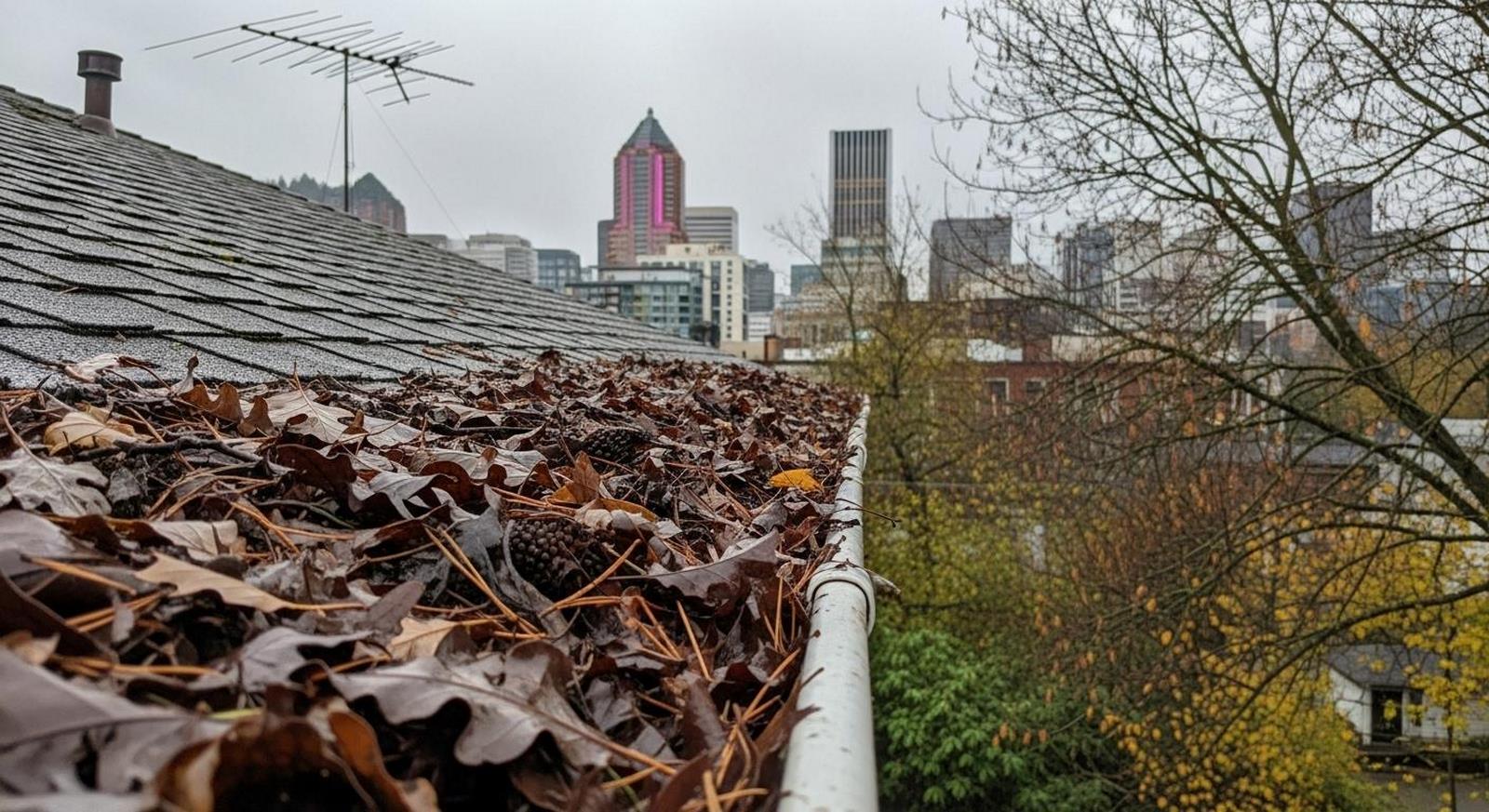
Fascia boards are the wooden boards your gutters attach to. When they start rotting, it means water has been getting somewhere it shouldn’t. Most homeowners never look closely at their fascia because it’s at the roofline and often painted. Problems develop invisibly until they become extensive.
Gutter overflow causes fascia rot. Leaking gutter seams cause fascia rot. Gutters pulling away from fascia boards cause rot. Ice dams in winter cause rot. All of these conditions allow water to contact wood repeatedly, and Portland’s climate keeps that wood damp long enough for rot to establish.
David in West Linn discovered he had fascia rot when a section of his gutter pulled completely away from his house during a windstorm. The mounting brackets had been attached to rotted wood. The fascia repair cost $3,400 and required painters afterward because the new wood didn’t match his existing trim.
“Nobody told me I should be checking fascia boards,” he says. “I cleaned my gutters regularly. I thought that was enough. I didn’t know there were other things I should have been watching for.”
Professional gutter services inspect fascia as part of their standard process. They catch rot early when repair costs hundreds instead of thousands.
 The Basement Waterproofing Trap
Here’s how this typically plays out. A Portland homeowner notices dampness in their basement. They call waterproofing companies. Everyone quotes $5,000 to $15,000 for interior or exterior waterproofing systems.
What usually doesn’t get addressed is the source of the water. If your gutters are directing water against your foundation, waterproofing your basement treats the symptom while leaving the cause in place. Your expensive waterproofing system has to work harder than it should for its entire lifespan.
Rachel in Milwaukie spent $11,200 on basement waterproofing. Two years later, she had her gutters professionally serviced for the first time. The technician showed her that all four downspouts discharged within two feet of her foundation. Her waterproofing system was handling water that shouldn’t have been near her foundation in the first place.
She had the downspouts extended for $280. “I should have done this before spending eleven thousand on waterproofing,” she admits. “But I didn’t know it mattered. I thought my wet basement was just a Portland thing everyone dealt with.”
What Professional Gutter Service Actually Catches
When All Seasons Cleaning Services sends teams to Portland homes for gutter service, the debris removal is just the starting point. The real value comes from comprehensive system evaluation that most homeowners don’t know to look for.
They check every downspout discharge point and verify water flows away from the foundation. They examine gutter slopes to ensure proper drainage toward downspouts. They inspect all mounting brackets for security and proper spacing. They look at fascia boards for early signs of moisture damage. They verify downspout connections are secure and leak-free. They check for standing water in gutter sections that should drain.
This evaluation catches expensive problems while they’re still cheap to fix. A loose bracket gets tightened for $40 instead of replacing an entire gutter section for $400 later. A downspout gets extended for $60 instead of paying $6,000 for foundation work later. Early fascia rot gets repaired for $200 instead of $3,000 after it spreads.
Mike in Happy Valley has used professional gutter service for four years. “They’ve caught three different issues that would have been expensive if I’d waited,” he says. “One was a bracket pulling away from rotted fascia. Another was a downspout that had separated from the underground drain, dumping water against my foundation. The third was a gutter slope that had reversed, causing standing water. I would never have noticed any of these doing my own cleaning.”
The Insurance Factor
Some Portland homeowners have discovered that foundation damage or water infiltration claims get complicated when the insurance adjuster determines poor gutter maintenance contributed to the problem. Insurance policies include language about maintaining property in reasonable condition. Gutters directing water against your foundation can be cited as evidence of inadequate maintenance.
Tom in Tigard filed a claim after discovering extensive water damage in his finished basement. The adjuster’s report noted that downspouts discharged improperly and contributed to the damage. His claim got reduced by 30% because the insurer determined better drainage would have prevented or limited the damage.
He’d been paying premiums for twelve years without a claim. When he finally needed coverage, his gutter drainage became a reason to reduce payout.
The Portland Tree Factor
Portland’s abundant trees make this problem worse. Douglas firs, cedars, maples, and other species drop massive amounts of organic material. Needles, leaves, seed pods, branches, all of it ends up in gutters. The volume is substantially higher than homeowners in less-wooded areas deal with.
This means Portland gutters need more frequent attention than gutters in many other cities. Cleaning once annually isn’t enough for homes with significant tree coverage. Twice-annual service addresses both fall leaf drop and spring debris from new growth, blossoms, and seed production.
David in Lake Oswego switched to twice-annual professional service after discovering his gutters were packed solid by May despite cleaning them in October. “I didn’t realize how much stuff comes down from trees in spring,” he says. “My gutters looked fine from the ground. When the service came out, they removed two five-gallon buckets of decomposed organic matter that had built up over six months.”
Making the Cost Comparison
Professional gutter cleaning in Portland typically runs $150 to $300 depending on home size and complexity. Twice-annual service might total $400 to $600 annually. Over ten years, that’s $4,000 to $6,000 for complete gutter system maintenance.
Compare that to the cost of problems that develop when drainage systems aren’t properly maintained:
Foundation waterproofing and repairs run $5,000 to $15,000. Fascia and soffit replacement runs $2,000 to $6,000. Basement water damage cleanup and repair runs $3,000 to $12,000. Landscape erosion damage runs $1,000 to $4,000.
The math is straightforward. Ten years of professional maintenance costs roughly the same as one moderate foundation repair. And that’s not counting the inspection value that catches small problems before they become expensive ones.
The Decision Most Homeowners Make Late
Portland homeowners who hire professional gutter services usually make that decision after something expensive happens. After foundation damage. After fascia rot. After discovering their DIY cleaning missed problems that professionals would have caught.
The homeowners who make the decision early avoid these expensive lessons. They recognize that proper drainage system maintenance costs less than reactive repair, that professional inspection catches problems DIY cleaning misses, and that Portland’s climate and tree coverage create challenges that favor professional service.
Michael standing in his damaged basement looking at a $6,400 repair bill wishes he’d made this decision eight years earlier. “I was saving maybe $200 a year by doing it myself,” he calculated. “That $1,600 in savings over eight years is now costing me four times that amount to fix. And this could have been prevented if someone had just pointed out where my downspouts were discharging.”
His neighbor hired professional gutter service after seeing Michael’s situation. The service found similar downspout placement issues, corrected them for $240, and probably prevented thousands in future foundation problems.
The question isn’t whether professional gutter service has value in Portland’s climate. The question is whether you learn that value before paying to fix expensive damage or after.