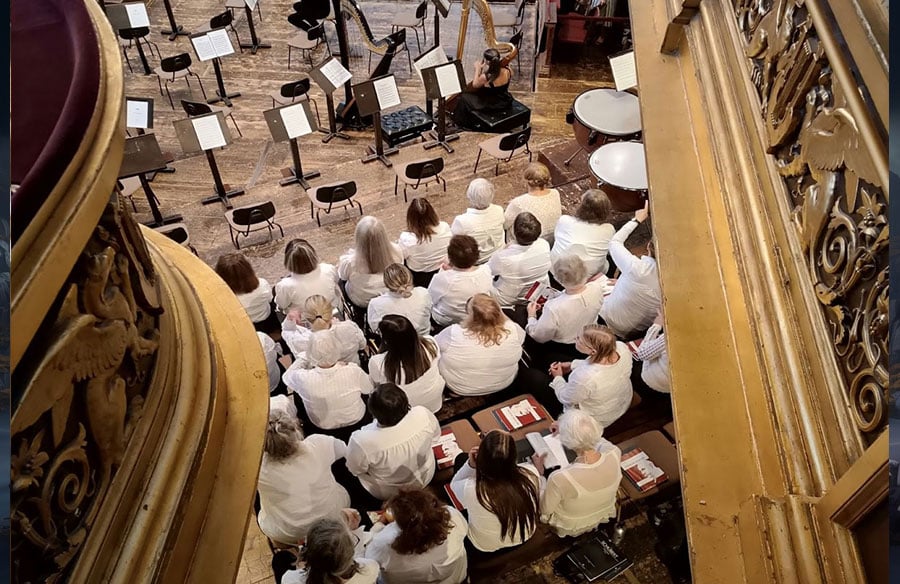
A maestro passionate about the power of collective voice, Dr. Hwanwook Lee stands as a distinguished figure in the world of choral music, seamlessly blending the roles of conductor, educator, composer, and scholar. With a career spanning continents and generations, Dr. Lee’s work is defined by an unwavering commitment to musical excellence, cultural exchange, and transformative education. His over decade of international experience has cultivated a distinctive artistic voice that honors tradition while embracing innovation.
At the heart of Dr. Lee’s philosophy is the concept of cultural storytelling through choral music, a practice he champions in both academic and congregational settings. “I see cultural storytelling through choral music as the act of conveying a community’s identity, history, values, and emotions through the collective voice of a choir,” Dr. Lee explains. He emphasizes that choral music, being one of the most accessible and inclusive ensemble forms, serves as a powerful medium for preserving and expressing culture.
“When I teach or conduct, I treat every piece not just as music to be performed, but as a cultural narrative,” he states. “Whether it’s a Korean folk song that embodies emotional resilience, a spiritual that reflects historical struggle, or a Latin mass rooted in sacred ritual, I view each work as a unique expression of cultural storytelling that deserves to be understood and honored.” In his classrooms and churches, he guides students and singers to engage with music on a deeper level, exploring context, language, and emotional background, and highlighting diverse interpretations across cultures.
Dr. Lee’s academic foundation is robust, culminating in a Doctor of Musical Arts in Choral Conducting from Texas Tech University. He also holds two Master of Music degrees in Choral Conducting from Missouri State University in the United States and Hansei University in South Korea, alongside a bachelor’s degree in Church Music with an emphasis on composition from Seoul Theological University.
His impact extends across varied educational and congregational settings. During his tenure at Texas Tech University, Dr. Lee served as an Instructor of Record for the Matador Singers and University Singers, and as associate conductor for the University Choir and Scarlet Voce. He also contributed to undergraduate courses and notably served as Chorus Master for the university’s opera production of La Clemenza di Tito. Most recently, he completed his appointment as Associate Choir Director at Odessa High School, where he independently and collaboratively led six ensembles, elevating the overall quality and cohesion of the school’s choral program.
A particularly poignant moment in his university conducting career involved introducing Korean choral music to American students. “At Missouri State University and Texas Tech University, I had the privilege of conducting ‘Azaleas’ and ‘Evocation’, both of which are settings of poetry by Kim Sowol, a Korean poet who wrote during the Japanese occupation,” Dr. Lee recounts. “These pieces carry deep emotional and historical weight, and it was important for me to help the students understand the emotions embedded in the poetry—grief, longing, and unresolved sorrow. I was genuinely moved by how open the students were to connecting with a narrative that came from a completely different time and culture. After one performance, I heard audible sobs from the audience, and I will never forget that moment.”
Beyond the technical aspects of performance, Dr. Lee views his role as an educator as deeply transformative. “As an educator—especially in the performing arts—I believe that one of our most important roles is to inspire and encourage students,” he asserts. “Music is both an academic discipline and a form of artistic expression, so it should never be taught through mere rote instruction. Instead, we should guide students to discover the artistic value of music for themselves, and learn how to reflect that in their own lives. Through this exchange, I believe we grow together—not just in knowledge, but in how we understand and shape musical expression.”
He cultivates a collaborative environment where students are empowered to transcend mere note-singing and instead explore what it means to tell their own story through music. “As they begin to internalize the emotional content of the music and express it authentically, I often see powerful personal growth alongside their musical development,” Dr. Lee observes.
“Even students who were initially shy or unsure eventually find the confidence to step forward and sing with pride. Those small moments—when someone finds their voice, both literally and figuratively—are what I value most. As a conductor and educator, I believe the deepest purpose of teaching music is not just skill-building, but empowering people to see themselves differently, to trust their voice, and to grow as expressive human beings.”
Dr. Lee’s artistic contributions also span composition and arrangement, reflecting a unique blend of Korean melodic identity and Western choral tradition. His choral work, “A Change of Heart,” published by Chorus Center, was notably performed by the professional Changwon City Choir at The Innovative Choir Seminar, South Korea’s largest church music conference.
His commitment to cultural diplomacy is further underscored by his 2015 appointment as a One Asia Culture Ambassador (OACA). In this prestigious role, he traveled to the Philippines to lead an ambitious musical project, uniting music majors from the University of Baguio and college students from various Southeast Asian countries in a multicultural choir. Their collaborative performances fostered unity, empathy, and artistic excellence.
Dr. Lee’s decade-long tenure as a church choir director in South Korea, leading adult and youth choirs at congregations like Yehyang and Youngbok Presbyterian Churches, showcases his profound community engagement. He not only conducted regular services but also founded a youth choir that achieved first prize at the Kyung-in Synod Youth Choir Competition. During his doctoral studies, he was also invited as a guest artist by Heavenly Light Korean Methodist Church in South Korea.
Dr. Lee’s exceptional contributions have garnered recognition, including the prestigious Outstanding Graduate Student award from the Texas Tech University School of Music in 2024, and twice being named Instructor of Record at TTU. His dedication is also reflected in his active participation in numerous professional organizations, including the American Choral Directors Association (ACDA) and the Texas Music Educators Association (TMEA).
Through every role he embodies – conductor, educator, composer, and cultural ambassador – Dr. Hwanwook Lee stands as a beacon of excellence and integrity in the musical arts. He recalls one anecdote in the classroom that was a pivotal moment in his own career; seeing how music can change a student’s life.
“At the high school level, one of the most powerful moments for me has been witnessing how students—many of whom had never sung before—gain confidence and grow through choir,” said Lee. “Some came into the class with little to no musical background, and even some resistance, but as they rehearsed together, they began to take pride in their progress and in each other. I remember one student coming off the stage after a concert and saying, ‘Teacher, this song made me love music.’ That single sentence reminded me that choral music isn’t just a class or performance—it can be a turning point in a young person’s life.”