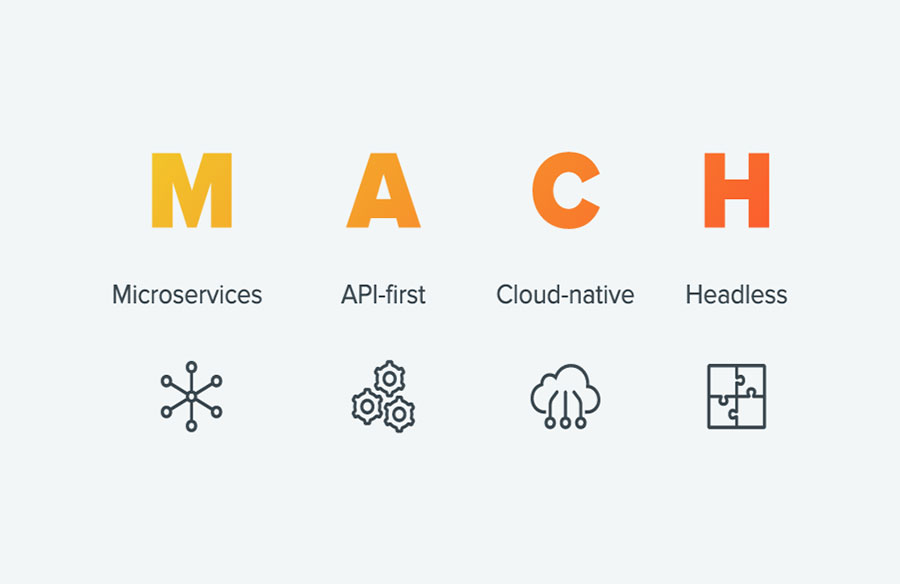
Have you ever felt that, while some online shops compose better to the human mind as being fast, smooth, and easy to work with, others are just slow and clunky? That would be the scenario of Mach commerce. MACH is an acronym for Microservices, API-first approach, Cloud-native, and Headless. It sounds all technical in the beginning; it is rather simple once you grasp the concepts. These ideas assist businesses in developing flexible, fast, and future-proof sceneries for online shopping.
I remember shopping online last minute. The first site I visited crashed and froze every now and then. It was really frustrating. Next, I tried the other site, which just worked-the page loaded quickly, and I was done with checkout with just two clicks. It was indeed the ream MACH principles at work. I did not know it then, but it made all the difference.
Microservices: In Pieces
Preferably think of the microservices system as a Lego set. Every component of the website for its job functions independently. If one block is broken, the entire site does not collapse? For instance, the search bar can be updated without touching the payment system. This makes fixing and improving things a lot faster and easier.
API First: Talking to Each Other
API stands for Application Programming Interface. That sounds pretty high-brow, but it is just a way for different systems to talk to each other. An API-first system implies that every building block of a system is prepared to be integrated with other tools. An API is like a translator-for-interactions that enables all apps and services to communicate with one another.
Cloud-native: Always Available
Being cloud-native means the entire system exists on the internet and not on some physical server. One time, I ran a small online shop, and the website would crash when too many people visited. Above all, it was quite a mess during holiday sales. Cloud-based systems scale with traffic, so sites stay up even if hundreds or thousands are online simultaneously.
Headless: Freedom to Create
To be headless essentially means the front end, which is what the user sees, is decoupled from the back end, where the data and logic live. This way, designers will have flexibility in creating beautiful, bespoke shopping experiences, rather than being limited by the usual constraints of legacy software. I like to think of it as picking an outfit instead of having to wear a uniform.
Why Should You Care?
In the case of a brick-and-mortar business or an online store, MACH commerce gives an umpteenth choice for you. You are not forced to use one big slow system. You can choose the best tools, add features as the days go by, and pivot with the growth of the business.
Conclusion
Technology can be overwhelming. Trust me-I’ve been there. But knowing about MACH commerce enlightened me to how the very best online stores operate. It gave me a sense of control when I launched a website for my own small business. Whether just curious about it or gearing up for something big, knowing the basic ethos is an excellent place to begin.