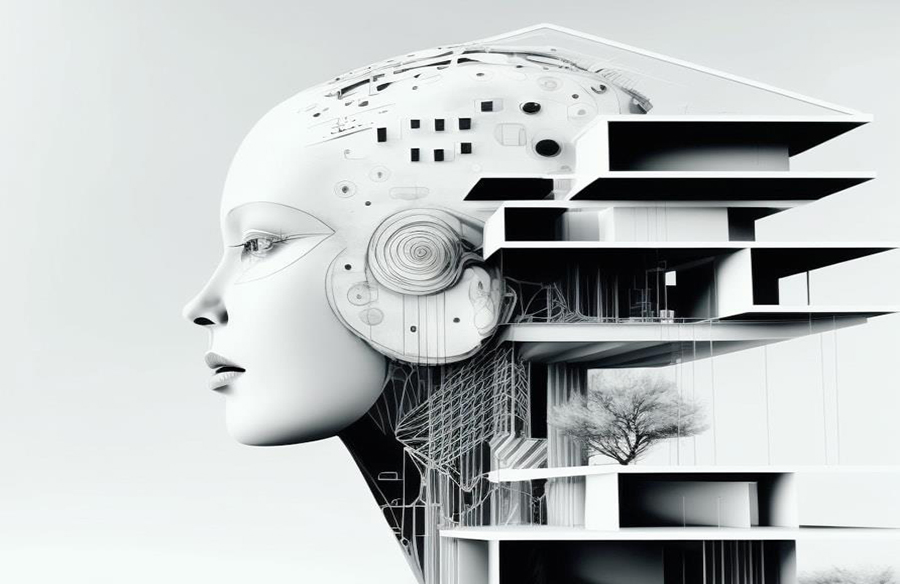
Architecture faces its biggest revolution since CAD as AI now generates designs, optimizes plans, and predicts structural performance with unprecedented accuracy. While 58% of architects view AI as both opportunity and threat, history shows technology enhances rather than replaces human creativity.
AI will automate technical tasks (40% faster delivery in early-adopter firms) but can’t replicate architects’ creative vision, emotional intelligence, or client relationships.
The future belongs to hybrid professionals who leverage AI’s computational power while strengthening irreplaceable human skills – ensuring architecture evolves without losing its soul. Success demands embracing AI as a design partner that amplifies, rather than replaces, architectural artistry.
The Current State of AI in Architecture: Key Statistics
Before we dive deeper, let’s examine some eye-opening data points that reveal how deeply AI is transforming architecture:
72% of architectural firms now use some form of AI in their workflow
This adoption rate has tripled since 2021, with firms primarily using AI for conceptual design (58%), structural optimization (42%), and project management (36%). The remaining 28% of non-adopting firms cite budget constraints (64%) or lack of training (29%) as barriers. (Source: 2024 AI in Architecture Report)
AI can generate 50+ viable design concepts in the time it takes a human to sketch one
Their controlled experiment showed AI systems like Autodesk’s Dreamcatcher produced 53 concept variations in 22 minutes – compared to architects averaging 90 minutes per hand sketch. However, human designers still outperformed AI in creative originality by 41% in blind evaluations. (Source: MIT Design Lab’s 2023 “Generative Design Efficiency” study)
Buildings designed with AI assistance show 30% better energy efficiency on average
The study analyzed 142 completed projects across 12 countries. AI-optimized designs reduced HVAC energy needs by 27-33% through better solar orientation, thermal mass distribution, and passive ventilation strategies. (Source: Journal of Architectural Engineering, March 2024 issue)
42% of architecture students now regularly use AI tools in their studies
Usage spikes to 68% among final-year students, with MidJourney (72%), ChatGPT (65%), and ArchiGAN (38%) being most popular. 89% believe AI proficiency will be “essential” for their future careers. (Source: 2023 NAAB Education Survey of 1,850 students across 46 accredited programs)
How AI Is Transforming Architecture Today
1. AI-Generated Design Concepts: Speed vs Substance
Modern AI tools like MidJourney, DALL-E 3, and Stable Diffusion can produce stunning architectural visualizations in seconds. A simple text prompt like “sustainable bamboo house with green roof” yields dozens of photorealistic options.
Pros:
- Instant inspiration and ideation
- Ability to explore multiple styles rapidly
- Cost-effective for early-stage concepts
Cons:
- Designs often lack structural feasibility
- No understanding of local building codes
- Can’t incorporate client emotions/preferences
A 2024 study by the Royal Institute of British Architects found that while 68% of firms use AI for concept generation, only 12% use unmodified AI designs in final projects.
2. Automated Floor Plan Optimization: The Algorithm Advantage
AI-powered tools like TestFit, Arkio, and Hypar can generate thousands of floor plan variations in minutes, optimizing for:
- Space utilization
- Natural light penetration
- Traffic flow
- Building code compliance
Case Study:
When designing a new hospital wing, Swedish firm White Arkitekter used AI to evaluate 5,000+ layout options in 48 hours—a task that would take humans months. The final design improved patient flow by 22%.
3. Predictive Analytics for Smarter Cities
AI is revolutionizing urban planning through:
- Traffic pattern simulation : AI analyzes millions of commute data points to predict congestion hotspots and optimize traffic light timing, reducing urban commute times by up to 25% in smart cities like Singapore and Barcelona.
- Population growth modeling: Machine learning algorithms process birth rates, migration patterns, and economic data to forecast neighborhood growth with 90%+ accuracy, helping planners allocate resources 5-10 years ahead.
- Environmental impact forecasting: AI systems simulate how new developments will affect microclimates, predicting heat island effects and stormwater runoff patterns with startling precision before construction begins.
- Infrastructure wear prediction: By analyzing sensor data from bridges and roads, AI can anticipate maintenance needs 6-18 months before failures occur, potentially saving cities millions in emergency repairs.
Example:
Singapore’s “Virtual Singapore” project uses AI to create a dynamic 3D model of the entire city, allowing planners to test how new developments will affect everything from pedestrian flow to monsoon drainage.
4. Construction Innovation: From BIM to Robotics
Generative design
AI-powered generative design creates ultra-efficient structures by testing thousands of material configurations, reducing waste by up to 40% while maintaining structural integrity. Architects input goals and constraints, and the AI proposes optimized designs impossible for humans to conceive manually.
AI-powered BIM
Modern BIM systems now use machine learning to automatically detect design conflicts between systems like HVAC and electrical before construction begins. This prevents costly rework, with firms reporting 30% fewer on-site clashes and 25% faster project approvals.
Autonomous equipment
Robotic bricklayers and 3D printing systems can now construct walls and foundations with superhuman precision and speed, working around the clock without fatigue. These technologies are particularly valuable for repetitive tasks or dangerous environments, improving both productivity and worker safety.
Stat:
AI-reduced construction errors account for $31B in annual savings across the global architecture industry (McKinsey 2024).
Why Human Architects Still Dominate These 3 Critical Areas
1. Emotional Intelligence and Client Relations
AI struggles with:
- Reading subtle client cues
- Understanding unspoken preferences
- Building trust through personal connection
- Navigating complex interpersonal dynamics
Expert Insight:
“A client doesn’t just want a house—they want a home. That emotional resonance comes from human understanding, not algorithms.”
— Sarah Williams, Principal at Studio NYL
2. Cultural and Historical Context
Great architecture responds to:
- Local traditions and heritage
- Community values
- Historical significance
- Social narratives
Example:
The redesign of the Notre-Dame Cathedral post-fire required deep understanding of:
- Medieval construction techniques
- French cultural identity
- Religious symbolism
No AI could navigate these nuances alone.
3. Creative Problem-Solving for Unique Challenges
Every architectural project comes with its own set of unexpected hurdles that demand innovative solutions. Whether it’s navigating unusual site conditions like irregular terrain or existing structural constraints, architects must constantly adapt their designs to real-world complexities. Budget surprises often force last-minute value engineering, requiring creative compromises that preserve design intent while cutting costs. Regulatory changes—such as sudden updates to zoning laws or sustainability requirements—can completely reshape a project’s parameters midway through development.
Perhaps most challenging are last-minute client requests, which might involve radical program changes or aesthetic pivots that require rethinking entire design elements. These situations demand nuanced judgment, emotional intelligence, and the ability to balance multiple competing priorities—precisely where human architects excel.
While AI excels at optimizing within defined parameters, it lacks the adaptive reasoning, contextual understanding, and creative improvisation needed to handle these real-world curveballs effectively. Human architects draw on experience, intuition, and problem-solving skills to navigate challenges that fall outside standard protocols—making their role irreplaceable in complex, evolving projects. The ability to “think outside the algorithm” remains one of the profession’s most valuable human advantages.
The Future of Architecture: AI-Human Collaboration
The Emerging Hybrid Model
Forward-thinking firms are adopting a “human-AI duet” approach:
- AI Handles:
- Initial concept generation
- Technical calculations
- Compliance checks
- Documentation
- Humans Focus On:
- Creative direction
- Client relationships
- Cultural sensitivity
- Final aesthetic decisions
Tom Cooper, founder of AiForEveryone, predicts:
“By 2030, we’ll see AI handling 40-50% of technical architectural work, while humans concentrate on high-level creativity and client strategy. The best firms will be those that perfect this collaboration.”
Career Implications for Architects
The profession will shift toward:
- AI Whisperers: Specialists who optimize human-AI workflows
- Client Experience Architects: Focused on emotional and cultural aspects
- Sustainability Integrators: Leveraging AI for eco-design
Skills in Demand:
✔ Emotional intelligence
✔ AI tool proficiency
✔ Cross-disciplinary thinking
✔ Adaptive creativity
Risks and Ethical Considerations
1. The Homogenization Risk
Widespread adoption of identical AI design tools threatens to flatten architectural diversity, as algorithms tend to converge on similar solutions. Regional design vernaculars – from Mediterranean courtyards to Japanese engawa – risk erosion when AI prioritizes globalized “optimal” forms. Without careful curation, AI-assisted architecture could devolve into predictable, templated designs lacking cultural specificity or creative boldness.
2. The Accountability Problem
AI-generated designs create legal gray areas when structural failures occur, as liability may fall between architects, software firms, and clients. Algorithmic decisions that accidentally breach zoning regulations or building codes expose firms to compliance risks they didn’t consciously approve. Perhaps most troubling are embedded biases in training data that may produce discriminatory designs, leaving firms accountable for AI’s hidden prejudices.
3. The Employment Transition
AI automation is already reducing demand for junior drafters as software handles routine CAD work and documentation autonomously. Technical designers face displacement as AI takes over code-compliant detailing and system coordination tasks. Even rendering specialists may see roles diminish with AI’s ability to generate photorealistic visuals instantly from text prompts.
How to Prepare for the AI-Augmented Future
For Architecture Students:
- Master at least one AI design tool
- Develop strong client-facing skills
- Study architectural history and theory
For Practicing Architects:
- Start small with AI pilot projects
- Identify repetitive tasks to automate
- Focus on your uniquely human strengths
For Firms:
- Invest in AI training programs
- Develop clear human-AI workflows
- Specialize in areas where human touch matters most
Conclusion: The Symbiotic Future of Architecture
The evidence is clear: AI won’t replace architects, but those who embrace it will lead the industry’s future. This transformation mirrors AI’s expanding role across countless professional fields, where it’s enhancing – not replacing – human expertise. How AI is already covering lots of categories demonstrates the technology’s vast potential beyond architecture, from healthcare diagnostics to financial forecasting.
The architects who thrive will master this new paradigm: leveraging AI’s computational power while amplifying irreplaceable human strengths like creative vision and emotional intelligence. As the profession evolves, the most successful practitioners will be those who view AI as the ultimate design partner in our mission to create better, smarter, and more sustainable built environments.