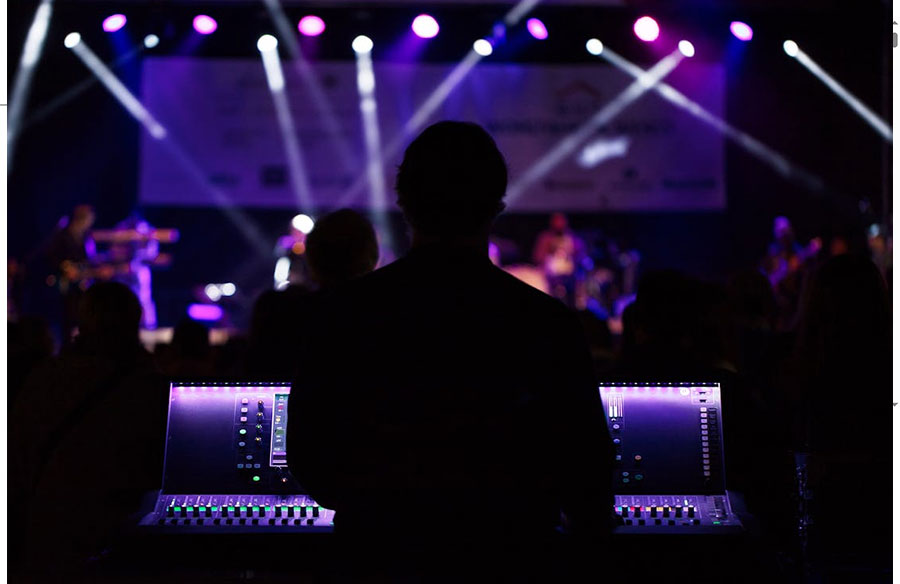
Temporary venues have one big challenge: they are not built for the experience you are trying to create. But technology solves the problem.
Tech like LED walls, intelligent lighting, projection mapping, and advanced audio systems allow designers to shape mood, focus attention, and guide audience energy throughout an event. Instead of fighting the limitations of temporary architecture, planners use tech to transform it.
LED Walls
LED walls have completely reshaped temporary event architecture. Instead of relying on heavy scenic builds, designers now use modular displays to create dynamic, high-impact visual environments.
Large-scale immersive LED environments like the Vegas Sphere rely on wraparound displays to create fully enveloping visual experiences. Even if your event is not stadium-sized, the same principle applies. Guests feel more engaged when content surrounds them rather than sitting flat behind a podium.
Event planners often rely on LED walls to create flexibility in short-term venues. Key advantages include:
- Transforming plain venues into fully branded environments
- Displaying live feeds and interactive content
- Creating depth without heavy scenic construction
Modular panels allow designers to scale up or down depending on venue size, ceiling height, and audience layout. For temporary installations, that adaptability saves time while delivering a polished, high-end look.
Intelligent Lighting
Lighting is no longer just about visibility. Intelligent lighting systems now guide attention, build anticipation, and control the emotional tone of an event.
Responsive lighting systems adapt to music, speakers, and audience interaction. When lighting shifts from cool tones during a panel discussion to bold color washes during a product reveal, energy in the room changes instantly.
Programmable fixtures and wireless controls also make load-in and load-out more efficient. Temporary venues benefit from lighter rigs and pre-programmed lighting cues that reduce setup time while increasing creative impact.
Projection Mapping
Projection mapping transforms ordinary structures into animated storytelling tools. Walls, arches, and stage elements become part of the narrative instead of simple backdrops.
Large-scale productions often combine LED and projection systems to create immersive environments. Corporate and experiential events are adopting similar techniques to animate temporary builds.
A standard stage façade can ripple with motion graphics, simulate texture, or shift brand themes in seconds.
Temporary event architecture benefits from this approach because physical materials remain simple and lightweight. Visual complexity happens digitally, allowing creative teams to experiment without rebuilding structures.
Advanced Audio Systems
Sound design plays a major role in how guests perceive space. Clear, evenly distributed audio can make a large ballroom feel intimate and controlled.
Modern line-array systems and digital mixing consoles allow engineers to fine-tune coverage zones. Presenters sound consistent whether someone is seated in the front row or standing near the back wall.
While temporary venues appear seamless to guests, the technical coordination behind them is highly complex. LED walls must sync precisely with lighting cues.
Projection content must align with stage geometry. Audio coverage must be tuned to room acoustics and audience layout.
When these systems are managed in isolation, signal delays, cue mismatches, and coverage gaps can disrupt presentations, product launches, and live performances.
In large-scale corporate meetings, trade shows, and conventions, even minor technical misalignment can damage brand perception.
This is where integrated AV staffing becomes essential. Experienced providers like Audio Visual Nation supply trained technicians, engineers, and stage crews who understand how to coordinate sound, lighting, and video systems in real time.
By centralizing technical execution, event planners reduce operational risk and ensure temporary architecture performs exactly as designed.
Where Temporary Event Architecture Is Headed Next
With LED walls, intelligent lighting, projection mapping, and advanced audio systems working together, temporary spaces can deliver long-term impressions.
If you are planning an upcoming event and want to explore how integrated production can elevate your space, securing trained AV crews early in the planning process ensures technical execution keeps pace with creative ambition. Providers such as Audio Visual Nation specialize in supplying event-ready technicians who integrate seamlessly into production teams.